Last updated: March 2026 | Reviewed by: VerdictLab Editorial Team
The water flosser vs string floss debate produces strong opinions — from dentists, hygienists, and the internet alike. Some dental professionals insist string floss is irreplaceable. Others argue water flossers produce better clinical outcomes. Most of the content online picks a side based on whoever is selling what.
We looked at the published clinical research, surveyed the professional recommendations, and factored in something the studies rarely measure: whether people actually use the tool consistently. Here’s what we found.
The Short Version
- String floss is better at mechanically scraping plaque from tight contact points between teeth
- Water flossers are better at flushing bacteria from periodontal pockets and around dental work
- Clinical studies show water flossers reduce bleeding and gingivitis as effectively or more effectively than string floss
- Compliance is the deciding factor — a tool you use daily beats a “superior” tool you skip
- The ideal routine includes both, but either one alone is far better than neither
In This Article
How They Work Differently
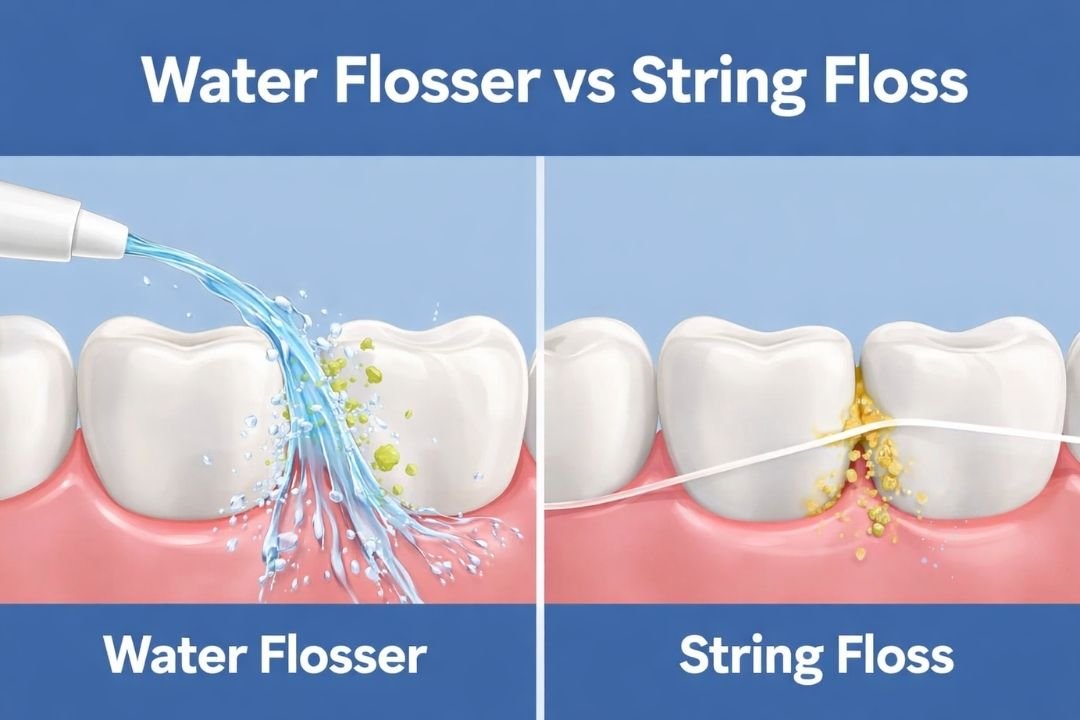
String floss and water flossers remove plaque through fundamentally different mechanisms, which is why comparing them isn’t as straightforward as “which is better.”
String floss uses mechanical scraping. You wrap a thin filament around the tooth, slide it below the gum line, and physically drag it against the tooth surface. This shearing action breaks the biofilm — the sticky matrix of bacteria that forms plaque — by direct contact. It’s particularly effective at tight contact points where two teeth press together, because the floss physically wedges between them and scrapes both surfaces.
Water flossers use hydraulic flushing. A pulsating stream of water (typically 1,200–1,400 pulses per minute at 10–100 PSI) creates a compression-decompression cycle that dislodges debris and disrupts bacterial colonies. The water reaches areas a physical filament can’t access easily — periodontal pockets below the gum line, the underside of bridges, around orthodontic brackets, and between widely spaced teeth where floss has nothing to grip against.
Neither mechanism is inherently superior. They target different aspects of the same problem.
What the Clinical Research Says
The clinical literature on this question is more extensive than most review sites suggest. Here are the key findings, presented as directly as the data allows.
Plaque removal
A 2013 study in the Journal of Clinical Dentistry found that a Waterpik water flosser removed up to 29% more plaque from interproximal (between-tooth) areas than string floss. A separate 2005 study comparing a Waterpik with an orthodontic tip against string floss in braces patients found the water flosser was three times more effective at removing plaque around brackets.
However, these results need context. The 2013 study was funded by Water Pik, Inc. That doesn’t invalidate the findings — the methodology was peer-reviewed and sound — but industry funding is worth noting. Independent studies generally show both methods reduce plaque effectively, with water flossers performing comparably or slightly better in interproximal areas and string floss performing better at tight contact points.
Gum health and bleeding
This is where water flossers consistently show stronger results. A 2012 study in the Journal of Clinical Dentistry found that water flossing was 93% more effective than string floss at reducing bleeding sites after four weeks of use. Multiple studies have found water flossers produce greater reductions in gingivitis scores compared to string floss over 2–4 week periods.
The likely explanation is reach. Water flossers access subgingival areas (below the gum line) more effectively than string floss, flushing out the bacteria that drive inflammation. For people with existing gum disease, this subgingival cleaning is particularly relevant.
The Cochrane Review perspective
Cochrane Reviews — considered the gold standard for evidence-based analysis — have examined interdental cleaning broadly. The overall conclusion is that interdental cleaning devices (including both floss and water flossers) reduce gingivitis and plaque compared to brushing alone. The evidence does not definitively crown either method as categorically superior to the other for the general population.
The takeaway from the research as a whole: both methods work. Water flossers appear to have an edge for gum health specifically. String floss retains a theoretical advantage for mechanical plaque disruption at tight contacts. Neither is a replacement for regular dental cleanings.
Where String Floss Wins
Tight contact points. When two teeth are pressed tightly together, string floss physically wedges between them and scrapes both surfaces. A water jet can flush around these contacts but doesn’t create the same mechanical disruption of the biofilm on the mesial and distal tooth surfaces. If your teeth have very tight contacts (your dentist or hygienist would know), string floss provides a cleaning action water alone can’t replicate.
Cost. A year’s supply of string floss costs $5–15. A water flosser costs $25–100 upfront, plus $10–30 per year for replacement tips and electricity. String floss wins on economics by a wide margin.
Portability. A spool of floss fits in your pocket. Even a compact cordless water flosser is the size of a small water bottle. For travel — especially backpacking or situations without reliable power — string floss is unbeatable.
No learning curve for basic use. Most people learn string flossing technique as children. Water flossers require a week or two to develop comfortable technique, manage splash, and find the right pressure setting.
No power or water source needed. String floss works anywhere. Water flossers need charged batteries or a power outlet, plus access to water for the reservoir.
Where Water Flossers Win
Subgingival cleaning. Water flossers reach 50% deeper into periodontal pockets than string floss, according to Waterpik’s internal research. Even accounting for potential bias in manufacturer-funded studies, the physics support this — a pressurised stream of water penetrates below the gum line in ways a physical filament cannot without causing tissue trauma.
Dental work. Braces, bridges, implants, crowns, and retainers all create geometry that string floss struggles with. Threading floss under a bridge wire or between orthodontic brackets requires floss threaders, patience, and dexterity. A water flosser cleans these areas in seconds. For a deeper look, see our guides on the best water flosser for braces and best water flosser for implants.
Gum disease management. The clinical evidence consistently shows water flossers outperform string floss at reducing bleeding and gingivitis. For people with active periodontal disease, a water flosser with a periodontal pocket tip can deliver low-pressure cleaning to areas where string floss would cause pain and further tissue damage. See: Best Water Flosser for Gum Disease.
Dexterity limitations. Arthritis, carpal tunnel, Parkinson’s disease, post-stroke mobility issues, and age-related hand weakness all make string flossing difficult or painful. A water flosser requires only the ability to hold a handle and press a button.
Speed. A thorough water flosser session takes 60–90 seconds. Proper string flossing — wrapping, inserting, scraping both sides of each contact, re-wrapping — takes 2–5 minutes when done correctly. Most people who string floss actually spend under 30 seconds, which is insufficient for effective plaque removal.
Comfort. For people with sensitive or inflamed gums, the lowest pressure setting on a water flosser is gentler than string floss sliding below an irritated gum line. This matters because pain avoidance is the primary reason people skip flossing entirely.
The Factor Studies Don’t Measure: Compliance
Here’s the uncomfortable reality that every clinical comparison misses: according to the American Dental Association, only about 30% of Americans floss daily with string floss. Many of those who do report flossing don’t do it correctly or thoroughly enough to be effective.
A water flosser that someone uses every day is categorically more effective than string floss that sits in a drawer. The studies comparing water flossers to string floss are conducted under controlled conditions where participants use both tools correctly and consistently. In the real world, consistency wins.
Anecdotally — and we’re transparent that this is anecdotal, not data — water flosser users report higher compliance rates. The speed (60–90 seconds vs 3–5 minutes), reduced discomfort, and the viscerally satisfying feeling of flushing debris all contribute to habit formation in ways that string floss rarely achieves. If you’ve tried and failed to build a string flossing habit, a water flosser may be the tool that actually sticks.
Can You Use Both?
Yes, and the combination produces the best results by covering both mechanisms — mechanical scraping and hydraulic flushing.
The recommended sequence: water floss first (to dislodge debris and flush periodontal pockets), then string floss tight contacts (to scrape the surfaces water couldn’t fully reach), then brush with fluoride toothpaste (to clean tooth surfaces and deliver fluoride to freshly cleaned interdental spaces).
That said, a three-step routine is time-intensive and realistic for some people but not most. If you’re going to use one tool, the decision framework in the next section should help.
Who Should Choose Which
Rather than declaring a universal winner, here’s a practical decision framework based on your specific situation.
Choose a water flosser if you:
- Have braces, bridges, implants, crowns, or other dental work
- Have gum disease, bleeding gums, or deep periodontal pockets
- Have limited hand dexterity (arthritis, mobility issues, age)
- Find string flossing painful or uncomfortable
- Have tried string flossing repeatedly and can’t maintain the habit
- Have wide spaces between teeth where string floss doesn’t grip
- Want the fastest effective interdental cleaning method
Choose string floss if you:
- Have very tight contacts between teeth (string floss excels here)
- Travel frequently without access to power or space for a water flosser
- Are on a very tight budget (string floss costs ~$10/year)
- Already have an established daily string flossing habit that works
- Prefer a tool with zero maintenance, no charging, and no parts to replace
Use both if you:
- Have the time and willingness for a thorough routine
- Have both tight contacts and dental work
- Are managing active periodontal disease and want maximum coverage
- Want the best possible interdental cleaning regardless of convenience
If you’re leaning toward a water flosser, our tested guide to the best water flossers of 2026 covers seven models across every price range.
What Dentists Actually Recommend
Professional opinion on this topic is less divided than the internet makes it seem. The dominant position among dental professionals is pragmatic: use whichever tool you’ll actually use consistently.
The ADA’s official stance is that both string floss and water flossers are effective methods of interdental cleaning. The ADA has granted its Seal of Acceptance to water flossers from Waterpik, Philips Sonicare, and Quip — confirming their safety and efficacy. The ADA has never stated that string floss is the only acceptable method of interdental cleaning.
Where you’ll find stronger opinions is among periodontists (gum disease specialists), who tend to favour water flossers for patients with periodontal disease because of the subgingival access advantage. Orthodontists increasingly recommend water flossers for braces patients because the compliance rate is dramatically higher than with threaded string floss.
Some hygienists remain firm advocates for string floss, particularly for patients with healthy gums and tight contacts. Their argument — that mechanical scraping of the biofilm is irreplaceable — has physiological merit. But the counterargument — that a cleaning method patients don’t use has zero clinical benefit — is equally valid.
For a deeper exploration, see our dedicated article: Do Dentists Actually Recommend Water Flossers?
Cost Comparison: Year 1 and Beyond
String floss is dramatically cheaper. Here’s the honest breakdown.
| Expense | String Floss | Water Flosser |
|---|---|---|
| Year 1 device cost | $0 | $25–100 |
| Annual consumables | $5–15 (floss refills) | $10–30 (replacement tips) |
| Electricity | $0 | Negligible (~$1/year) |
| Year 1 total | $5–15 | $36–131 |
| Year 2+ annual cost | $5–15 | $10–30 |
Water flosser range based on budget models (Bitvae C6 at ~$26) to mid-range (Waterpik Aquarius at ~$70). Premium models push Year 1 higher. Replacement tips estimated at 2–4 per year depending on brand.
After Year 1, the ongoing cost difference narrows to roughly $5–15 per year. Whether the upfront investment is “worth it” depends on your dental situation, your compliance history with string floss, and how you value the time savings of a 60-second routine versus a 3–5 minute one. For people with dental work who would otherwise need floss threaders ($8–12 per pack), the cost gap narrows further.
Frequently Asked Questions
Can a water flosser completely replace string floss?
For most people, yes — a water flosser used daily provides effective interdental cleaning that maintains gum health. The exception is people with very tight tooth contacts where string floss’s mechanical scraping provides a cleaning action water alone doesn’t fully replicate. If you’re unsure whether your contacts are tight enough to warrant string floss, ask your hygienist at your next cleaning.
Is a Waterpik as good as flossing?
Clinical research suggests a Waterpik is as good as or better than string floss for reducing plaque between teeth and significantly better for reducing gum bleeding. The ADA has granted its Seal of Acceptance to Waterpik products, confirming their safety and effectiveness. “As good as” is probably underselling it for people with gum issues; “different but effective” is the most accurate framing.
Why do some dentists still recommend string floss over water flossers?
Two main reasons. First, string floss provides mechanical biofilm disruption through physical contact that water pressure doesn’t fully replicate — and for patients with healthy, tight contacts, this is a genuine advantage. Second, dental education has emphasised string flossing for decades, and professional practice evolves gradually. Younger dentists and periodontists tend to be more open to water flossers, while many experienced practitioners maintain a preference for the tool they’ve recommended throughout their careers.
What about floss picks — how do they compare?
Floss picks (the Y-shaped or F-shaped plastic handles with a short strand of floss) are better than not flossing at all, but less effective than either proper string flossing or water flossing. The short, taut strand can’t wrap around the tooth to scrape both mesial and distal surfaces, and the fixed angle makes it difficult to adapt to each contact point. If you’re choosing between floss picks and a water flosser, the water flosser is the stronger option.
Do I need to water floss if I already brush twice a day?
Yes. Brushing — even with an excellent electric toothbrush — cleans roughly 60% of tooth surfaces. The remaining 40% are the interdental surfaces and the subgingival areas that only interdental cleaning tools can reach. Skipping interdental cleaning is like washing three walls of a room and ignoring the fourth.
Is a water flosser worth the money?
If you currently floss consistently with string floss and have healthy gums, a water flosser is a convenience upgrade rather than a clinical necessity. If you don’t floss regularly, have dental work, have gum disease, or struggle with string floss, a water flosser is worth the investment — the clinical benefit of daily interdental cleaning far outweighs the $25–70 cost. Budget models like the Bitvae C6 (~$16) make the financial barrier minimal. See our full tested guide for recommendations at every price point.
The Bottom Line
String floss scrapes. Water flossers flush. Both reduce plaque and improve gum health. The research gives water flossers a measurable edge for gum bleeding and subgingival cleaning, while string floss retains an advantage at tight contact points. If you have dental work, gum disease, or a history of failed flossing habits, a water flosser is the stronger choice. If you already floss effectively every day, keep doing it — and consider adding a water flosser for the subgingival cleaning it provides.
The worst choice is neither. Roughly 70% of adults don’t floss daily. Any interdental cleaning tool used consistently is a significant improvement over brushing alone.
Related Guides
Sources
• Barnes CM et al. Journal of Clinical Dentistry (2013)
• Sharma NC et al. Journal of Clinical Dentistry (2008)
• Worthington HV et al. Cochrane Database of Systematic Reviews
• American Dental Association – Interdental cleaning recommendations