Last updated: March 2026 | Reviewed by: VerdictLab Editorial Team
Short answer: yes. Water flossers remove plaque — and the clinical evidence supporting this is more robust than most people expect. The longer answer involves some nuance about where they remove plaque, how they compare to string floss, and what “removes plaque” actually means in clinical terms.
We reviewed the published research to separate marketing claims from measured outcomes. Here’s what the data shows.
Key Findings
- Clinical studies show water flossers remove up to 29% more plaque than string floss in interproximal (between-tooth) areas
- Water flossers are particularly effective at disrupting plaque in periodontal pockets and around dental work
- They reduce gum bleeding by up to 93% more effectively than string floss — a direct result of plaque removal along the gum line
- Water flossers do not scrape plaque the way string floss does — they use hydraulic force to dislodge and flush it
- For tight contact points between teeth, string floss may still have an edge for mechanical biofilm disruption
In This Article
What Plaque Actually Is (and Why It Matters)
Plaque isn’t just “stuff on your teeth.” It’s a structured biofilm — a colony of bacteria embedded in a sticky matrix of proteins and sugars that adheres to tooth surfaces, particularly along the gum line and between teeth. This biofilm begins forming within minutes of brushing and becomes clinically significant within 24–48 hours.
Left undisturbed, plaque hardens into calculus (tarite) that can only be removed by a dental professional. Before that happens, the bacteria within the biofilm produce acids that erode enamel (causing cavities) and toxins that inflame gum tissue (causing gingivitis and eventually periodontal disease). This is why daily disruption of plaque — not just once-a-week deep cleaning — matters.
The key word is disruption. Plaque doesn’t need to be perfectly eliminated every day. It needs to be disturbed frequently enough that it can’t mature into the thick, organised biofilm that causes damage. Both string floss and water flossers achieve this disruption, but through different mechanisms.
How Water Flossers Remove Plaque
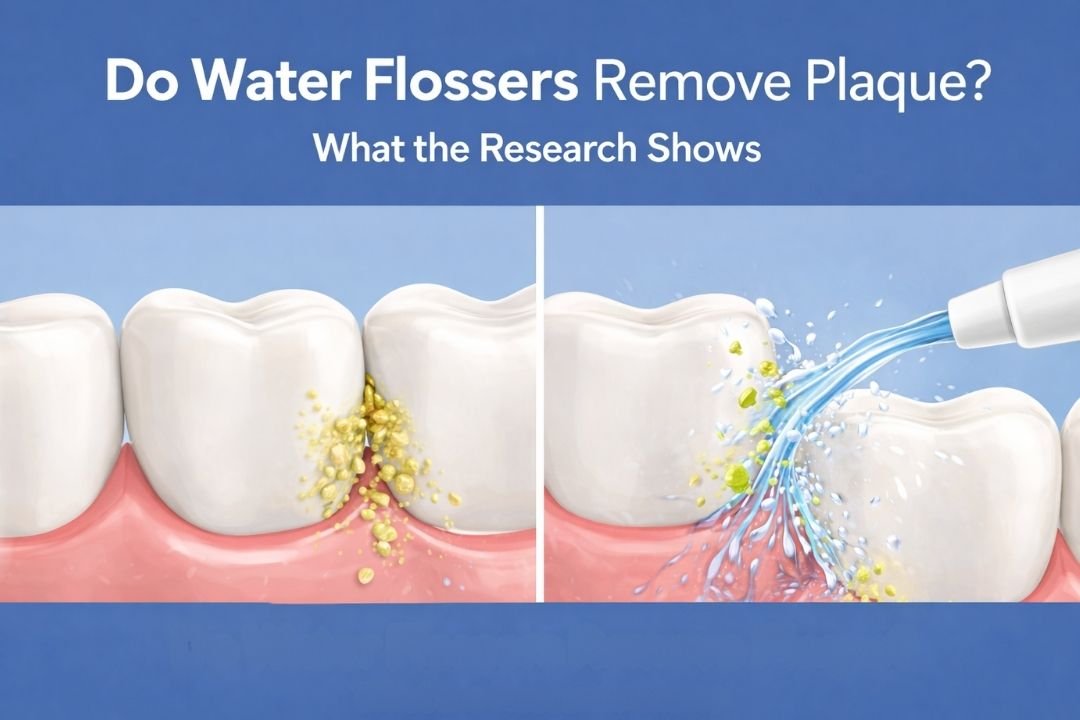
Water flossers deliver a pulsating stream of water — typically 1,200–1,400 pulses per minute at pressures ranging from 10 to 100 PSI — through a narrow nozzle aimed at the gum line and interdental spaces. The plaque removal mechanism is hydraulic, not mechanical.
Each pulse creates a brief compression-decompression cycle against the tooth surface and gum tissue. The compression phase pushes water into the interdental space and below the gum line. The decompression phase creates a suction effect that lifts and flushes debris outward. This cycle repeats over a thousand times per minute, gradually dislodging the bacterial biofilm from surfaces it adheres to.
This is fundamentally different from string floss, which uses physical contact — a thin filament dragged against the tooth surface — to scrape the biofilm away through shearing force. Neither method is inherently superior. They’re targeting the same problem through different physics.
One advantage of the hydraulic approach: water reaches areas a physical filament cannot. Periodontal pockets (the gaps between tooth and gum that deepen with gum disease), the undersides of dental bridges, and the complex geometry around orthodontic brackets are all accessible to a directed water stream but difficult or impossible to reach with string floss.
What the Clinical Studies Found
The research on water flosser plaque removal is more extensive than most consumer review sites suggest. Here are the key studies, presented with appropriate context about methodology and funding.
The 29% finding
A 2013 study published in the Journal of Clinical Dentistry compared a Waterpik water flosser with a manual toothbrush against string floss with a manual toothbrush over a four-week period. The water flosser group showed 29% greater reduction in plaque from interproximal areas compared to the string floss group. This is the most widely cited statistic in water flosser marketing — and it’s legitimate peer-reviewed data.
The context worth noting: this study was funded by Water Pik, Inc. Industry-funded research isn’t automatically invalid — the methodology was peer-reviewed and published in a reputable journal — but the funding source is worth disclosing, which is more than most affiliate sites do.
The orthodontic plaque study
A 2005 study, also in the Journal of Clinical Dentistry, examined plaque removal around orthodontic brackets specifically. Patients using a Waterpik with an orthodontic tip removed three times more plaque around brackets than those using string floss. For anyone who has tried threading floss around braces, this finding is not surprising — the geometry heavily favours a directed water stream over a physical filament.
The gum bleeding connection
A 2012 study in the same journal found water flossing was 93% more effective than string floss at reducing bleeding sites after four weeks. Gum bleeding is a direct indicator of inflammation caused by plaque bacteria along the gum line. The significant reduction in bleeding suggests the water flosser was disrupting plaque more effectively in subgingival areas — the zone just below the visible gum line where inflammation begins.
The broader evidence base
A 2019 systematic review published in the Journal of Clinical Periodontology examined multiple studies on oral irrigation (the clinical term for water flossing). The review concluded that water flossers, when used as an adjunct to tooth brushing, significantly reduce plaque and gingivitis compared to brushing alone. The evidence also showed water flossers to be at least as effective as string floss for plaque reduction, with some studies showing superior outcomes — particularly for gum health metrics.
Cochrane Reviews — the gold standard for evidence synthesis — have examined interdental cleaning broadly and concluded that both methods are effective. The evidence does not conclusively declare either method categorically superior to the other across all measures and populations.
Where Water Flossers Excel at Plaque Removal
Subgingival plaque (below the gum line). This is the most clinically significant advantage. Water flossers can deliver a pulsating stream into periodontal pockets — the spaces between tooth and gum that deepen as gum disease progresses. String floss can reach 1–2mm below the gum line at best. Water flossers access pockets 3–5mm deep or more, flushing out the bacteria that drive periodontal disease progression. For product recommendations in this area, see our guide to the best water flosser for gum disease.
Around dental work. Implant abutments, bridge pontics, orthodontic brackets, and retainer wires all create complex surfaces where plaque accumulates in hard-to-reach crevices. A directed water stream navigates this geometry in seconds. String floss requires threaders, patience, and dexterity — and still can’t reach every surface. See: Best Water Flosser for Braces.
Wide interdental spaces. If you have gaps between teeth (diastema) or gum recession that has created wider-than-normal spaces, string floss has nothing to grip against. It slides through without contacting the tooth surface effectively. A water stream fills the entire space and cleans all exposed surfaces.
The back molars. The second and third molars are the most neglected teeth in most people’s cleaning routines — they’re difficult to reach with any tool. A water flosser nozzle with 360-degree rotation reaches these areas with considerably less wrist contortion than threading floss between molars.
Where Water Flossers Fall Short
Tight contact points. When two teeth are pressed firmly together, string floss physically wedges between them and scrapes both mesial and distal surfaces through direct contact. A water stream can flush around tight contacts but doesn’t replicate the mechanical shearing action that physically strips the biofilm from these surfaces. If your teeth have very tight contacts — your hygienist would know — string floss retains an advantage here.
Mature, hardened plaque. Water flossers are effective at disrupting soft plaque — the biofilm that forms within 24–48 hours. They are not effective against calculus (tartar), which is mineralised plaque that has hardened onto tooth surfaces. Only professional scaling instruments can remove calculus. This is why regular dental cleanings remain essential regardless of your home care routine.
Technique-dependent results. A water flosser aimed at the wrong angle (at the tooth surface instead of the gum line) or swept too quickly (without pausing 2–3 seconds between each tooth) produces significantly worse results. The clinical studies showing strong plaque removal used proper technique under controlled conditions. Real-world results depend on the user. For guidance, see our step-by-step technique guide.
Plaque Removal: Water Flosser vs String Floss
Rather than declaring a winner, here’s where the evidence points for specific plaque removal scenarios:
| Plaque Location | Water Flosser | String Floss |
|---|---|---|
| Between teeth (interproximal) | Strong (29% better in studies) | Strong |
| Below the gum line (subgingival) | Superior | Limited reach |
| Tight contact points | Adequate | Superior (mechanical scraping) |
| Around braces and brackets | Superior (3× more effective) | Difficult without threaders |
| Around implants and bridges | Superior | Limited access |
| Wide gaps between teeth | Superior | Ineffective (nothing to grip) |
| Back molars | Easier to reach | Harder but effective if done |
| Hardened calculus | Ineffective | Ineffective |
Neither tool removes hardened calculus — that requires professional dental scaling.
For a more detailed comparison beyond plaque removal, including cost, comfort, and compliance data, read our full article: Water Flosser vs String Floss — What the Evidence Says.
How to Maximise Plaque Removal With a Water Flosser
The clinical studies that produced strong plaque removal results used specific techniques. Here’s what translates to daily practice.
Aim at the gum line, not the tooth surface. Plaque accumulates most heavily at the junction where tooth meets gum. Pointing the nozzle at the flat tooth surface — where your toothbrush already cleans — wastes the water flosser’s primary advantage. A 90-degree angle to the gum line directs the water stream exactly where plaque hides.
Pause 2–3 seconds between each tooth. The pulsating action needs time to dislodge the biofilm. Sweeping the nozzle quickly across all teeth turns your water flosser into an expensive mouth rinse. The pause-move-pause rhythm is what makes the difference between “used a water flosser” and “effectively removed plaque.”
Use it before brushing. A 2018 study in the Journal of Periodontology found that flossing before brushing resulted in greater plaque reduction than brushing first. Loosening plaque with the water flosser allows your toothbrush and fluoride toothpaste to reach freshly cleaned surfaces.
Use warm water. Warm water is more comfortable, but it also helps loosen debris and plaque slightly better than cold water. A small detail, but one that costs nothing.
Don’t skip the inner gum line. Most people water floss only the outer (cheek-facing) surfaces. The inner (tongue-facing) gum line accumulates just as much plaque. It takes an extra 30 seconds. Do both, every session.
Be consistent. Plaque reforms within hours. A single thorough session per day — every day — is more effective than an aggressive session twice a week. The ADA recommends interdental cleaning once daily. Consistency matters more than intensity.
For the complete technique with step-by-step instructions, see: How to Use a Water Flosser Correctly.
Frequently Asked Questions
Can a water flosser remove plaque as well as flossing?
Clinical research shows water flossers are at least as effective as string floss for overall interproximal plaque removal, and up to 29% more effective in some studies. They outperform string floss for subgingival plaque (below the gum line) and around dental work. String floss may retain an edge at very tight contact points where mechanical scraping is beneficial.
Can a water flosser remove tartar?
No. Tartar (calculus) is hardened, mineralised plaque that has bonded to the tooth surface. Neither water flossers nor string floss can remove it. Only professional scaling instruments used by a dentist or hygienist can remove tartar. What a water flosser can do is prevent plaque from hardening into tartar in the first place — by disrupting the biofilm daily before it mineralises.
How long does it take for a water flosser to show results?
Most users notice cleaner-feeling teeth and fresher breath after the first session. Measurable improvements in gum health — reduced bleeding, less inflammation — typically appear within 2–4 weeks of consistent daily use. This aligns with the timeframes used in clinical studies.
Is a Waterpik better at removing plaque than other brands?
Most clinical plaque removal studies have been conducted using Waterpik products, so they have the strongest evidence base. However, the underlying mechanism — pulsating water pressure — is the same across all reputable water flosser brands. A Philips Sonicare or Bitvae operating at similar pressure levels would be expected to produce comparable plaque removal results, though brand-specific clinical data is more limited. See our comparison of all major models for detailed specifications.
Do I still need to brush if I use a water flosser?
Absolutely. A water flosser cleans between teeth and along the gum line — roughly 40% of tooth surfaces. Your toothbrush handles the remaining 60%: the outer, inner, and biting surfaces of each tooth. They are complementary tools, not substitutes for each other. The recommended sequence is: water floss, then brush with fluoride toothpaste.
What pressure setting removes the most plaque?
Higher pressure dislodges more plaque — but only if your gums can tolerate it. Starting on high pressure with unadapted gums causes discomfort, bleeding, and abandonment of the habit. Begin on the lowest setting for 1–2 weeks, then gradually increase. Most people settle at a medium setting (4–6 on a 10-setting Waterpik) for effective daily plaque removal without discomfort.
Can a water flosser reverse gum disease?
A water flosser is a maintenance and prevention tool, not a treatment for established gum disease. It can reduce the bacterial load in periodontal pockets and significantly improve gum health metrics (bleeding, inflammation) — but it cannot reverse bone loss or repair damaged gum tissue. If you have active periodontal disease, consult your dentist for a treatment plan. A water flosser will likely be part of that plan, but it won’t be the only component.
The Bottom Line
Water flossers remove plaque. The clinical evidence is clear on this. They’re particularly effective at disrupting plaque in the subgingival zone, around dental work, and in the interproximal spaces where gum disease begins. For tight contact points, string floss offers a mechanical advantage that water alone doesn’t fully replicate — but for the majority of plaque removal scenarios, a water flosser performs as well as or better than string floss.
The caveat that matters most: technique determines results. A water flosser aimed at the gum line with a 2–3 second pause between each tooth removes significantly more plaque than the same device swept quickly across all teeth. Get the technique right, use it daily, and the plaque doesn’t stand much of a chance.
If you’re ready to choose a model, our complete guide to the best water flossers of 2026 covers seven options from $15.98 to $99.99.
Related Guides
Sources
• Barnes CM et al. Journal of Clinical Dentistry (2013)
• Sharma NC et al. Journal of Clinical Dentistry
• Rosema NAM et al. International Journal of Dental Hygiene
• Worthington HV et al. Cochrane Database of Systematic Reviews
• American Dental Association – Interdental cleaning recommendations