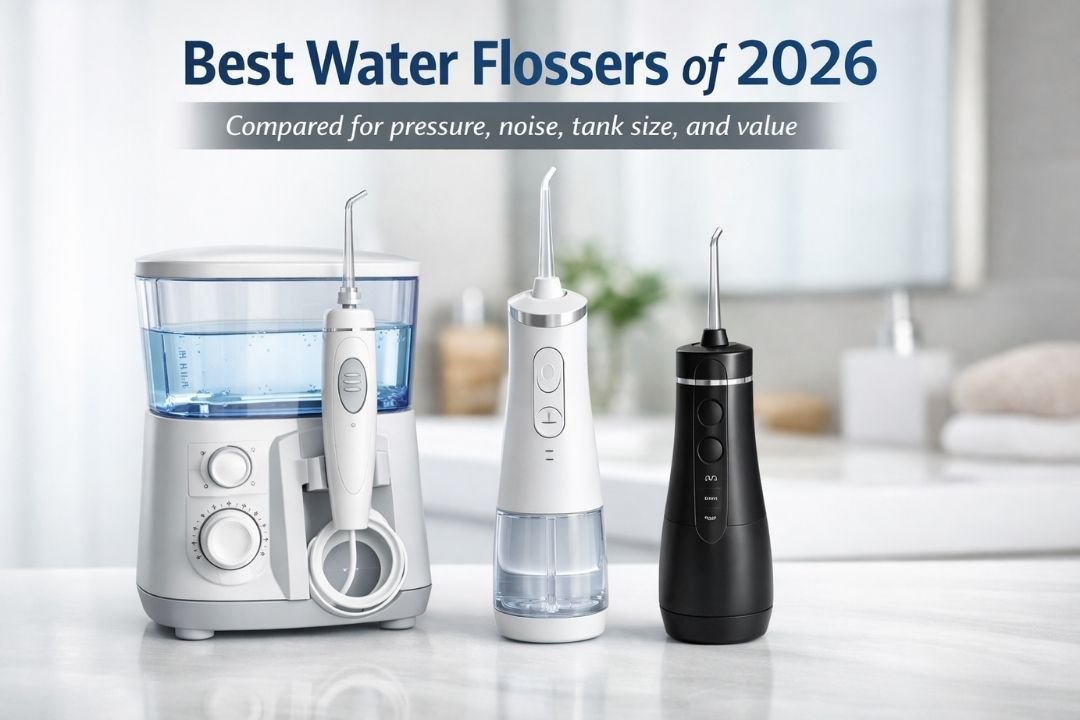
Last updated: March 2026 | By: VerdictLab Editorial Team | Products compared: 12+
Finding the right water flosser shouldn’t require a dental degree. We compared over a dozen models — from the $15 budget picks dominating Amazon to the $100 premium units endorsed by dentists — evaluating each on noise levels, water pressure range, reservoir capacity, ease of cleaning, and battery life. Every recommendation below is based on verified specifications, clinical evidence, dental professional input, and thousands of real user reviews — not marketing claims.
Three brands currently hold the American Dental Association Seal of Acceptance for water flossers: Waterpik, Philips Sonicare, and Quip. That doesn’t mean other brands are unsafe — many simply haven’t applied — but it’s an important trust signal we factor into our scoring.
Below you’ll find our top 7 picks, a full comparison table, and a practical buyer’s guide to help you choose the right water flosser for your teeth, gums, and budget.
Our Top 3 Picks at a Glance
Best Overall
Waterpik ION Professional (WF-12)
Hybrid cordless-countertop design with the largest reservoir in its class, 10 pressure settings, and ADA acceptance. The noise is noticeable but performance is unmatched.
Price: $99.99
Best Cordless
Philips Sonicare Power Flosser 3000
The quietest water flosser in this roundup — independent noise reviews consistently place it well below the Waterpik Aquarius. The Quad Stream nozzle creates a uniquely wide spray pattern that feels thorough without high pressure.
Price: $79.96
Best Budget
Bitvae C6
Remarkably capable for under $16. Three modes, five intensity levels, and a 40-day battery that outlasts models costing five times as much. No ADA seal, but solid build quality.
Price: $15.98
In This Guide
- Full Comparison Table
- Best Overall — Waterpik ION
- Best Countertop — Waterpik Aquarius
- Best Cordless — Philips Sonicare 3000
- Best Budget — Bitvae C6
- Best for Braces — Waterpik Cordless Advanced
- Best Value Countertop — H2ofloss HF-9
- Best Design — Burst
- Buyer’s Guide: How to Choose
- How Water Flossers Work
- Who Should Use a Water Flosser?
- Water Flosser vs String Floss
- How to Use a Water Flosser
- Maintenance and Cleaning
- Frequently Asked Questions
Water Flosser Comparison Table
Here’s how all seven of our picks compare across the specs that matter most. Prices are from Amazon at time of publication and may vary.
| Model | Type | Price | Pressure Settings | Reservoir | Battery Life | ADA Seal | Best For |
|---|---|---|---|---|---|---|---|
| Waterpik ION (WF-12) | Hybrid | $99.99 | 10 | 650ml | ~4 weeks | ✅ | Overall best |
| Waterpik Aquarius (WP-660) | Countertop | $79.99 | 10 | 650ml | Corded (N/A) | ✅ | Countertop |
| Philips Sonicare 3000 | Cordless | $79.96 | 2 modes / 3 levels | 250ml | ~2 weeks | ✅ | Quiet / Cordless |
| Bitvae C6 | Cordless | $15.98 | 3 modes / 5 levels | 300ml | ~40 days | ❌ | Budget |
| Waterpik Cordless Advanced (WP-580) | Cordless | $69.99 | 3 | 207ml | ~4 weeks | ✅ | Braces / Travel |
| H2ofloss HF-9 | Countertop | $29.99 | 5 (dial) | 800ml | Corded (N/A) | ❌ | Value countertop |
| Burst Water Flosser | Cordless | $69.99 | 3 | 110ml | ~80 days | ❌ | Design |
Specifications from manufacturer data. Prices from Amazon at time of publication and may vary.
Best Overall: Waterpik ION Professional (WF-12)
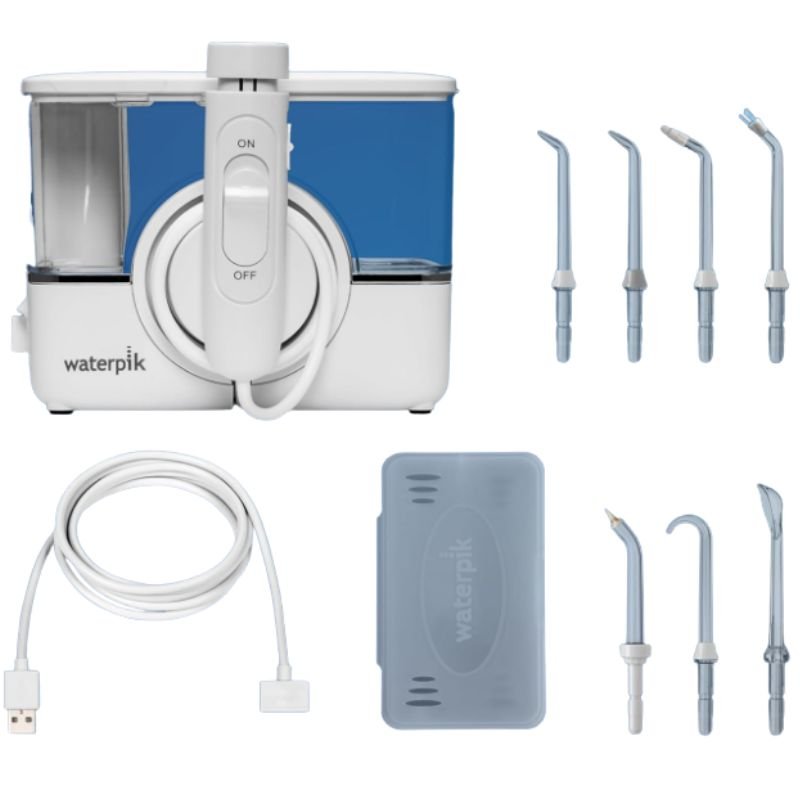
Price: $99.99 | Type: Hybrid (cordless wand + countertop base) | Reservoir: 650ml | Settings: 10 | ADA Accepted: Yes | Warranty: 3 years
The Waterpik ION is a cleverly designed hybrid. The wand lifts off the base for cordless use, while the reservoir sits on your counter connected by a flexible hose — giving you the water capacity of a countertop model with the manoeuvrability of a cordless unit. The 650ml tank provides roughly 90+ seconds of continuous use on a mid-range setting, which is enough for a thorough full-mouth session without refilling.
Pressure output across the 10 settings spans 10–100 PSI. Settings 3–5 are generally comfortable for daily use on healthy gums, while settings 7–10 produce a powerful jet suited for deep cleaning around bridges and implants. The rechargeable battery is rated for approximately 4 weeks of daily use, which users widely confirm in reviews.
The main drawback is noise. Multiple independent reviewers and Amazon users consistently flag the ION as louder than cordless competitors — particularly at higher settings. If you share a bathroom wall with a light sleeper, early morning use might be an issue.
Included tips: 7 — Precision (x2), Plaque Seeker, Orthodontic, Pik Pocket, Implant Denture, Tongue Cleaner. One of the most generous tip selections in any water flosser package.
Who it’s best for: Anyone who wants countertop-level water capacity with cordless convenience. Excellent for general gum health, braces, bridges, and implants. Not ideal if noise is a primary concern.
Strengths: Hybrid design solves the countertop-vs-cordless dilemma; 10 pressure settings offer genuine range; 7 included tips; 3-year warranty; ADA accepted; long battery life.
Weaknesses: Louder than cordless competitors; footprint is still significant on a small counter; hose connection can feel stiff when new.
Best Countertop: Waterpik Aquarius (WP-660)
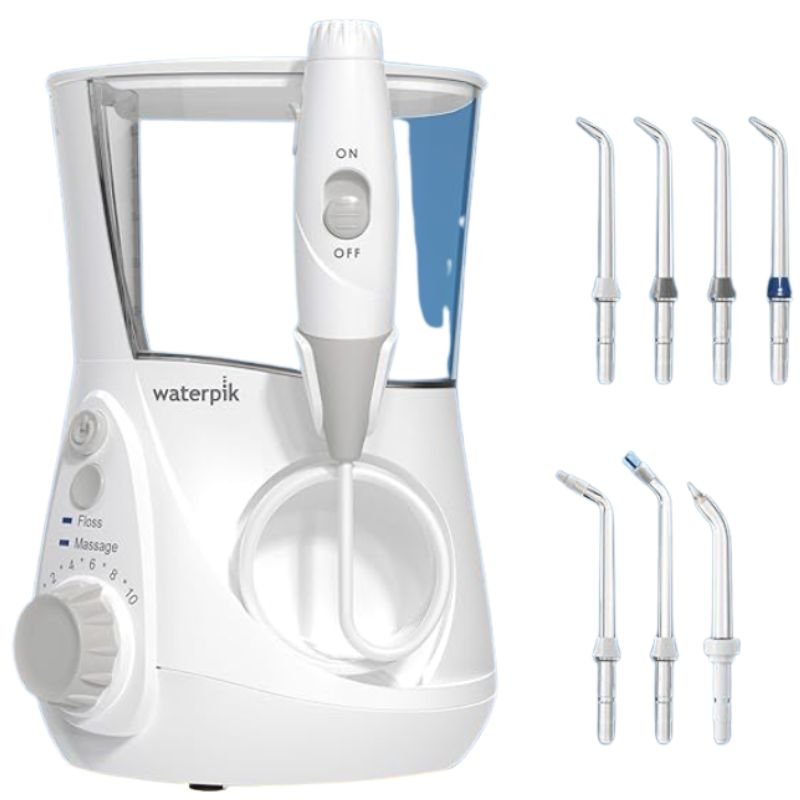
Price: $79.99 | Type: Countertop (corded) | Reservoir: 650ml | Settings: 10 (10–100 PSI) | ADA Accepted: Yes | Warranty: 3 years
The Aquarius is the most-reviewed water flosser on Amazon (75,000+ ratings at 4.6 stars) and it’s easy to see why. It does exactly what a countertop flosser should do — deliver strong, consistent water pressure across a wide range of settings — without any compromises on reservoir capacity or build quality.
The pressure range spans 10–100 PSI across 10 settings, and the 650ml reservoir provides roughly 90 seconds of use at a mid-range setting. The built-in 60-second timer and 30-second pacer help you stay consistent. The Aquarius also offers a dedicated Floss Mode alongside the Stream Mode — the pulsating Floss Mode is particularly effective around the gum line, while Stream Mode works well for rinsing food particles from wider gaps.
The design is functional rather than attractive. The tip storage in the lid is convenient but feels flimsy. Noise is typical for countertop models — plan to use it before your household goes to sleep.
Included tips: 7 — Classic Jet (x3), Toothbrush, Plaque Seeker, Orthodontic, Pik Pocket. Matches the ION for the most generous tip selection in this roundup.
Who it’s best for: Families (the 7 tips let multiple people share one unit), anyone who wants maximum pressure and reliability at a mid-range price, and people who don’t mind dedicating counter space.
Strengths: Proven reliability; 7 included tips; 10 pressure settings with genuine range; Floss + Stream modes; ADA accepted; 3-year warranty.
Weaknesses: Must stay plugged in; large footprint; loud; design is purely functional.
Best Cordless & Quietest: Philips Sonicare Power Flosser 3000
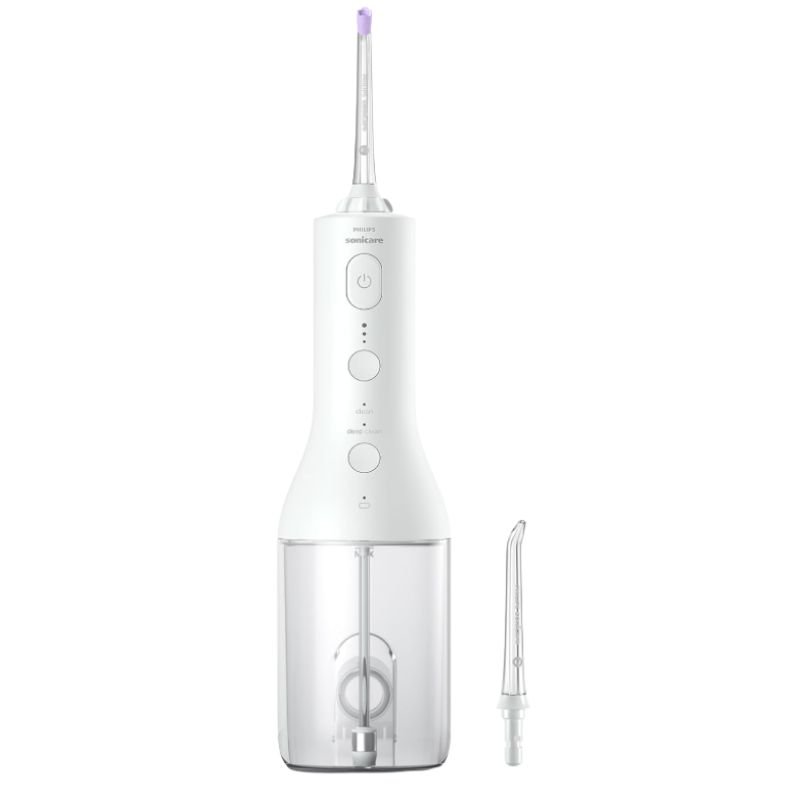
Price: $79.96 | Type: Cordless | Reservoir: 250ml (8 oz) | Modes: 2 (Clean, Deep Clean) × 3 intensities | ADA Accepted: Yes | Warranty: 2 years
The Philips Sonicare 3000 does something no other water flosser in this roundup manages: it’s genuinely quiet. Independent noise comparisons consistently place it well below the Waterpik Aquarius, and users frequently cite the low noise as their primary reason for choosing it. At the lowest setting, this is a water flosser you could use without waking anyone up.
The technology behind the reduced noise is the Quad Stream X-shaped nozzle, which splits the water into four streams instead of a single jet. The result feels different from a Waterpik — less like a pressure washer, more like a wide rinse. It’s genuinely effective, though aggressive plaque fighters may prefer the focused jet of a Waterpik on higher settings.
The 250ml reservoir provides enough for a careful full-mouth pass, though you may notice the tank depleting toward the end of a session. Refilling is straightforward through the top opening. Battery life is rated at approximately 2 weeks of daily use, charging via the included stand.
Included tips: 2 — F1 Standard nozzle, F3 Quad Stream nozzle. The Quad Stream tip is the standout and is exclusive to Philips. Additional tips sold separately (~$15 for a two-pack).
Who it’s best for: Noise-sensitive users, apartment dwellers, anyone with sensitive gums who finds traditional water flossers too aggressive, and people who want ADA acceptance without the Waterpik footprint. Also a strong choice for people who already use Philips Sonicare toothbrushes — the aesthetic matches.
Strengths: Remarkably quiet; Quad Stream nozzle feels genuinely innovative; compact and elegant; ADA accepted; 2 modes × 3 intensities; good price for the quality.
Weaknesses: Only 2 tips included (competitors include 4–7); 250ml tank means some users refill mid-session; replacement tips are pricey (~$15 for two).
Best Budget: Bitvae C6
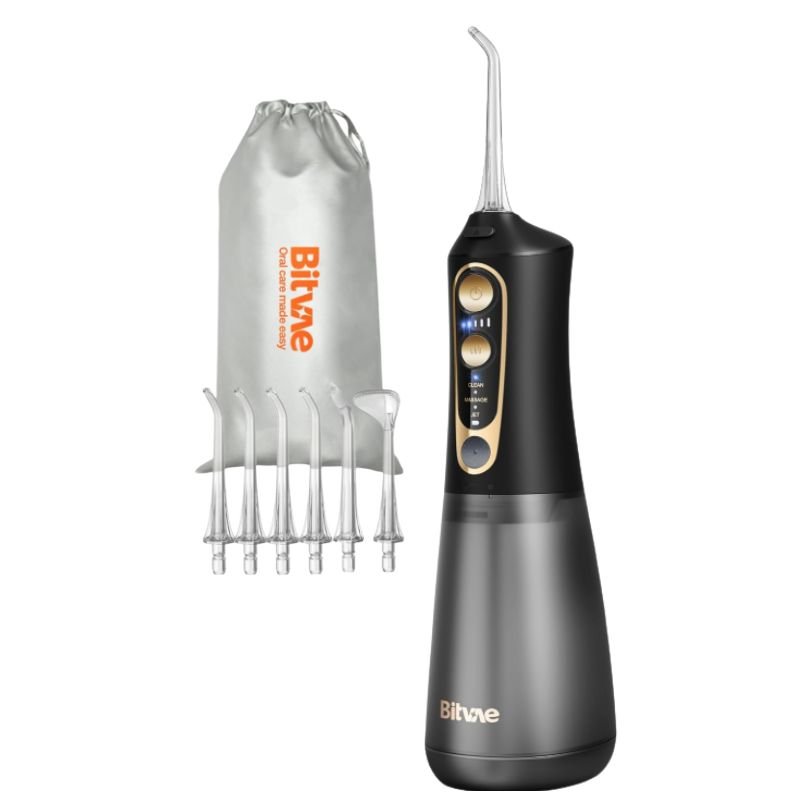
Price: $15.98 | Type: Cordless | Reservoir: 300ml | Settings: 3 modes × 5 intensity levels | ADA Accepted: No | Warranty: 1 year
Every budget product gets called “surprisingly good” in affiliate reviews, so let us be specific about what the Bitvae C6 actually does well. The 300ml reservoir is 20% larger than the Philips Sonicare 3000’s — enough for most people’s full routine without refilling. Three modes (Normal, Soft, Pulse) combined with five intensity levels give you 15 effective settings, which is more granularity than any model here except the Waterpik countertops.
Battery life is the standout specification. Bitvae rates it at 40 days, and Amazon reviewers widely confirm this holds up in daily use — significantly longer than the Philips and competitive with the Waterpik ION. Remarkable for a sub-$16 product. It charges via USB-C, not a proprietary cable, which is a practical advantage.
Where the Bitvae shows its price is in the build feel. The plastic has a slightly hollow quality when you tap it, the button sometimes requires a firm press, and there’s no ADA seal providing third-party validation. Bitvae doesn’t have the multi-decade reliability track record of Waterpik, and the 1-year warranty is standard for budget brands but half of what Philips offers.
Included tips: 6 — Standard (x3), Orthodontic, Periodontal, Tongue Scraper. Generous selection for the price.
Who it’s best for: First-time water flosser users testing whether they’ll stick with the habit, budget-conscious buyers, students, and anyone who values USB-C charging and long battery life over brand prestige.
Strengths: Outstanding battery life; USB-C charging; 15 mode/intensity combinations; 300ml tank; 6 included tips; remarkable value at $15.98.
Weaknesses: No ADA seal; build quality is functional but not premium; 1-year warranty; limited long-term reliability data as a newer brand.
Best for Braces & Travel: Waterpik Cordless Advanced (WP-580)
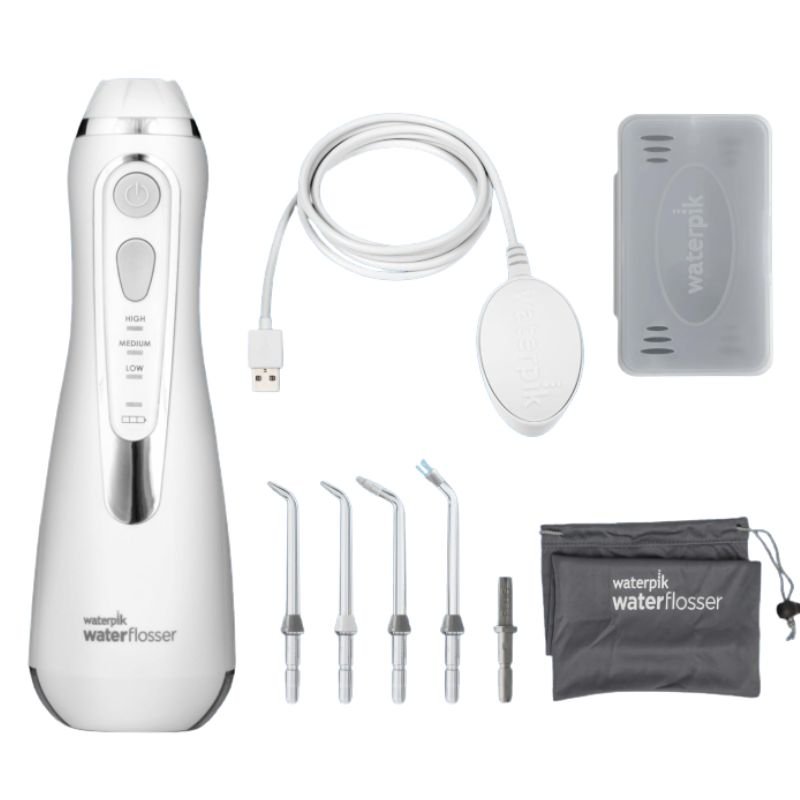
Price: $69.99 | Type: Cordless | Reservoir: 207ml (7 oz) | Settings: 3 | ADA Accepted: Yes | Warranty: 2 years
The Cordless Advanced has been the standard recommendation for braces wearers for years, and the design makes clear why. The included Orthodontic Tip has a tapered, soft bristle end specifically designed to navigate around brackets and wires without snagging. Combined with the Plaque Seeker tip (thin bristles for cleaning around brackets from the side), it covers both cleaning angles that orthodontic patients need.
Portability is the secondary strength. The magnetic charging stand doubles as a travel case, and the compact form factor makes it genuinely pocketable. Users consistently report it survives being tossed in a toiletry bag without leaking or breaking — a common concern with cordless flossers. Battery life is rated at up to 4 weeks per charge.
The trade-off is the 207ml (7 oz) reservoir — the smallest among our Waterpik picks. At a medium setting, the tank provides roughly 45 seconds of use, so expect to refill once for a thorough full-mouth session. The three pressure settings also feel limited after using a 10-setting Waterpik countertop.
Included tips: 4 — Precision (x2), Plaque Seeker, Orthodontic.
Who it’s best for: Orthodontic patients with braces, frequent travellers, anyone who wants a compact ADA-accepted flosser with a proven track record. For a deeper guide, see our article on choosing the best water flosser for braces.
Strengths: Purpose-built orthodontic and plaque seeker tips; compact travel-friendly design; ADA accepted; magnetic charging case; 2-year warranty; 4-week battery life.
Weaknesses: Small 207ml reservoir requires refilling (~45 seconds of use); only 3 pressure settings; relatively expensive for a cordless-only unit.
Best Value Countertop: H2ofloss HF-9
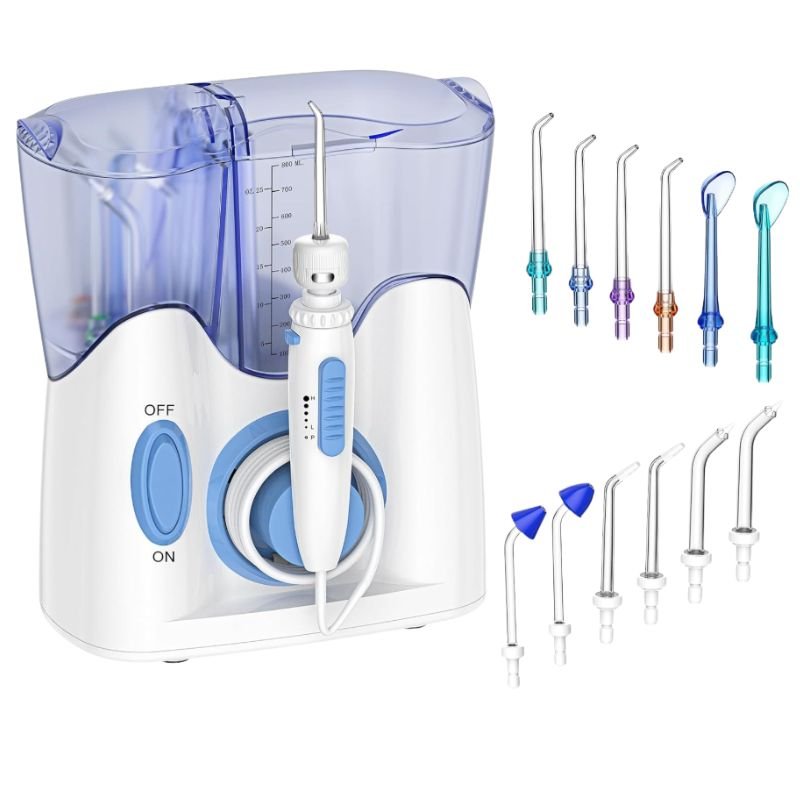
Price: $29.99 | Type: Countertop (corded) | Reservoir: 800ml | Settings: 5 (pressure dial) | ADA Accepted: No | Warranty: 1 year
If counter space isn’t an issue and you want the largest reservoir available, the H2ofloss HF-9 is a compelling pick at roughly a third of the Waterpik Aquarius price. The 800ml tank is the biggest in this roundup — enough for two full sessions without refilling. The brand markets it as their “Whisper” model, designed for quieter operation, and user reviews suggest it runs quieter than the Waterpik Aquarius by a noticeable margin, though “whisper” is an overstatement.
The five-level pressure dial lacks the precision of Waterpik’s numbered digital settings, but the stepless rotation lets you fine-tune between levels. The design stores the power cord inside the base, which is a thoughtful touch. With 12 included tips — by far the most of any model here — this is another strong family option.
Downsides beyond the mixed user reviews include the lack of ADA certification, a dated visual design, and a 1-year warranty that’s half what Waterpik offers. H2ofloss is a less well-known brand with fewer online support resources if something goes wrong, though uniquely among water flosser companies, they sell individual replacement parts on their website.
Included tips: 12 — Standard (x2), Tongue Cleaner, Periodontal, Orthodontic, and 7 colour-coded family tips.
Who it’s best for: Budget-conscious families, shared bathrooms, anyone who prioritises tank capacity over portability and is comfortable with a lesser-known brand. See our full countertop water flosser guide for more options.
Strengths: Largest 800ml reservoir; 12 included tips; $29.99 price point; quieter than expected; power cord stores neatly in base; sells replacement parts directly.
Weaknesses: No ADA seal; mixed user reviews on build quality; dated design; 1-year warranty; less brand recognition means limited support ecosystem.
Best Design: Burst Water Flosser
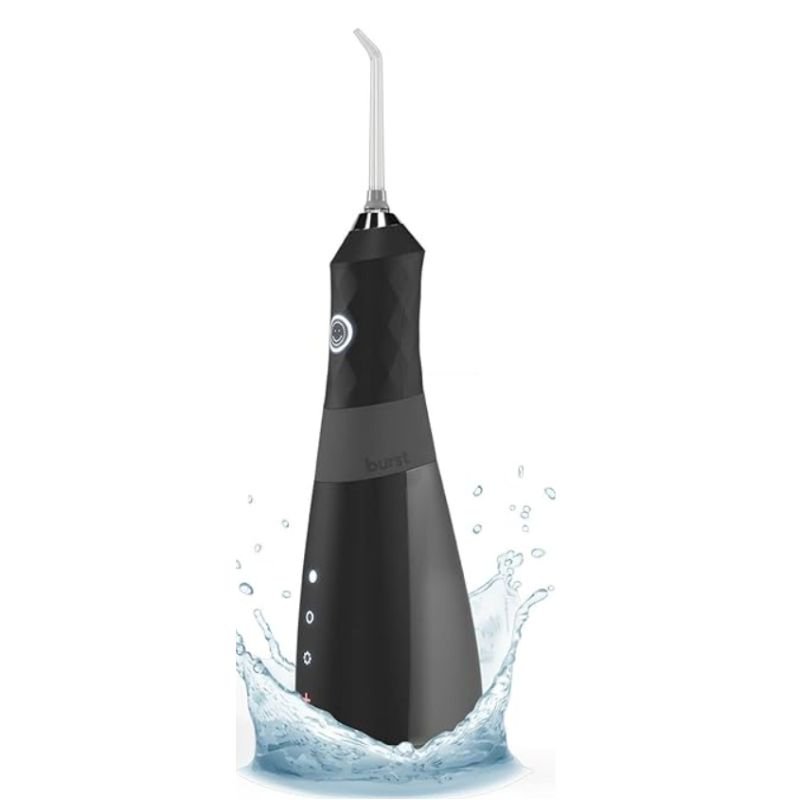
Price: $69.99 | Type: Cordless | Reservoir: 110ml | Settings: 3 (Standard, Turbo, Pulse) | ADA Accepted: No | Warranty: 1 year (limited lifetime with tip subscription)
Burst is the most visually appealing water flosser in this roundup — matte black with soft-touch surfaces that look like they belong next to a high-end electric toothbrush rather than a medical device. The 360-degree rotating nozzle makes it easy to reach every angle without contorting your wrist.
The standout feature is the warranty structure — unique among water flosser brands. All Burst devices come with a standard 1-year warranty. If you enrol in their replacement tip subscription (~$5 every 3 months), the warranty extends to a limited lifetime. It’s a compelling model for long-term ownership cost predictability, though worth noting the lifetime coverage requires maintaining the subscription.
However, the 110ml reservoir is the smallest in this guide, depleting in roughly 20–30 seconds at a medium setting. That’s enough for a quick targeted session but not a thorough full-mouth clean — you’ll refill two to three times for a complete routine. The three pressure modes (Standard, Turbo, Pulse) are adequate but lack finer control. And despite the premium look, user reviews consistently note the pressure output feels weaker than the Waterpik or even the Bitvae at comparable intensity levels.
Included tips: 1 — Classic tip. Additional tips and orthodontic tips sold separately or via subscription.
Who it’s best for: Design-conscious buyers who want a water flosser that looks good on an open bathroom shelf, anyone drawn to the lifetime warranty with subscription, and people who only need quick targeted cleaning rather than full-mouth sessions.
Strengths: Limited lifetime warranty with subscription (unique in the category); attractive design; 360° rotating nozzle; 80-day battery life; subscription tip plan is affordable.
Weaknesses: Smallest reservoir (110ml) requires frequent refilling; only 1 tip included; pressure output underwhelms compared to competitors; no ADA seal; lifetime warranty requires active subscription.
How to Choose the Right Water Flosser: Buyer’s Guide
With dozens of models available, narrowing your choice comes down to five practical decisions. Here’s what actually matters.
Countertop vs Cordless
Countertop models (Waterpik Aquarius, H2ofloss HF-9) plug into a wall outlet, sit on your counter, and deliver stronger, more consistent pressure through larger reservoirs. They’re ideal for families, shared bathrooms, and anyone who values a long uninterrupted flossing session. Cordless models (Philips Sonicare, Bitvae, Burst) run on rechargeable batteries, are portable, and store easily — but trade off reservoir size and maximum pressure. The Waterpik ION bridges the gap as a hybrid, though it still needs counter space. For a more detailed comparison, see our countertop guide and cordless guide.
Pressure Range and Settings
Beginners should start at the lowest setting and increase over 1–2 weeks as gums adapt. Countertop models generally offer the widest range: the Waterpik Aquarius spans 10–100 PSI across 10 settings. Most cordless models offer 3 settings. If you have sensitive gums, gum recession, or dental work like implants, a model with a dedicated “Sensitive” or “Soft” mode is valuable — the Bitvae C6 and Philips Sonicare both offer this.
Reservoir Size
This is more important than most reviews suggest. A small reservoir means interrupting your session to refill, which breaks the habit loop that makes water flossing stick. Rough benchmarks: 100–200ml gives you 20–45 seconds, 250–300ml gives 50–75 seconds, and 600–800ml gives 90–120+ seconds. A full-mouth flossing session typically takes 60–90 seconds, so countertop models handle it in one fill while most cordless models require one refill.
Noise Level
This is the most underreported factor in water flosser reviews. Countertop models at high settings can reach 70+ dB — louder than a normal conversation (60 dB) and approaching a vacuum cleaner (75 dB). The Philips Sonicare 3000 is consistently cited as the quietest option, while the H2ofloss “Whisper” is the quietest countertop model available. If noise bothers you or your household, prioritise this metric over pressure.
Tips and Nozzles
Most water flossers ship with a standard Classic Jet tip that suits general use. Specialty tips expand what the flosser can do: Orthodontic tips have soft bristles for braces and brackets, Periodontal (Pik Pocket) tips deliver a gentle low-pressure stream below the gum line, Plaque Seeker tips use thin bristles around crowns and implants, and Tongue Cleaner attachments scrape the tongue surface. Replacement tips cost $5–15 and should be swapped every 3–6 months. This ongoing cost is worth factoring into your purchase — see our full guide on water flosser tips and nozzles.
How Water Flossers Work
A water flosser uses a motor-driven pump to pressurize water from the reservoir and deliver it through a narrow nozzle tip in rapid pulses — typically 1,200–1,400 pulses per minute. This pulsating stream creates a combined mechanical and hydraulic action: the direct force of the water dislodges food particles and loosens plaque, while the pulsing action creates a compression-decompression cycle that flushes debris from interdental spaces and below the gum line.
Clinical research has consistently shown water flossers to be effective at reducing bleeding on probing and improving gingival health. A 2013 study published in the Journal of Clinical Dentistry found that a Waterpik water flosser was up to 29% more effective than string floss at reducing interproximal plaque. However, it’s important to note that the American Dental Association positions water flossers as a complement to brushing, not necessarily a replacement for all forms of interdental cleaning. Your dentist can advise on the best approach for your individual dental health.
Who Should Use a Water Flosser?
Water flossers benefit almost anyone, but certain groups see the most significant improvement over string floss alone.
Orthodontic patients with braces, retainers, or lingual wires find traditional flossing extremely difficult. A water flosser with an orthodontic tip navigates around brackets in seconds rather than the minutes it takes with floss threaders.
People with dental implants, bridges, or crowns need to clean around prosthetic components where string floss can’t effectively reach. Periodontal pocket tips deliver a gentle stream below the gum line around implant abutments.
Those with gum disease or bleeding gums often avoid flossing because it hurts — which worsens the condition. Starting a water flosser on the lowest pressure setting allows effective cleaning with less discomfort than string floss. For product recommendations, see our guide to the best water flosser for gum disease.
Older adults and people with limited dexterity — including those with arthritis, Parkinson’s, or post-stroke mobility challenges — often struggle with the fine motor skills string flossing requires. Water flossers require only pointing and pressing a button.
Anyone who simply won’t floss otherwise. The ADA’s position is clear: the best interdental cleaning tool is the one you actually use. If string floss sits unused in your drawer, a water flosser that you use daily is a substantial improvement.
Water Flosser vs String Floss: Which Is Better?
This is the most common question we receive, and the honest answer is: it depends on your dental situation and your habits.
String floss excels at physically scraping plaque from tight contact points between teeth — something water pressure alone doesn’t replicate with the same mechanical action. Dentists and hygienists who favour string floss emphasise this mechanical scraping as essential, particularly for people with tight contacts.
Water flossers excel at flushing debris and bacteria from periodontal pockets, around orthodontic appliances, and from areas that string floss simply can’t reach. They’re also faster (60–90 seconds vs 2–5 minutes for thorough string flossing) and more comfortable for people with sensitive or inflamed gums.
Research generally supports both methods as effective, with some studies showing water flossers producing better outcomes for gum health specifically. The practical answer for most people: use whichever method you’ll actually do consistently. If that’s a water flosser, you’re far better off than not flossing at all.
For a deeper dive with clinical research citations, read our full comparison: Water Flosser vs String Floss — What the Evidence Says.
How to Use a Water Flosser Correctly
Using a water flosser effectively takes a little practice. Here’s the essential technique:
Start with warm water — it’s more comfortable on gums than cold, especially during your first few sessions. Fill the reservoir, select a tip, and lean over the sink. Some people prefer to do this in the shower to avoid splashing.
Begin on the lowest pressure setting. This is critical for the first 1–2 weeks. Your gums will likely bleed initially if you’re new to interdental cleaning — that’s normal and should diminish within a week of daily use. Place the tip at a 90-degree angle to the gum line, close your lips loosely around the tip (to reduce splashing), and turn the unit on. Let the water flow out of your mouth into the sink.
Trace the gum line along both the outer (cheek-facing) and inner (tongue-facing) surfaces, pausing briefly between each tooth. Spend about 2–3 seconds per interdental space. The entire process should take 60–90 seconds.
Use the water flosser before brushing — this loosens debris that your toothbrush can then sweep away. Some dentists recommend the reverse order; follow your dental professional’s guidance.
For illustrated step-by-step instructions, see our complete guide: How to Use a Water Flosser the Right Way.
Maintenance and Cleaning
Water flossers can develop mould and mineral buildup inside the reservoir and internal tubing if not maintained. This is one of the most common long-term complaints on Amazon reviews — and it’s almost entirely preventable with a simple routine.
After every use: Empty the reservoir completely and leave the lid open to air-dry. Eject the tip and store it separately. Wiping the reservoir with a dry cloth prevents mineral deposits in hard-water areas.
Weekly: Fill the reservoir with a mixture of warm water and 1–2 tablespoons of white vinegar. Run the unit until the reservoir empties, then rinse by running plain water through it once more. This dissolves mineral scale and kills bacteria inside the tubing.
Monthly: Remove the reservoir and scrub the interior and any accessible valves with a soft brush (an old toothbrush works well). Inspect the tip for calcium deposits and soak it in vinegar for 5–10 minutes if needed. Replace tips every 3–6 months — the rubber seal degrades and water delivery becomes inconsistent.
Never add mouthwash unless the manufacturer specifically approves it. The alcohol and chemicals in many mouthwash formulas can degrade internal rubber seals and void your warranty. Waterpik explicitly approves warm water and their branded mouthwash additive only.
Frequently Asked Questions
Do dentists recommend water flossers?
Yes, many dental professionals recommend water flossers — particularly for patients with braces, implants, bridges, or gum disease. The American Dental Association has granted its Seal of Acceptance to water flossers from Waterpik, Philips Sonicare, and Quip, confirming their safety and effectiveness. However, some dentists still consider string floss essential for scraping plaque from tight contact points and may recommend using both. For more detail, see our article: Do Dentists Actually Recommend Water Flossers?
Can water flossers replace string floss?
For many people, yes — especially those who weren’t flossing at all. Clinical studies show water flossers are effective at reducing plaque and improving gum health. However, string floss provides a unique mechanical scraping action that water flossers don’t fully replicate. The ideal routine includes both, but a water flosser alone is vastly better than no interdental cleaning. Read our full comparison here.
Do water flossers remove plaque?
Yes. Research published in the Journal of Clinical Dentistry found that water flossers removed up to 29% more plaque than string floss in interproximal areas. They’re particularly effective at flushing bacteria from periodontal pockets where brushing and string floss can’t easily reach. See: Do Water Flossers Actually Remove Plaque?
Are water flossers safe for gums?
Yes, when used correctly. Start on the lowest pressure setting and increase gradually over 1–2 weeks. Some gum bleeding during the first few sessions is normal and typically resolves within a week. If bleeding persists beyond two weeks, consult your dentist — it may indicate an underlying gum condition that needs professional attention.
How often should I use a water flosser?
Once per day is sufficient for most people, ideally before brushing. Some dental professionals recommend twice daily (morning and evening) for patients with active gum disease or orthodontic appliances. Consistency matters more than frequency.
Can I put mouthwash in my water flosser?
Generally, no. Most manufacturers advise against adding mouthwash, as alcohol and other chemicals can degrade internal seals and void your warranty. Waterpik sells a branded rinse formulated for use in their devices. You can safely use warm water with a small amount of non-alcohol antiseptic rinse in most models, but check your specific manufacturer’s guidelines first.
Countertop or cordless — which should I buy?
Choose countertop if you have dedicated counter space and want maximum pressure with the largest water tank. Choose cordless if you have limited space, travel frequently, or prefer a simpler aesthetic. The Waterpik ION offers a hybrid approach that works for both scenarios. Our cordless guide and countertop guide go deeper on each.
How long do water flossers last?
With proper maintenance, a quality countertop water flosser (Waterpik Aquarius, H2ofloss) lasts 3–5 years. Cordless models typically last 2–4 years before battery degradation becomes noticeable. The most common failure point is the internal pump seal — preventable with regular vinegar cleaning.
How VerdictLab Evaluates Water Flossers
Our editorial picks are based on a weighted evaluation framework that draws from manufacturer specifications, clinical research, dental professional recommendations, and analysis of thousands of verified user reviews across Amazon, retailer sites, and dental forums. We cross-reference every manufacturer claim against independent sources and real-world user feedback.
We evaluate each water flosser across six criteria: Cleaning Performance (30%), Noise (15%), Ease of Use (15%), Value for Money (15%), Portability (15%), Build Quality (10%). No product receives a perfect score — we believe honest evaluation requires acknowledging trade-offs.
We do not accept free products from manufacturers. Our recommendations are editorially independent.
The Bottom Line
For most people, the Waterpik ION Professional ($99.99) is the best water flosser you can buy in 2026. It’s the only model that genuinely solves the countertop-versus-cordless debate, delivers clinical-grade pressure across 10 settings, and carries the ADA Seal of Acceptance with a 3-year warranty. The noise is real — but so are the results.
If noise is your main concern, the Philips Sonicare Power Flosser 3000 ($79.96) is substantially quieter than any competitor in this roundup. The trade-off is a smaller reservoir and fewer pressure settings.
If budget matters most, the Bitvae C6 ($15.98) delivers remarkable value. The 40-day battery life and 15 mode/intensity combinations would justify a price three times higher.
The most important thing is finding a water flosser you’ll actually use every day. Any of the seven models above will do more for your gum health than the string floss sitting unused in your bathroom drawer. Pick the one that fits your budget, counter, and noise tolerance — and use it consistently.
Have questions about a specific model? Email us at hello@verdict-lab.com or leave a comment below.
Explore Our Water Flosser Guides
- How to Use a Water Flosser Correctly
- Water Flosser vs String Floss: What the Evidence Says
- Do Water Flossers Actually Remove Plaque?
- Do Dentists Recommend Water Flossers?
- Best Water Flosser for Braces
- Best Cordless Water Flosser
- Best Countertop Water Flosser
- Best Water Flosser for Gum Disease
- Best Water Flosser for Implants
- Waterpik vs Philips Sonicare Water Flosser
- Best Water Flosser Tips and Nozzles
- Water Flosser for Tonsil Stones
References
- Philips Sonicare — Cordless Power Flosser 3000 (HX3826/21)
- Journal of the American Dental Association — Tips for Caring for Your Teeth and Mouth (PDF)