Last updated: March 2026 | By: VerdictLab Editorial Team
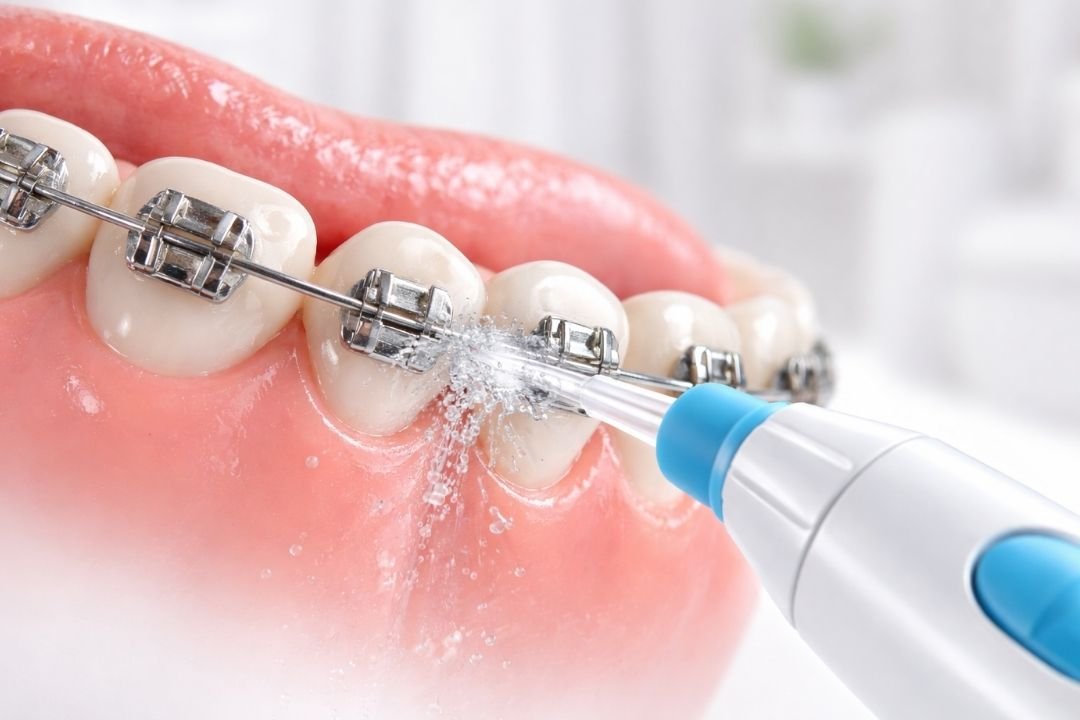
Braces make flossing miserable. Threading string floss under archwires, navigating around brackets, trying not to snap the wire — it takes 10–15 minutes of careful work that most people (especially teenagers) abandon within weeks. A water flosser changes this from a dreaded chore into a 90-second routine.
But not every water flosser works well with braces. You need a model with an orthodontic tip designed for bracket cleaning, adjustable pressure that starts low enough for sensitive gums, and ideally an ADA Seal of Acceptance confirming it’s safe for orthodontic use. We compared the options and narrowed it to four picks — from a premium countertop to a $15.98 budget cordless.
For our full comparison of all water flosser types, see the complete VerdictLab guide to the best water flossers of 2026.
Quick Summary
- Best overall for braces: Waterpik Cordless Advanced WP-580 ($69.99) — purpose-built orthodontic tip, ADA accepted, travel-friendly
- Best countertop for braces: Waterpik Aquarius WP-660 ($79.99) — 10 pressure settings, 7 tips including orthodontic, longest reservoir life
- Best premium for braces: Waterpik ION WF-12 ($99.99) — hybrid design, 7 tips, best of both worlds
- Best budget for braces: Bitvae C6 ($15.98) — includes orthodontic tip, 15 mode/intensity combinations, remarkable value
In This Guide
Why Braces Need a Water Flosser
Brackets, archwires, bands, and ligatures create dozens of crevices that trap food particles and plaque. A toothbrush can clean the front surfaces reasonably well, but it can’t reach between the bracket base and the tooth surface, under the archwire, or in the gaps between bands and gum tissue. These are exactly the areas where decalcification (white spots), cavities, and gum inflammation develop during orthodontic treatment.
String floss with a threader can technically reach these areas, but the process is so tedious that compliance rates among orthodontic patients are poor. Studies consistently show that patients instructed to string floss with braces rarely maintain the habit beyond a few weeks.
A water flosser changes the equation. A 2005 study published in the Journal of Clinical Dentistry found that a Waterpik with an orthodontic tip removed three times more plaque around brackets than string floss. The time investment drops from 10–15 minutes to about 90 seconds. For teenagers — who account for the majority of braces patients — that difference in effort is the difference between daily compliance and complete abandonment.
Most orthodontists now recommend water flossers for patients in active treatment, and some include them in their treatment starter kits. For more on professional recommendations, see: Do Dentists Recommend Water Flossers?
What to Look for in a Water Flosser for Braces
Not every water flosser is equally suited for orthodontic use. Four features matter most.
Orthodontic tip
This is the most important feature. An orthodontic tip has a tapered, soft-bristle end designed to brush around bracket bases while the water stream flushes debris from behind them. A standard jet tip works for general interdental cleaning, but it doesn’t provide the bristle contact needed to clean the bracket-to-tooth junction effectively. Models from Waterpik and Bitvae include orthodontic tips; Philips Sonicare and Burst do not.
Adjustable pressure starting low
Gums around braces are frequently inflamed, especially in the first months of treatment and after adjustments. A water flosser that starts at a genuinely low pressure setting prevents pain and bleeding. Models with 10 settings (Waterpik Aquarius, Waterpik ION) offer the most granularity. Budget models with 3–5 levels work if the lowest setting is gentle enough — the Bitvae C6’s Soft mode at intensity 1 is adequate.
ADA Seal of Acceptance
Three brands carry the ADA Seal for their water flossers: Waterpik, Philips Sonicare, and Quip. For braces specifically, Waterpik is the only brand with clinical research demonstrating orthodontic effectiveness. If your orthodontist asks what you’re using, “an ADA-accepted water flosser with an orthodontic tip” is a stronger answer than a brand they’ve never heard of.
Reservoir size
Braces require more thorough cleaning than unbanded teeth — each bracket adds a cleaning zone. Budget an extra 30 seconds beyond a standard flossing session, which means a larger reservoir helps. Countertop models (650–800ml) handle this easily. Cordless models (200–300ml) may require one refill during a braces cleaning session.
Best Overall for Braces: Waterpik Cordless Advanced (WP-580)
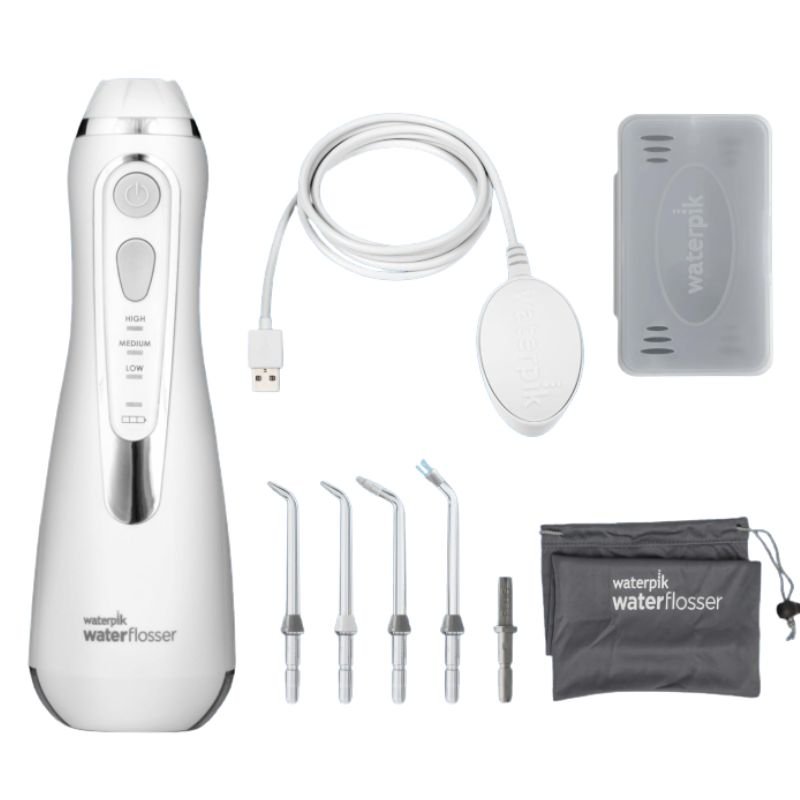
Price: $69.99 | Type: Cordless | Reservoir: 207ml | Settings: 3 | ADA Accepted: Yes | Orthodontic Tip: Yes (included) | Warranty: 2 years
The Cordless Advanced is the most recommended water flosser for braces — by orthodontists, by review sites, and by the orthodontic patient community. The reason is straightforward: it was designed with this use case in mind.
The included Orthodontic Tip has a tapered brush end that navigates around brackets and under wires without snagging. The Plaque Seeker tip complements it by targeting the bracket-to-tooth junction from the side with thin bristles. Together, they cover the two main angles needed for thorough bracket cleaning — direct approach and lateral approach.
The cordless form factor matters for braces patients specifically. Teenagers using this in a shared bathroom don’t need to negotiate counter space or a power outlet. The travel bag means it goes to sleepaway camp, college dorms, or orthodontic appointments without hassle. Battery life of approximately 4 weeks per charge eliminates daily charging friction.
The trade-off is the 207ml reservoir. At a medium setting, it provides roughly 45 seconds of use — enough for a standard session but tight for the more thorough cleaning braces demand. Plan on one refill per session. The three pressure settings are also less granular than the Aquarius’s 10, though the low setting is gentle enough for freshly-adjusted gums.
Strengths: Purpose-built orthodontic + plaque seeker tips; ADA accepted; compact and portable; travel bag included; 4-week battery; 2-year warranty.
Weaknesses: Small 207ml reservoir (one refill needed for braces); only 3 pressure settings; no countertop option.
Best Countertop for Braces: Waterpik Aquarius (WP-660)
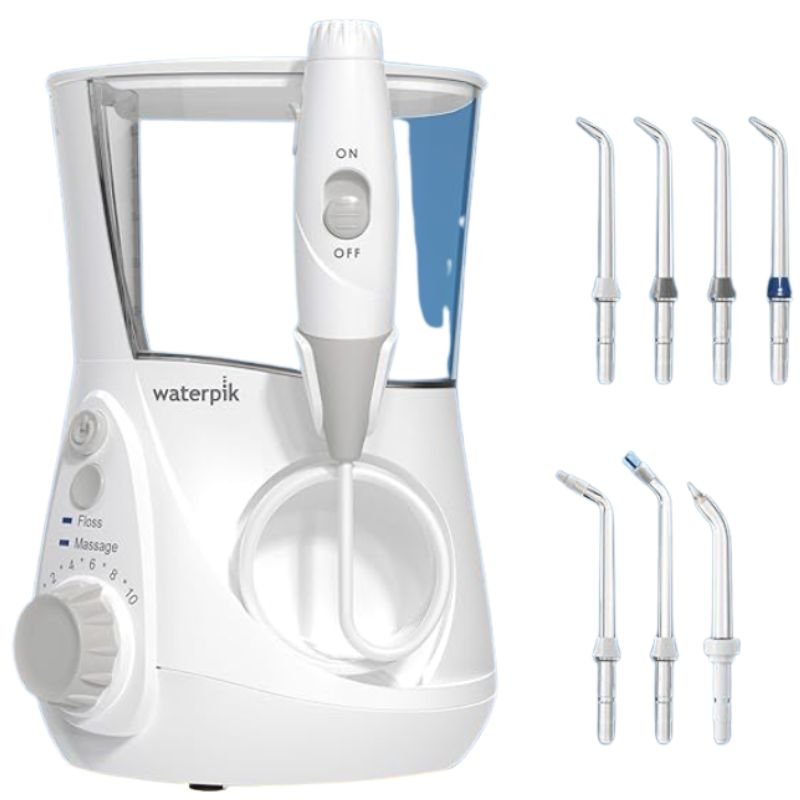
Price: $79.99 | Type: Countertop | Reservoir: 650ml | Settings: 10 (10–100 PSI) | ADA Accepted: Yes | Orthodontic Tip: Yes (included) | Warranty: 3 years
If you have counter space and a power outlet, the Aquarius is the more thorough option for braces cleaning. The 650ml reservoir provides roughly 90 seconds of continuous use — enough for a full braces session without refilling. That uninterrupted session makes a practical difference: refilling mid-clean breaks your rhythm and adds friction that reduces compliance over time.
The 10 pressure settings offer significantly more control than the Cordless Advanced’s 3. After an orthodontic adjustment — when gums are sore and brackets are freshly tightened — dropping to setting 1 or 2 makes the experience comfortable rather than painful. By the end of the month, you can work up to setting 5 or 6 for more effective plaque removal. This adjustability matters across the 18–24 month duration of typical orthodontic treatment.
The Aquarius includes the same Orthodontic Tip as the Cordless Advanced, plus a Plaque Seeker and Pik Pocket tip — giving you three specialised approaches for bracket cleaning. The 7-tip total also makes this a strong family option if multiple household members share the unit (each person uses their own colour-coded tip).
The downsides are the same as any countertop model: it needs dedicated counter space, a power outlet, and it’s louder than cordless alternatives. Not portable, not shower-friendly.
Strengths: 650ml reservoir (no refills needed); 10 pressure settings for fine-tuned comfort; orthodontic + plaque seeker + Pik Pocket tips; ADA accepted; 3-year warranty; ideal for families.
Weaknesses: Countertop only (not portable); requires outlet; loud; takes up counter space.
Best Premium for Braces: Waterpik ION Professional (WF-12)
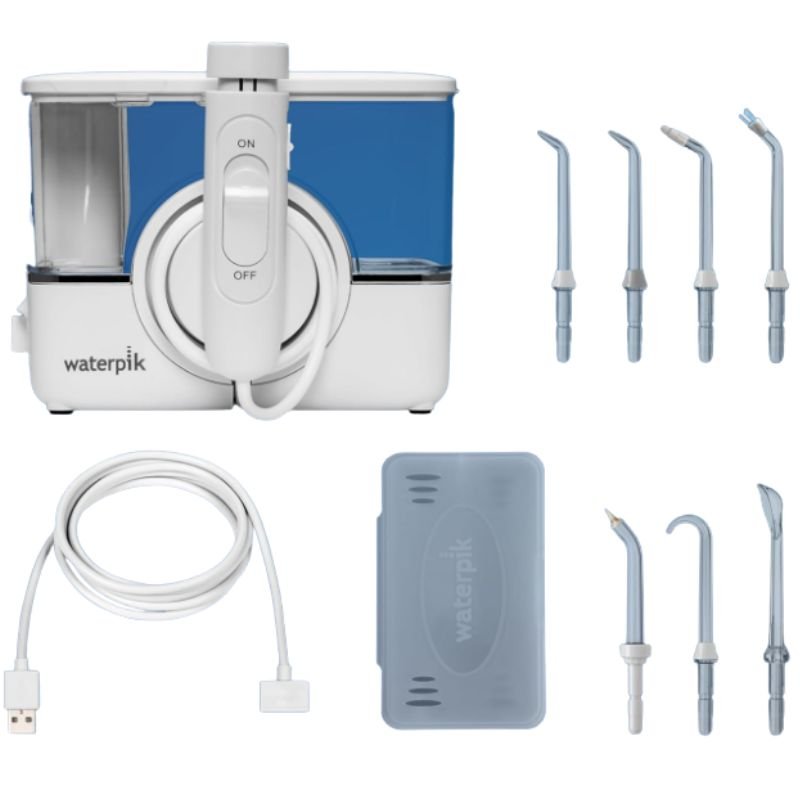
Price: $99.99 | Type: Hybrid | Reservoir: 650ml | Settings: 10 | ADA Accepted: Yes | Orthodontic Tip: Yes (included) | Warranty: 3 years
The ION gives you everything the Aquarius offers — 650ml reservoir, 10 pressure settings, 7 tips including orthodontic — with cordless convenience. The wand lifts off the countertop base for cable-free use, which matters in the smaller bathrooms where teenagers typically operate.
For braces patients specifically, the ION’s 90+ second reservoir life combined with the cordless wand means you get the cleaning thoroughness of a countertop model with the manoeuvrability to reach every bracket from every angle. The 4-week rechargeable battery adds to the convenience.
The $99.99 price is the main barrier. For a teenager’s braces — a temporary condition lasting 18–24 months — the $69.99 Cordless Advanced handles the job effectively at a lower investment. The ION makes more sense if you plan to continue using it after braces come off, or if the household shares the unit.
Strengths: Hybrid cordless + countertop; 650ml reservoir; 10 settings; 7 tips; ADA accepted; 3-year warranty; long-term value beyond braces.
Weaknesses: Most expensive option; louder than fully cordless models; still needs counter space for the base.
Best Budget for Braces: Bitvae C6
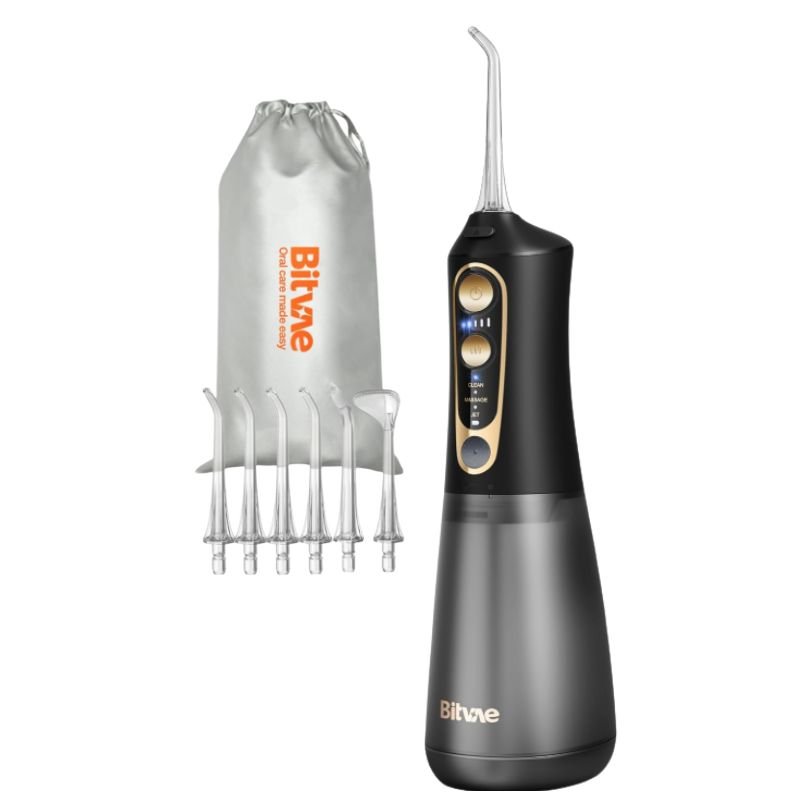
Price: $15.98 | Type: Cordless | Reservoir: 300ml | Settings: 3 modes × 5 levels | ADA Accepted: No | Orthodontic Tip: Yes (included) | Warranty: 1 year
At $15.98, the Bitvae C6 removes the cost objection entirely. It includes an orthodontic tip, which is the essential requirement for braces cleaning, and the Soft mode at its lowest intensity delivers a gentle enough stream for post-adjustment sensitivity.
The 300ml reservoir is actually larger than the Waterpik Cordless Advanced (207ml), providing roughly 50–75 seconds of use depending on the mode — close to enough for a full braces session. The 15 mode/intensity combinations (3 modes × 5 levels) offer more granularity than the WP-580’s 3 settings, which is an unexpected advantage at this price point.
The 40-day battery life and USB-C charging are practical wins for a teenager who won’t remember to charge their water flosser regularly. Charging from a laptop, phone charger, or portable battery means it works wherever they are.
The trade-offs are what you’d expect at this price: no ADA seal, less proven long-term reliability than Waterpik, a 1-year warranty, and build quality that feels functional rather than premium. The orthodontic tip design is also simpler than Waterpik’s — it lacks the specialised bristle arrangement of the Waterpik Orthodontic Tip. But for a student, a budget-conscious family, or anyone testing whether water flossing will become a habit before investing more, the Bitvae C6 is a legitimate option.
Strengths: $15.98 price; orthodontic tip included; 300ml reservoir; 15 mode/intensity combinations; 40-day battery; USB-C charging.
Weaknesses: No ADA seal; simpler orthodontic tip design; 1-year warranty; less proven brand reliability; build quality is functional, not premium.
How to Water Floss With Braces: Technique Guide
The technique for braces differs from standard water flossing. Brackets and wires create additional surfaces that need deliberate attention.
Start on the lowest pressure setting
This matters even more with braces than without. Brackets can trap water pressure between the wire and gum tissue, amplifying the force. Begin at setting 1 (or the lowest available) and increase gradually over 1–2 weeks. Most braces patients settle at a mid-range setting — 3–5 on a 10-setting model.
Use the orthodontic tip
Switch from the standard jet tip to the orthodontic tip for your entire session. The tapered bristle end is designed to brush around bracket bases while the water stream flushes behind them. A standard tip works for the gum line between brackets, but it misses the bracket-to-tooth junction where decalcification is most likely to occur.
Clean each bracket from multiple angles
Don’t just sweep along the gum line as you would without braces. At each bracket, approach from three directions: above the bracket (between bracket and gum), below the bracket (between bracket and biting edge), and from the side (along the archwire). Spend 3–5 seconds per bracket rather than the 2–3 seconds per gap in standard water flossing.
Don’t forget the inner surfaces
Lingual brackets (braces on the inner surface of teeth) and lingual wires require the same attention. Even with traditional labial braces, the inner gum line still needs cleaning — plaque doesn’t limit itself to the side with brackets.
Budget extra time
A standard water flossing session takes 60–90 seconds. With braces, plan for 2–3 minutes. Each bracket adds a cleaning zone, and thoroughness matters more than speed when orthodontic hardware is trapping debris against your tooth surfaces.
For the complete water flossing technique (beyond braces-specific guidance), see: How to Use a Water Flosser Correctly.
Mistakes to Avoid When Water Flossing With Braces
Using too high a pressure after an adjustment. Gums are most sensitive in the days following an orthodontic adjustment. What felt comfortable at setting 5 last week may cause pain and bleeding at the same setting after wires are tightened. Drop back to setting 1–2 after every adjustment and work your way up again.
Only cleaning the front of the brackets. The most plaque accumulates behind and underneath brackets — the areas you can’t see. Direct the water stream at angles that flush behind the bracket base, not just at the visible front surface.
Skipping the gum line. Brackets naturally draw your attention, but the gum line between brackets still needs the same attention it would get without braces. Gingivitis during orthodontic treatment is common and largely preventable with thorough gum line cleaning.
Replacing brushing with water flossing. A water flosser is an interdental tool — it cleans between and behind teeth and brackets. Your toothbrush still handles the front and biting surfaces. Use both, every session. The recommended order: water floss first, then brush. For the research behind this sequence, see: Water Flosser vs String Floss.
Using a water flosser without an orthodontic tip for the entire treatment. A standard jet tip is fine for the gum line, but it won’t effectively clean the bracket-to-tooth junction. Use the orthodontic tip for at least part of each session — ideally the entire session during the first year of treatment when plaque management is most critical.
Frequently Asked Questions
Do orthodontists recommend water flossers?
Yes. Most orthodontists now recommend water flossers for patients with braces, particularly those who struggle with string floss compliance. A 2005 study found water flossers with an orthodontic tip removed three times more plaque around brackets than string floss. Many orthodontic practices include water flossers in their treatment starter packs. See: Do Dentists Recommend Water Flossers?
Can a water flosser damage braces?
No — when used correctly. The water pressure from a water flosser is not strong enough to dislodge brackets or bend wires. Even at the highest settings, the hydraulic force is within safe limits for orthodontic hardware. If a bracket comes loose after using a water flosser, the adhesive was likely already failing. Start on the lowest setting for comfort, not because of any risk to the braces themselves.
Is a Waterpik better than other brands for braces?
Waterpik has the strongest evidence base for orthodontic use — they’re the only brand with published clinical studies demonstrating plaque removal around brackets. Their Orthodontic Tip is also more purpose-built than competitors’ versions, with a specialised bristle arrangement. That said, any water flosser with an orthodontic-style tip on a low pressure setting will be significantly better than no interdental cleaning at all. The Bitvae C6 at $15.98 is a legitimate alternative if budget is the primary constraint.
Should I still string floss with braces if I use a water flosser?
Your orthodontist can give the most personalised answer, but for most braces patients, a water flosser with an orthodontic tip provides effective interdental cleaning on its own. Adding string floss with a threader provides additional mechanical plaque removal at tight contact points — but the compliance rate for this combination is low. A water flosser used daily is more effective than a water flosser plus string floss used inconsistently.
What pressure setting should I use with braces?
Start at the lowest setting (setting 1 on a Waterpik, Soft mode on a Bitvae). Increase gradually over 1–2 weeks. Most braces patients settle between settings 3 and 5 on a 10-setting model. Drop back to the lowest setting for 2–3 days after every orthodontic adjustment, then work your way back up.
How often should I water floss with braces?
Once daily at minimum — ideally before brushing in the evening. Some orthodontists recommend twice daily (morning and evening) during active treatment, particularly if plaque buildup is a concern at your appointments. Consistency matters more than frequency: daily use produces better outcomes than aggressive twice-daily sessions done sporadically.
Can kids use a water flosser with braces?
Yes. Children aged 6 and older can use a water flosser safely under supervision. For younger children, use the lowest pressure setting and supervise the first several sessions to ensure proper technique. The Bitvae C6’s Soft mode at its lowest intensity is gentle enough for children, and the $15.98 price point makes it a low-risk investment. Waterpik also rates their products for ages 6 and up.
The Bottom Line
The Waterpik Cordless Advanced WP-580 ($69.99) is the best water flosser for most braces patients. It has the orthodontic tip that matters, ADA acceptance that orthodontists trust, and portability that teenagers need. The Aquarius ($79.99) is the better choice if counter space is available and you want the longest uninterrupted session time. The ION ($99.99) makes sense if you plan to use it well beyond braces removal.
If cost is the deciding factor, the Bitvae C6 ($15.98) includes an orthodontic tip and delivers enough performance that the barrier to daily compliance drops to nearly zero. A $15.98 water flosser used every day will keep braces cleaner than a $100 model used sporadically.
For a broader comparison of all water flosser types — not just those suited for braces — see our complete guide to the best water flossers of 2026.
Related Guides
References