Tag: gum health tools

  • Waterpik vs Philips Sonicare Water Flosser: Which Is Better?

    Waterpik vs Philips Sonicare Water Flosser: Which Is Better?

    Editorial transparency: VerdictLab earns a commission when you purchase through our links — this never influences our ratings or recommendations. Our editorial picks are based on specifications, clinical evidence, expert opinions, and real user feedback. As an Amazon Associate I earn from qualifying purchases. Full disclosure.

    Last updated: March 2026  |  By: VerdictLab Editorial Team

    Waterpik and Philips Sonicare are the two most trusted names in water flossers — both carry the ADA Seal of Acceptance, both are recommended by dental professionals, and both produce genuinely effective products. So which one should you buy?

    The short answer: they’re built for different priorities. Waterpik delivers more pressure, more tips, and bigger reservoirs. Philips Sonicare delivers quieter operation, a gentler experience, and a more innovative nozzle design. Neither is categorically better. The right choice depends on what matters most to you.

    In real-world use, most users notice the biggest difference not in cleaning performance — but in noise level and ease of daily use.

    Here’s the detailed comparison.

    The Verdict in 30 Seconds

    • Choose Waterpik if you want: maximum pressure range, specialty tips (orthodontic, periodontal, implant), larger reservoirs, or a countertop option
    • Choose Philips Sonicare if you want: the quietest operation, the gentlest low setting, a more compact cordless design, or innovative Quad Stream technology
    • Both carry the ADA Seal of Acceptance
    • Both are clinically effective at reducing plaque and improving gum health
    • Waterpik offers more models across more price points; Sonicare focuses on a smaller, more refined cordless lineup


    Head-to-Head Comparison Table

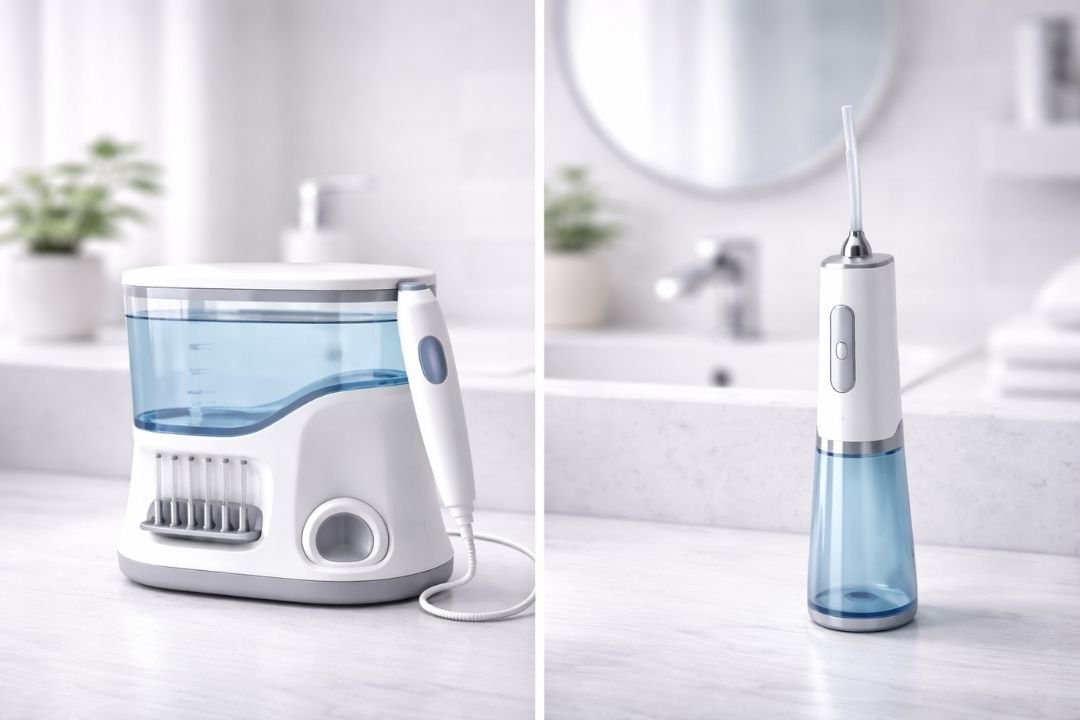
    We’re comparing the flagship models from each brand that most people choose between: the Waterpik Aquarius WP-660 (best-selling countertop), the Waterpik ION WF-12 (hybrid), and the Philips Sonicare Power Flosser 3000 (cordless).

    Feature Waterpik Aquarius (WP-660) Waterpik ION (WF-12) Philips Sonicare 3000
    Price $79.99 $99.99 $79.96
    Type Countertop (corded) Hybrid (cordless wand) Cordless
    Pressure Settings 10 (10–100 PSI) 10 2 modes × 3 levels
    Reservoir 650ml 650ml 250ml (8 oz)
    Included Tips 7 7 2
    Specialty Tips Orthodontic, Pik Pocket, Plaque Seeker, Toothbrush Orthodontic, Pik Pocket, Plaque Seeker, Implant Denture, Tongue Cleaner Quad Stream only
    Noise Level Loud Loud Very quiet
    Battery Corded (N/A) ~4 weeks ~2 weeks
    ADA Seal
    Warranty 3 years 3 years 2 years

    Specifications from manufacturer data. Prices from Amazon at time of publication.


    Pressure and Cleaning Power

    Winner: Waterpik

    The Waterpik Aquarius and ION both deliver 10–100 PSI across 10 numbered settings. That’s the widest range available in any consumer water flosser. Setting 1 is gentle enough for post-surgical tissue. Setting 10 delivers aggressive plaque removal for deep pockets and stubborn debris.

    The Philips Sonicare 3000 offers 2 modes (Clean and Deep Clean) with 3 intensity levels each — 6 effective combinations. Philips doesn’t publish PSI ratings, which makes direct comparison harder. What users consistently report is that the Sonicare’s maximum output feels noticeably less powerful than a Waterpik at settings 7–10. For most daily cleaning, this doesn’t matter. For people who want maximum flushing force — particularly those with deep periodontal pockets or extensive dental work — the Waterpik delivers more.

    The flip side: the Sonicare’s lower maximum pressure is partly by design. The Quad Stream technology disperses force across a wider area, so the cleaning effect is broader even if the concentrated pressure is lower. Different physics, not inferior physics.


    Noise

    Winner: Philips Sonicare (by a wide margin)

    This is the Sonicare’s defining advantage. Independent noise comparisons and thousands of user reviews converge on the same conclusion: the Sonicare 3000 is dramatically quieter than any Waterpik model. Users describe it as “whisper quiet” and “barely audible” — descriptions that have never been applied to a Waterpik product.

    The Waterpik Aquarius at mid-to-high settings reaches 65–70+ dB. That’s louder than a normal conversation (60 dB) and approaching a vacuum cleaner (75 dB). The ION is similarly loud. Early-morning use in a shared household announces itself through walls.

    If noise is anywhere in your top three concerns — apartment living, early-morning routine, shared bathrooms, sleeping children — the Sonicare wins this category decisively. No amount of design refinement on the Waterpik side has closed this gap.


    Reservoir and Session Length

    Winner: Waterpik

    The Waterpik Aquarius and ION both hold 650ml — roughly 90+ seconds of continuous use at a mid-range setting. That’s enough for a thorough full-mouth session, a braces cleaning routine, or two users back-to-back without refilling.

    The Sonicare 3000 holds 250ml (8 oz), providing roughly 60 seconds of use. Philips describes this as “enough water for a 1-minute clean without refilling.” For a standard daily session, that’s adequate. For braces cleaning, implant care, gum disease management, or any situation requiring extra time, you’ll refill once.

    The Waterpik’s reservoir advantage grows with use complexity. If you’re a healthy adult doing a quick daily pass, the Sonicare’s 250ml is fine. If you have orthodontic brackets, three implants, and a bridge, the Waterpik’s 650ml means an uninterrupted session.


    Tips and Nozzles

    Winner: Waterpik (and it’s not close)

    Waterpik’s tip ecosystem is the deepest in the water flosser market. The Aquarius ships with 7 tips. The ION ships with 7 tips. These include specialty tips that no other brand offers: the Pik Pocket for periodontal pockets, the Plaque Seeker for crowns and implants, the Orthodontic Tip for braces, the Implant Denture Tip (ION only) for cleaning under bridges and dentures, and a Tongue Cleaner. Replacement tips cost ~$8–12 per pack.

    The Sonicare 3000 ships with 2 tips: the F1 Standard nozzle and the F3 Quad Stream nozzle. The Quad Stream is innovative and exclusive to Philips — no competitor offers anything similar. But that’s the entire lineup. No orthodontic tip, no periodontal pocket tip, no implant tip. Replacement tips cost ~$15 per two-pack — roughly double Waterpik’s per-tip cost.

    If you have any specific dental condition — braces, implants, gum disease, bridges — Waterpik’s specialty tips are a meaningful clinical advantage. If you have healthy teeth and gums and just need standard interdental cleaning, the Sonicare’s 2 tips cover that adequately. For a deeper guide, see: Best Water Flosser Tips and Nozzles.


    Technology: Single Jet vs Quad Stream

    Winner: Depends on your preference

    Waterpik uses traditional single-jet pulsation — one focused stream of water delivered in rapid pulses (1,200–1,400 per minute). This produces a concentrated, powerful cleaning action at a specific point. You aim it, it cleans that spot intensely, you move to the next spot.

    Philips Sonicare’s Quad Stream X-shaped nozzle splits the water into four simultaneous streams that cover a wider area. The cleaning action is more diffused — less intense at any single point but reaching more surface area with each pass. The result feels different: less like a pressure washer, more like a wide rinse.

    Neither technology is clinically proven to be superior to the other for plaque removal. Both carry ADA acceptance. The practical difference is user preference: some people prefer the focused intensity of a single jet and the control it provides. Others prefer the broader coverage and gentler feel of the Quad Stream. If you’ve never used either, it’s worth knowing that these are meaningfully different experiences — the Sonicare doesn’t just feel like a quieter Waterpik.


    Battery Life

    Winner: Waterpik ION

    The Waterpik ION’s rechargeable battery lasts approximately 4 weeks per charge. The Sonicare 3000 lasts approximately 2 weeks. Both charge via USB cables (ION uses USB-A magnetic; Sonicare uses a proprietary small-plug cable).

    The Waterpik Aquarius plugs directly into a wall outlet — no battery to manage, no degradation over time, no dead-flosser surprises. If battery management irritates you, the Aquarius eliminates it entirely (at the cost of portability).

    Two weeks (Sonicare) is adequate for daily use but requires more frequent charging awareness. Four weeks (ION) is closer to “set and forget” territory. Neither requires daily charging.


    Build Quality and Design

    Winner: Philips Sonicare

    The Sonicare 3000 is a noticeably more refined product in hand. The materials feel premium, the controls are intuitive, and the overall aesthetic is clean and modern. It looks like it belongs next to a Sonicare electric toothbrush — because it was designed to.

    Waterpik products are functional. The Aquarius is a white plastic appliance that does its job without any visual ambition. The tip storage lid feels fragile after months of use. The ION is better — the magnetic cradle and slimmer wand add some polish — but it still reads as a medical device rather than a consumer electronics product.

    If your water flosser sits on an open shelf and you care about bathroom aesthetics, the Sonicare wins. If it lives in a drawer between uses and you care about performance per dollar, this category doesn’t matter.


    Warranty and Support

    Winner: Waterpik

    Waterpik offers a 3-year limited warranty on the Aquarius and ION. Philips offers a 2-year limited warranty on the Sonicare 3000. Both are manufacturer warranties covering defects in materials and workmanship.

    Waterpik’s US-based customer support (Colorado headquarters) is consistently praised in Amazon reviews for responsiveness. Philips operates larger global support infrastructure but individual interactions are less frequently highlighted as exceptional. Both honour warranty claims reasonably.

    The extra year matters for a device you use 365 times per year. Pump motors, seals, and batteries degrade with daily use — a failure at month 30 is covered by Waterpik, not by Philips.


    Price and Value

    The pricing is surprisingly close at the flagship level:

    • Waterpik Aquarius WP-660: $79.99 — 7 tips, countertop, 3-year warranty
    • Philips Sonicare 3000: $79.96 — 2 tips, cordless, 2-year warranty
    • Waterpik ION WF-12: $99.99 — 7 tips, hybrid, 3-year warranty

    Dollar for dollar, the Waterpik Aquarius delivers more: more tips (7 vs 2), a longer warranty (3 years vs 2), a larger reservoir (650ml vs 250ml), and wider pressure range (10 settings vs 6 combinations). The Sonicare’s premium goes toward quieter engineering, better design, and Quad Stream technology.

    Ongoing costs differ too. Waterpik replacement tips run ~$4–6 per tip. Sonicare replacement tips run ~$7.50 per tip. Over 2–3 years of quarterly tip replacement, the Sonicare’s higher per-tip cost adds up — roughly $15–20 more per year in consumables.

    The value proposition is clear: Waterpik gives you more stuff for the money. Sonicare gives you a more refined experience. Which you value more is personal.


    Who Should Buy Which

    Buy a Waterpik if you:

    • Have braces, implants, bridges, or other dental work (the specialty tips matter)
    • Have gum disease and need a Pik Pocket tip for subgingival cleaning
    • Want the widest pressure range for flexibility as your dental needs change
    • Share the unit with family members (7 tips, large reservoir)
    • Prefer a countertop model with consistent corded power
    • Want the longest warranty (3 years)
    • Prioritise value and tip variety over design

    Best Waterpik options: Waterpik Aquarius WP-660 ($79.99) for countertop, Waterpik ION WF-12 ($99.99) for hybrid cordless.

    Buy a Philips Sonicare if you:

    • Need the quietest possible operation (apartment, shared bathroom, early mornings)
    • Have sensitive gums and want the gentlest available low setting
    • Want a compact cordless design that stores easily and looks clean on a shelf
    • Have healthy teeth and gums with no specialty tip requirements
    • Already use Philips Sonicare toothbrushes and want a matching aesthetic
    • Prefer the wider, gentler Quad Stream cleaning sensation over a focused jet
    • Value design refinement and quiet engineering over raw specs

    Best Sonicare option: Philips Sonicare Power Flosser 3000 ($79.96)

    Still undecided?

    Ask yourself one question: “Is noise a dealbreaker?” If yes, buy the Sonicare. If no, buy the Waterpik that matches your format preference (Aquarius for countertop, ION for hybrid). That single question resolves the decision for most people.


    Frequently Asked Questions

    Is Waterpik or Sonicare better for plaque removal?

    Both are ADA-accepted for plaque removal effectiveness. Most published clinical research has used Waterpik products, giving them a slightly stronger evidence base. The Sonicare’s Quad Stream technology covers more area per pass but with less concentrated force. For practical daily plaque removal with healthy gums, both perform well. For aggressive subgingival plaque removal in deep pockets, Waterpik’s higher maximum pressure and Pik Pocket tip give it an edge. See: Do Water Flossers Actually Remove Plaque?

    Is Philips Sonicare really that much quieter?

    Yes. The difference is not subtle. Users who switch from Waterpik to Sonicare consistently describe the noise reduction as “dramatic” or “night and day.” If you’ve used a Waterpik and found the noise annoying, the Sonicare will feel like a different category of product. This is the single largest experiential difference between the two brands.

    Can I use Waterpik tips on a Philips Sonicare?

    No. The tip connection systems are proprietary and incompatible. Waterpik tips only fit Waterpik flossers. Sonicare nozzles only fit Sonicare flossers. This is worth considering before committing to an ecosystem — Waterpik’s wider tip range gives you more long-term flexibility.

    Which is better for braces?

    Waterpik. It includes an Orthodontic Tip specifically designed for cleaning around brackets, and clinical research shows it removes three times more plaque around brackets than string floss. The Sonicare does not include an orthodontic tip. For detailed braces recommendations, see: Best Water Flosser for Braces.

    Which is better for sensitive gums?

    Philips Sonicare. Its lowest intensity setting is genuinely softer than Waterpik’s setting 1, and the Quad Stream nozzle disperses force across a wider area, reducing the concentrated pressure on any one point. If your gums bleed easily and you want the gentlest possible introduction to water flossing, the Sonicare is the safer starting point. For gum disease specifically, see: Best Water Flosser for Gum Disease.

    Which lasts longer?

    The Waterpik Aquarius has the longevity advantage: it plugs into the wall (no battery to degrade), carries a 3-year warranty, and has a multi-decade track record of reliable long-term performance across 75,000+ Amazon reviews. The Sonicare is a newer product line with a 2-year warranty and a rechargeable battery that will eventually degrade (typically noticeable after 2–3 years of daily use). The Waterpik ION’s battery will also degrade, but its 3-year warranty provides more coverage.

    Are Waterpik and Sonicare the only good brands?

    No. The Bitvae C6 ($15.98) delivers strong performance at a fraction of the price and is worth considering if budget is a factor. It lacks the ADA seal and the specialty tips of Waterpik, but for basic daily interdental cleaning, it competes well. See our full guide for the complete comparison.


    Beyond Brushing Oral Health Guide Book
    Get the Free Oral Health Guide
    Get Beyond Brushing — a practical 30,000+ word guide to healthier teeth, gums, and fresher breath after 45.
    Marketing email consent
    • No spam • Unsubscribe anytime


    The Bottom Line

    Waterpik wins on specs: more pressure, more tips, bigger reservoir, longer warranty, wider clinical evidence base. If you have dental work, gum disease, or want maximum flexibility, Waterpik is the stronger choice. The Aquarius ($79.99) is the best value countertop. The ION ($99.99) adds cordless convenience.

    Philips Sonicare wins on experience: quieter, gentler, better-designed, more compact. If noise matters, gums are sensitive, or aesthetics influence whether you’ll use it daily, the Sonicare 3000 ($79.96) is the better choice.

    Both carry the ADA Seal. Both remove plaque effectively. Both are recommended by dental professionals. The deciding question remains: is noise a dealbreaker? If yes, Sonicare. If no, Waterpik.

    For the full comparison including budget options, see our complete guide to the best water flossers of 2026.


    References

    ADA (MOST IMPORTANT)
    https://www.ada.org/resources/research/science-and-research-institute/ada-seal-of-acceptance

    2. Water Flosser Clinical Evidence
    https://www.ncbi.nlm.nih.gov/pmc/articles/PMC3702002/

    3. Interdental Cleaning Importance (NIH)
    https://www.ncbi.nlm.nih.gov/books/NBK507808/

    4. Harvard Health
    https://www.health.harvard.edu/diseases-and-conditions/bad-breath-halitosis

    5. AADSM https://www.aadsm.org/oral-health-and-overall-health.aspx
  • Best Cordless Water Flosser (2026)

    Best Cordless Water Flosser (2026)

    Editorial transparency: VerdictLab earns a commission when you purchase through our links — this never influences our ratings or recommendations. Our editorial picks are based on specifications, clinical evidence, expert opinions, and real user feedback. As an Amazon Associate I earn from qualifying purchases. Full disclosure.

    Last updated: March 2026  |  By: VerdictLab Editorial Team

    Cordless water flossers solve the two biggest objections to countertop models: they don’t need a power outlet and they don’t colonise your bathroom counter. The trade-off has traditionally been weaker pressure and smaller reservoirs — but the current generation of cordless models has narrowed that gap considerably.

    We compared five cordless and hybrid models across the metrics that matter most for portable use: battery life, reservoir capacity, noise, pressure range, and whether they’ll survive being tossed in a travel bag. Here are the five worth considering.

    For a comparison that includes countertop models, see our complete guide to the best water flossers of 2026. If you specifically want a countertop unit, see our best countertop water flosser guide.

    Quick Summary

    • Best cordless overall: Philips Sonicare Power Flosser 3000 ($79.96) — quietest, Quad Stream technology, ADA accepted
    • Best hybrid (cordless + countertop): Waterpik ION WF-12 ($99.99) — 650ml reservoir with cordless wand, 10 settings
    • Best for travel and braces: Waterpik Cordless Advanced WP-580 ($69.99) — compact, ADA accepted, travel bag included
    • Best budget cordless: Bitvae C6 ($15.98) — 40-day battery, 300ml tank, 15 mode/intensity combinations
    • Best battery life: Burst Water Flosser ($69.99) — 80-day battery, attractive design, lifetime warranty with subscription


    Cordless vs Countertop: The Real Trade-offs

    The decision between cordless and countertop isn’t about which is “better” — it’s about which constraints you’re willing to accept.

    Cordless advantages: No power outlet needed, no cord clutter, compact storage, portable for travel, many models are shower-safe, and they don’t claim permanent counter space. Most people who abandon water flossing cite inconvenience — and cordless models reduce that friction significantly.

    Cordless disadvantages: Smaller reservoirs (110–300ml vs 650–800ml for countertop), which means shorter sessions and potential mid-session refills. Generally fewer pressure settings. Battery management — although modern lithium-ion batteries last 2–12 weeks, they do eventually need charging. And slightly lower maximum pressure output than the best countertop models.

    The honest assessment: for most people, a cordless water flosser is the better starting choice. The convenience advantage drives higher daily compliance, and compliance is the single largest determinant of whether water flossing improves your oral health. A cordless model used every day outperforms a countertop model used three times a week because the countertop one is inconvenient to set up.

    The exception is families sharing a single unit, people who need extended session time (braces, extensive dental work), and anyone who values maximum pressure above all else. For those users, see our countertop water flosser guide.


    What Matters Most in a Cordless Water Flosser

    Battery life

    The range among current cordless models is enormous: from roughly 1 week (older models) to 80 days (Burst). For daily use, anything under 2 weeks creates charging anxiety. Anything over 4 weeks means you effectively forget the charger exists until the indicator light reminds you. The Bitvae C6 at 40 days and Burst at 80 days lead the field. The Philips Sonicare at 2 weeks is the shortest in this roundup, though still adequate for most routines.

    Reservoir capacity

    This determines whether you can complete a full session without refilling. A standard full-mouth flossing session takes 60–90 seconds. Rough time-to-empty benchmarks by reservoir size: 110ml gives 20–30 seconds (2–3 refills needed), 200ml gives 40–50 seconds (1 refill), 250–300ml gives 50–75 seconds (usually enough in one fill). The Bitvae C6’s 300ml tank and the Philips Sonicare’s 250ml tank are the most practical for a complete session. The Burst’s 110ml requires multiple refills, which is its most common complaint.

    Noise

    Cordless models are generally quieter than countertop models — smaller pumps produce less vibration. But there’s still meaningful variation. The Philips Sonicare 3000 is consistently cited as the quietest water flosser available in any form factor. The Waterpik cordless models are moderate. If you’re using this in a shared apartment, a hotel room, or before anyone else wakes up, noise matters.

    Waterproofing

    Most current cordless models carry IPX7 waterproof ratings, meaning they can be fully submerged in up to 1 metre of water for 30 minutes. In practical terms, this means shower use is safe and cleaning under running water is fine. The Waterpik WP-580, Bitvae C6, Philips Sonicare 3000, and Burst are all IPX7 rated.

    Travel-friendliness

    Beyond being cordless, travel-friendliness involves size, weight, whether a travel case or bag is included, and charging flexibility. USB-C charging (Bitvae) means any phone charger works. Magnetic USB-A charging (Waterpik) requires the specific cable. Proprietary charging (some Philips models) means packing yet another cable.


    Cordless Water Flosser Comparison Table

    Model Price Reservoir Battery Life Settings Tips ADA Seal Best For
    Philips Sonicare 3000 $79.96 250ml ~2 weeks 2 modes / 3 levels 2 Quiet / Overall
    Waterpik ION (WF-12) $99.99 650ml ~4 weeks 10 7 Hybrid power
    Waterpik WP-580 $69.99 207ml ~4 weeks 3 4 Travel / Braces
    Bitvae C6 $15.98 300ml ~40 days 3 modes / 5 levels 6 Budget
    Burst Water Flosser $69.99 110ml ~80 days 3 1 Battery / Design

    Specifications from manufacturer data. Prices from Amazon at time of publication and may vary.


    Best Cordless Overall: Philips Sonicare Power Flosser 3000

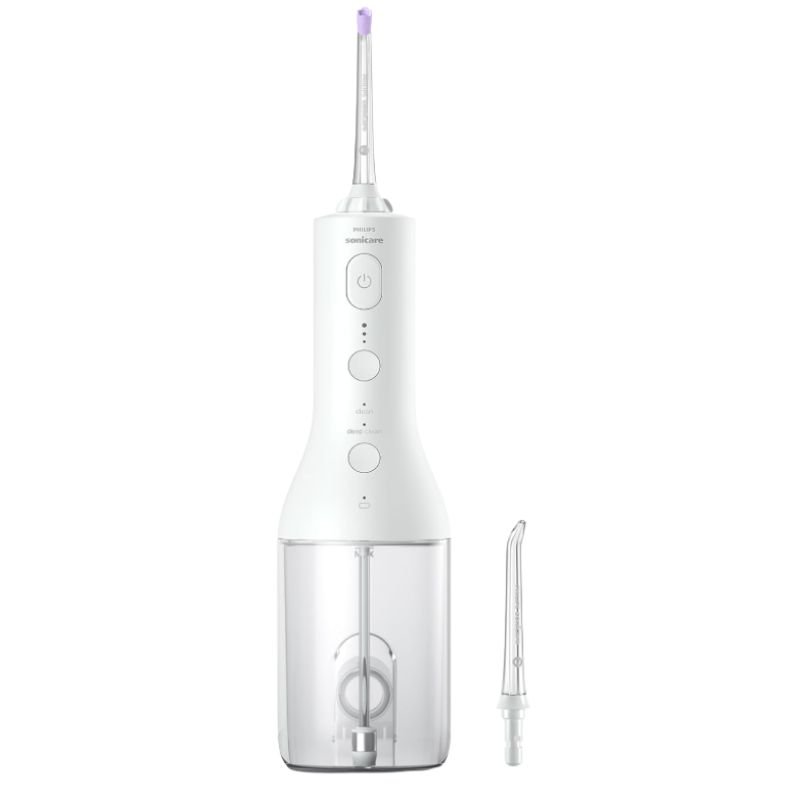
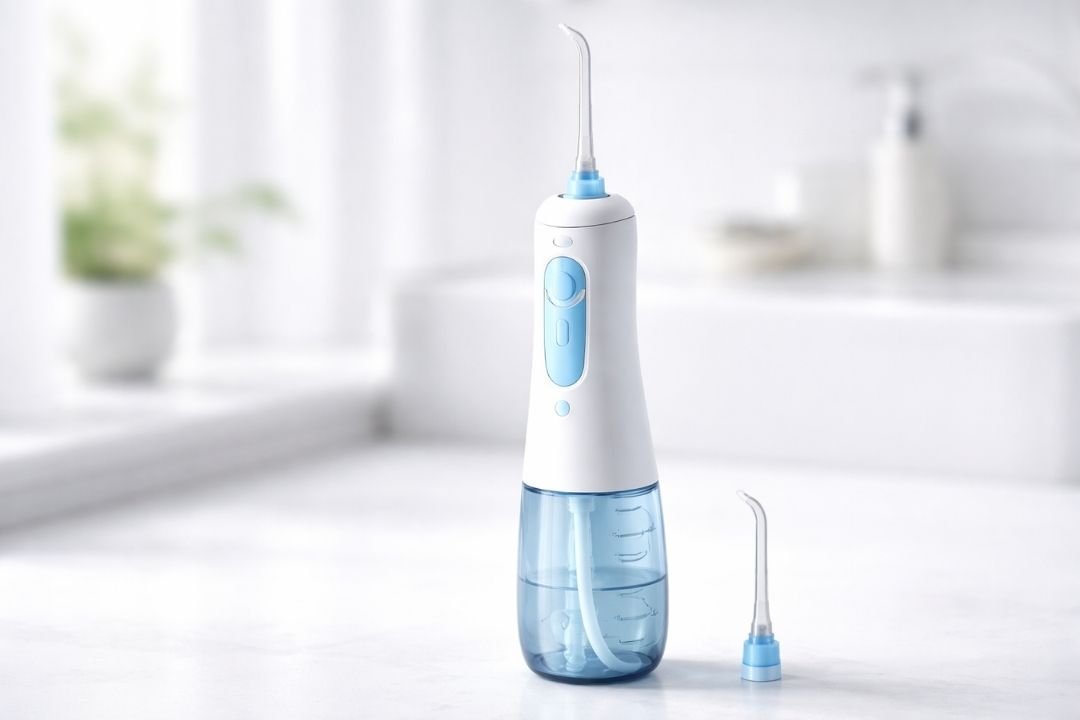
    Philips Sonicare Power Flosser 3000 cordless water flosser with Standard and Quad Stream nozzles

    Price: $79.96  |  Reservoir: 250ml (8 oz)  |  Modes: 2 (Clean, Deep Clean) × 3 intensities  |  Battery: ~2 weeks  |  ADA Accepted: Yes  |  Warranty: 2 years

    The Sonicare 3000 earns the top cordless spot for one reason no competitor can match: noise — or rather, the absence of it. Where Waterpik cordless models produce a noticeable mechanical hum, the Sonicare operates at a level users consistently describe as “whisper quiet.” If you share a bathroom, use your flosser early in the morning, or simply find the drone of a water flosser irritating, this is the model that solves that problem.

    The technology behind the quiet operation is the Quad Stream X-shaped nozzle. Instead of a single concentrated jet, it disperses water into four streams that cover a wider area with less focused force. The result is a gentler, more thorough cleaning sensation — less targeted power, more surface coverage. For general gum health, this approach works well. For aggressive plaque removal in deep pockets, a Waterpik’s focused jet at higher settings still has the edge.

    Two cleaning modes — Clean (continuous flow with 15-second pauses) and Deep Clean (pulse wave technology) — combined with three intensity levels give you six effective combinations. The 250ml reservoir holds enough water for a careful full-mouth session, though heavy users will notice the tank depleting toward the final quadrant.

    The 2-week battery life is the shortest in this roundup, which is the primary trade-off for the Sonicare’s other advantages. It charges via an included USB stand, not USB-C, so you’ll need to bring the cable when traveling.

    Included tips: 2 — F1 Standard nozzle, F3 Quad Stream nozzle. Additional tips ~$15 per two-pack.

    Strengths: Quietest cordless water flosser available; Quad Stream technology; ADA accepted; 2 modes × 3 intensities; compact and elegant design; IPX7 waterproof.

    Weaknesses: Shortest battery life in this roundup (~2 weeks); only 2 tips included; proprietary charging stand; replacement tips are pricey.

    Check Price on Amazon


    Best Hybrid: Waterpik ION Professional (WF-12)

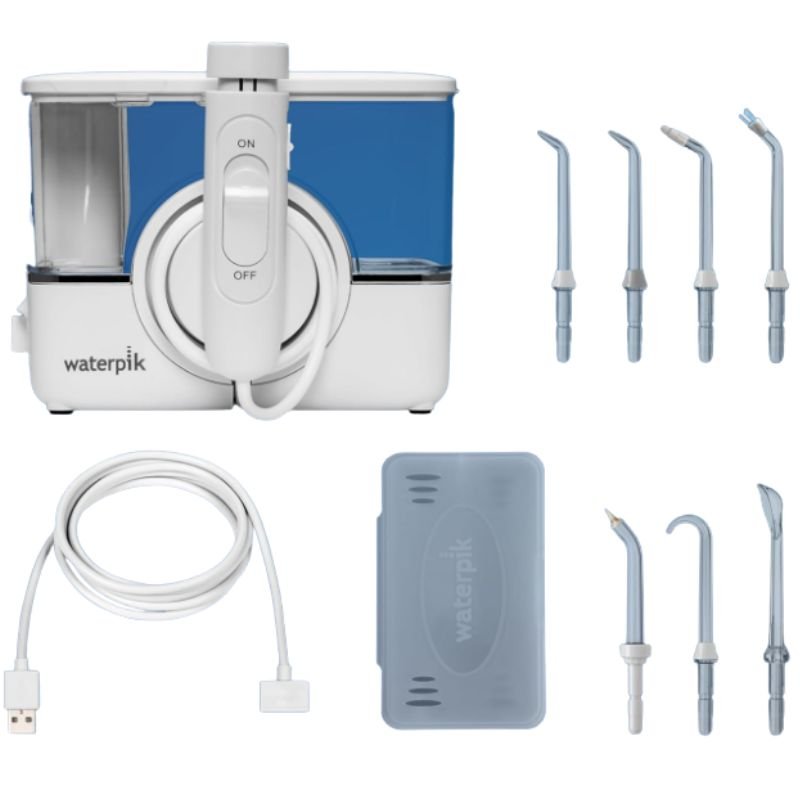
    Waterpik ION Professional WF-12 hybrid water flosser with 7 tips

    Price: $99.99  |  Reservoir: 650ml  |  Settings: 10  |  Battery: ~4 weeks  |  ADA Accepted: Yes  |  Warranty: 3 years

    The ION appears in this cordless guide because its wand is genuinely cordless — it lifts off the base for cable-free use. The reservoir stays on the counter connected by a flexible hose, which means you get the 650ml capacity and 10 pressure settings of a countertop model with the hand manoeuvrability of a cordless unit.

    If the main reason you want a cordless water flosser is hand freedom rather than portability or space saving, the ION is the best of both worlds. The 90+ seconds of reservoir life eliminates refilling. The 10 pressure settings provide the finest control in any water flosser. The 7 included tips cover every use case from general cleaning to orthodontics to implants.

    Where the ION falls short of a true cordless model: it still needs counter space for the base. It’s not portable in the way the WP-580 or Bitvae are — you won’t toss this in a travel bag. And the hose, while flexible, tethers you within a few feet of the base. If “cordless” to you means “no counter footprint and fully portable,” skip the ION and look at the three fully cordless options below.

    Included tips: 7 — Precision (x2), Plaque Seeker, Orthodontic, Pik Pocket, Implant Denture, Tongue Cleaner.

    Strengths: Cordless wand with countertop reservoir capacity (650ml); 10 pressure settings; 7 tips; ADA accepted; 3-year warranty; 4-week battery.

    Weaknesses: Not fully portable (base stays on counter); hose limits range; most expensive option; louder than purely cordless models.

    Check Price on Amazon


    Best for Travel: Waterpik Cordless Advanced (WP-580)

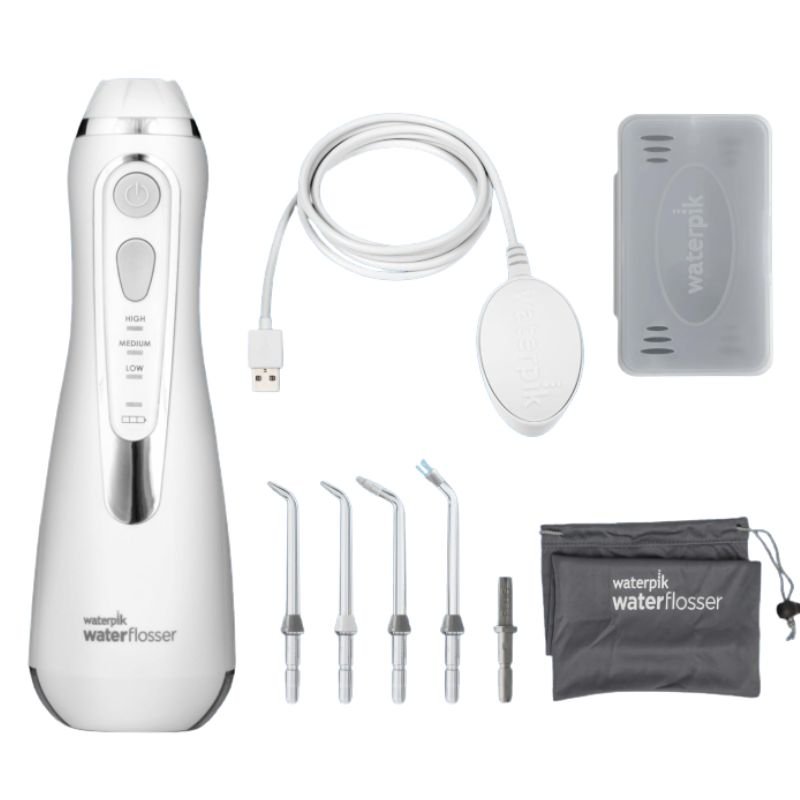
    Waterpik Cordless Advanced WP-580 with travel bag and tip storage

    Price: $69.99  |  Reservoir: 207ml (7 oz)  |  Settings: 3  |  Battery: ~4 weeks  |  ADA Accepted: Yes  |  Warranty: 2 years

    For people whose primary need is a water flosser they can take on trips, the WP-580 is purpose-built. It includes a microfiber travel bag, a tip storage case, and a compact form factor that fits into a toiletry bag without dominating it. The magnetic USB charging cable is small and travel-friendly. The unit is IPX7 waterproof, so hotel shower use is safe.

    The 4-week battery life per charge is the most travel-relevant spec. A two-week business trip or a month-long holiday doesn’t require packing a charger if you charge before departure. Global voltage compatibility means the charger works with international outlets.

    ADA acceptance and the inclusion of 4 tips (including an Orthodontic Tip and Plaque Seeker) make this the most credentialed portable option available. It’s also the go-to recommendation for braces patients — see our dedicated guide on the best water flosser for braces.

    The 207ml reservoir and 3 pressure settings are the compromises for portability. At ~45 seconds per fill on a medium setting, plan on one refill per session. The limited pressure range means less granularity than the Sonicare’s 6 combinations or the ION’s 10 settings.

    Strengths: Travel bag + tip case included; 4-week battery; ADA accepted; compact form factor; 4 tips including orthodontic; IPX7 waterproof; global voltage.

    Weaknesses: Smallest reservoir among Waterpik picks (207ml, ~45 seconds); only 3 pressure settings; magnetic charging cable is proprietary.

    Check Price on Amazon


    Best Budget Cordless: Bitvae C6

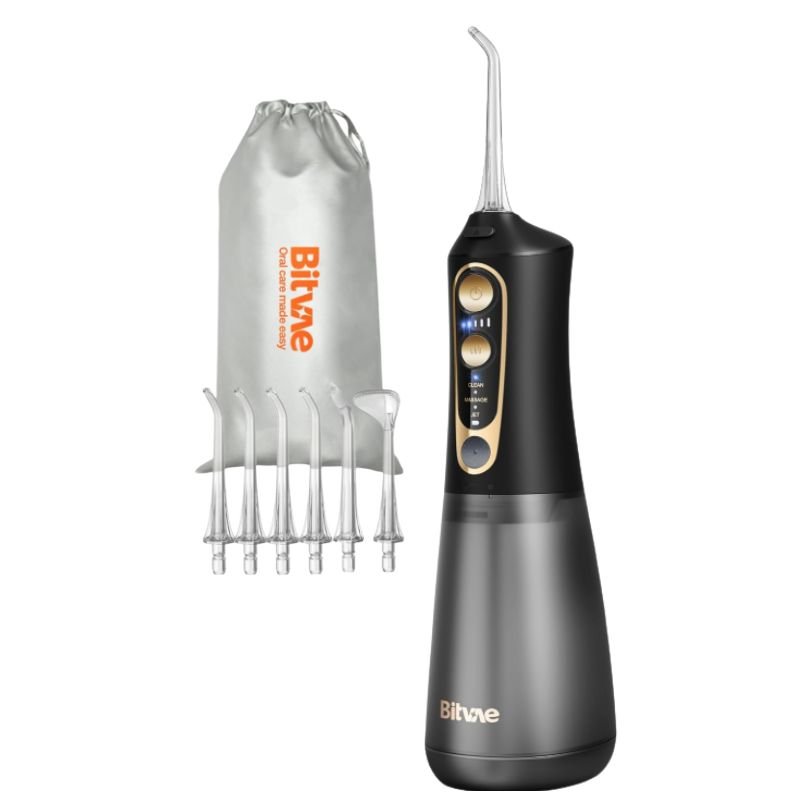
    Bitvae C6 cordless water flosser with 6 tips and travel bag

    Price: $15.98  |  Reservoir: 300ml  |  Settings: 3 modes × 5 levels  |  Battery: ~40 days  |  ADA Accepted: No  |  Warranty: 1 year

    The Bitvae C6 has no business being this capable at $15.98. Its 300ml reservoir is the largest among the fully cordless models in this roundup — 20% larger than the Philips Sonicare and 45% larger than the Waterpik WP-580. Its 40-day battery life means charging roughly nine times per year. It charges via USB-C, which is the cable you already own five of.

    The 15 mode/intensity combinations (3 modes × 5 levels) provide more granularity than either Waterpik cordless model. The Soft mode at level 1 is gentle enough for sensitive gums, while Normal mode at level 5 delivers enough pressure for effective plaque disruption. Six included tips — standard, orthodontic, periodontal, and tongue scraper — cover more use cases out of the box than the Philips Sonicare’s 2 tips.

    The trade-offs are real but proportional to the price. No ADA seal, a 1-year warranty (half of Philips, a third of Waterpik), and build quality that feels functional rather than premium. The button occasionally requires a deliberate press. The plastic doesn’t have the density of a Waterpik or the elegance of a Philips. Bitvae as a brand doesn’t have the decades of reliability data that Waterpik carries.

    For someone testing whether water flossing will become a daily habit, a student on a tight budget, or a household that wants a second cordless flosser for travel, the Bitvae C6 is the lowest-risk entry point available.

    Strengths: $15.98 price; largest cordless reservoir (300ml); 40-day battery; USB-C charging; 6 tips; 15 mode/intensity combinations; IPX7 waterproof.

    Weaknesses: No ADA seal; 1-year warranty; build quality is adequate but not premium; newer brand with limited long-term reliability data.

    Check Price on Amazon


    Best Battery Life: Burst Water Flosser

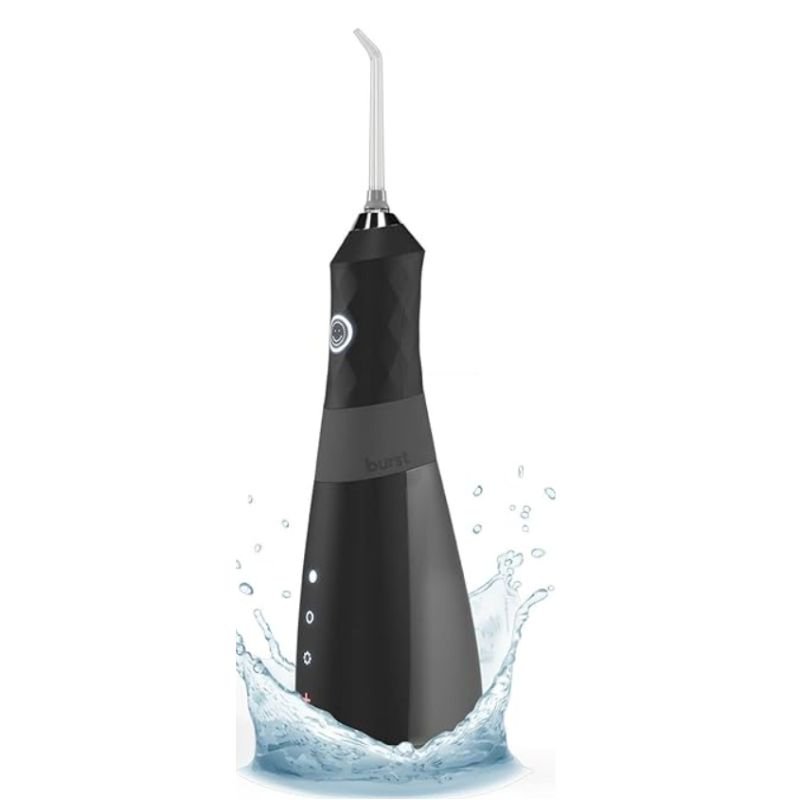
    Burst Water Flosser in black with waterproof design

    Price: $69.99  |  Reservoir: 110ml  |  Settings: 3 (Standard, Turbo, Pulse)  |  Battery: ~80 days  |  ADA Accepted: No  |  Warranty: 1 year (limited lifetime with subscription)

    The Burst makes this list for two reasons: an 80-day battery life that dwarfs every competitor, and a design that looks like it belongs in a product photography studio rather than a bathroom drawer. If charging your water flosser is the kind of minor friction that leads you to skip sessions, the Burst eliminates it almost entirely — you charge it roughly four times per year.

    The 360-degree rotating nozzle and waterproof IPX7 design are practical features. The warranty structure is unique: 1 year standard, extending to a limited lifetime if you subscribe to the tip replacement plan (~$5 every 3 months).

    The Burst earns its place in this roundup, but with a significant caveat: the 110ml reservoir. It depletes in roughly 20–30 seconds at a medium setting. That’s 2–3 refills for a full-mouth session. Amazon reviews confirm this is the number one complaint. For targeted, quick cleaning — rinsing after lunch, cleaning a specific area between dental appointments — the small reservoir is manageable. For a thorough daily routine, the refill friction is real.

    Pressure output also trails the Waterpik and Bitvae at comparable settings, according to user feedback. And at $69.99 with only 1 included tip, the per-dollar value is lower than the Bitvae C6, which offers more tips, a larger reservoir, and longer-than-average battery life at less than a quarter of the price.

    Strengths: 80-day battery (best in class); attractive matte design; 360° rotating nozzle; IPX7 waterproof; limited lifetime warranty with subscription.

    Weaknesses: 110ml reservoir (smallest here, 2–3 refills per session); only 1 tip included; lower pressure than competitors; $69.99 with fewer accessories than cheaper models; lifetime warranty requires active subscription.

    Check Price on Amazon


    Frequently Asked Questions

    Are cordless water flossers as effective as countertop models?

    For plaque removal and gum health, yes — the cleaning mechanism is the same. Cordless models may have lower maximum pressure and smaller reservoirs, but clinical effectiveness at moderate pressure settings is comparable. The primary advantage of countertop models is convenience for longer sessions (no refilling) and wider pressure range, not fundamentally better cleaning.

    How long do cordless water flosser batteries last?

    In this roundup, battery life ranges from approximately 2 weeks (Philips Sonicare 3000) to 80 days (Burst). The Waterpik ION and WP-580 last about 4 weeks each. The Bitvae C6 lasts roughly 40 days. All use rechargeable lithium-ion batteries. Actual battery life depends on pressure setting used and session length.

    Can I use a cordless water flosser in the shower?

    All five models in this roundup carry IPX7 waterproof ratings, making them safe for shower use. Using a water flosser in the shower eliminates the splashing problem entirely — the most common complaint from new users. Just ensure the charging port is covered or sealed before water exposure.

    Which cordless water flosser has the biggest tank?

    Among fully cordless models, the Bitvae C6 has the largest reservoir at 300ml. The Philips Sonicare 3000 follows at 250ml. The Waterpik ION has a 650ml reservoir, but it’s a hybrid (the reservoir sits on the counter). For a deeper comparison including countertop models, see our main water flosser guide.

    Is a cordless water flosser good for travel?

    Cordless water flossers are the best option for travel. The Waterpik WP-580 is specifically designed for it — compact form factor, travel bag, tip case, and 4-week battery. The Bitvae C6 is the budget travel option with USB-C charging from any phone charger and a 40-day battery. The Burst also travels well but the tiny reservoir is more limiting for full sessions away from a convenient refill point.

    Do I need an ADA-accepted cordless water flosser?

    The ADA Seal confirms a product has been independently evaluated for safety and effectiveness. It’s a meaningful trust signal but not a requirement. Three cordless-compatible models in this roundup carry the seal: Philips Sonicare 3000, Waterpik ION, and Waterpik WP-580. The Bitvae C6 and Burst do not — but that reflects the brands not having applied for the review, not a finding of ineffectiveness. For more context, see: Do Dentists Recommend Water Flossers?


    Beyond Brushing Oral Health Guide Book
    Get the Free Oral Health Guide
    Get Beyond Brushing — a practical 30,000+ word guide to healthier teeth, gums, and fresher breath after 45.
    Marketing email consent
    • No spam • Unsubscribe anytime


    The Bottom Line

    The Philips Sonicare Power Flosser 3000 ($79.96) is the best cordless water flosser for most people. The noise advantage alone justifies choosing it over louder competitors — it’s the kind of difference that determines whether water flossing becomes a permanent habit or an abandoned experiment. ADA acceptance, the innovative Quad Stream technology, and a compact design round out a strong package.

    If you want cordless hand freedom without sacrificing countertop reservoir capacity, the Waterpik ION ($99.99) is the hybrid solution. For dedicated travellers or braces patients, the Waterpik Cordless Advanced WP-580 ($69.99) is purpose-built.

    If budget is the deciding factor, the Bitvae C6 ($15.98) delivers more reservoir capacity, more tips, and longer battery life than models costing four times as much. At that price, there’s almost no reason not to try cordless water flossing.

    For a comparison that includes countertop models, see our complete guide to the best water flossers of 2026.


    References

    1. American Dental Association (ADA). Oral Health and Interdental Cleaning

    2. Mayo Clinic. Dental Care: How to Keep Your Teeth Healthy

    3. Harvard Health Publishing. Flossing and Oral Hygiene Benefits

    4. Waterpik Clinical Research. Effectiveness of Water Flossers

    5. Philips Sonicare. Power Flosser Technology Overview