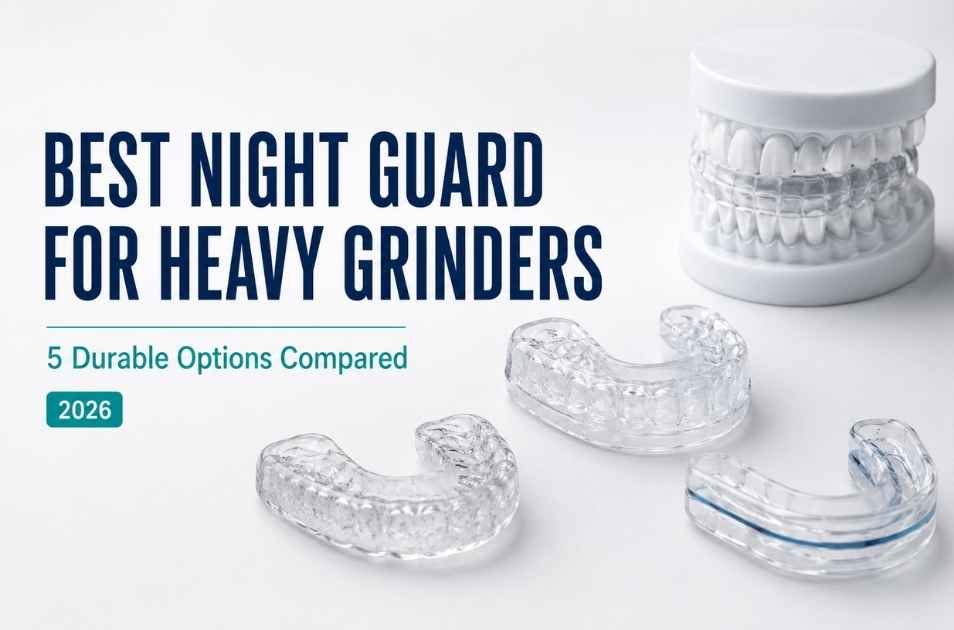
Last updated: August 2026 | By: VerdictLab Editorial Team
If you repeatedly chew through night guards, you already know that durability matters. Some moldable guards compress, deform, or develop bite-through holes much faster than others, and repeated replacements can eventually erase the savings of buying the cheapest option.
That changes the calculus on what guard to buy. Material matters. Thickness matters. Fit matters. And the most useful number isn’t necessarily the sticker price — it’s what you end up spending over the period the guard remains usable for you.
For example, if a $25 guard lasts you three months, that’s $100 a year. If a $150 custom guard lasts 18 months in your particular case, that’s also about $100 a year. Those are only examples — actual wear rates vary enormously — but they show why replacement frequency belongs in the buying decision.
These are five options worth comparing if you tend to wear through standard guards quickly.
Quick Picks for Frequent Guard Wear
- Best rigid custom option: enCore Hard Guard — rigid custom construction in 2mm and 3mm options
- Best two-guard custom option: Remi 2mm — dual-laminate construction, 2 guards per standard order, FDA-cleared
- Best durability-warranty OTC: LunaGuard — 1.6mm, remoldable up to 20×, 180-day durability warranty
- Best thicker OTC option: SOVA Max — 2.4mm, remoldable up to 20×, 120-day durability warranty
- Best two-layer OTC option: The Doctor’s NightGuard — patented soft/firm two-layer construction
In This Guide
Signs You’re Wearing Through Guards Quickly
There’s no simple home grading scale that can reliably tell you whether your sleep bruxism is “mild,” “moderate,” or “severe.” Tooth wear, jaw symptoms, partner reports, and damage to a guard can all provide useful information, but none of them alone gives you a precise bruxism severity score.
What you can observe is how your teeth and guards are behaving.
Your dentist has noticed substantial or progressing wear. Flattened tooth surfaces, chips, fractures, or other grinding-related damage are good reasons to discuss both tooth protection and the possible causes of the bruxism.
You repeatedly wear through guards much faster than expected. Visible holes, deep grooves, distortion, or rapid loss of material tell you that your current appliance is not holding up well to your individual grinding pattern.
Your partner regularly hears grinding. Partner reports can be useful evidence that grinding activity occurs during sleep, although sound alone doesn’t provide a precise measurement of severity.
You regularly wake with jaw-muscle soreness or fatigue. Morning symptoms can occur alongside bruxism, but they’re not specific enough to diagnose its severity by themselves.
If several of these apply, especially if you’re damaging teeth or repeatedly destroying appliances, a dental evaluation is worthwhile. Your own wear history is also useful when deciding whether to move toward a more durable guard.
Why Some Guards Wear Faster
Many inexpensive OTC guards use flexible thermoplastic materials. Flexibility can make a guard comfortable and easy to mold, but repeated grinding can gradually compress, deform, or wear through the material.
The pattern is different for every user. One person may use the same moldable guard for a long time; another may create deep wear marks surprisingly quickly.
Shape matters as well as material loss. Once a guard develops deep grooves, thin spots, cracks, holes, or major distortion, it’s worth reassessing rather than automatically continuing to wear it indefinitely.
Thickness can influence durability, but it isn’t the only factor. Material properties, guard design, fit, where your teeth contact the appliance, and your individual grinding pattern all affect how quickly it wears.
People who repeatedly wear through thin or flexible guards may benefit from comparing thicker or more wear-resistant designs rather than simply buying the same product again.
What to Look for
Material designed for durability. Rigid custom guards and tougher moldable thermoplastics are worth considering when repeated wear is your main problem. Harder doesn’t automatically mean better for every person, but material choice becomes more important when you’re visibly destroying softer appliances.
Enough material for your wear pattern. A thicker design gives you more material to wear through, but there is no universal minimum thickness that every frequent grinder needs. enCore, for example, offers its Hard Guard in 2mm and 3mm versions, while SOVA Max is a 2.4mm OTC design.
Good fit. A guard should seat securely and comfortably. A poor mold can create unstable contacts and make the appliance difficult to wear consistently. Custom guards are fabricated from your individual impression, while remoldable OTC guards such as SOVA and LunaGuard give you multiple chances to improve the fit at home.
Manufacturer durability support. A durability warranty gives you something more concrete than an article promising a specific lifespan. LunaGuard currently carries a 180-day durability warranty, while SOVA backs the Max with a 120-day durability warranty.
A replacement strategy. If you already know you destroy guards quickly, think about how easy and expensive replacements will be. A second guard in the package or a lab that can remake from a stored impression may matter more to you than it would to a light user.
Product Picks for Frequent Guard Wear
enCore Hard Guard — Best Rigid Custom Option
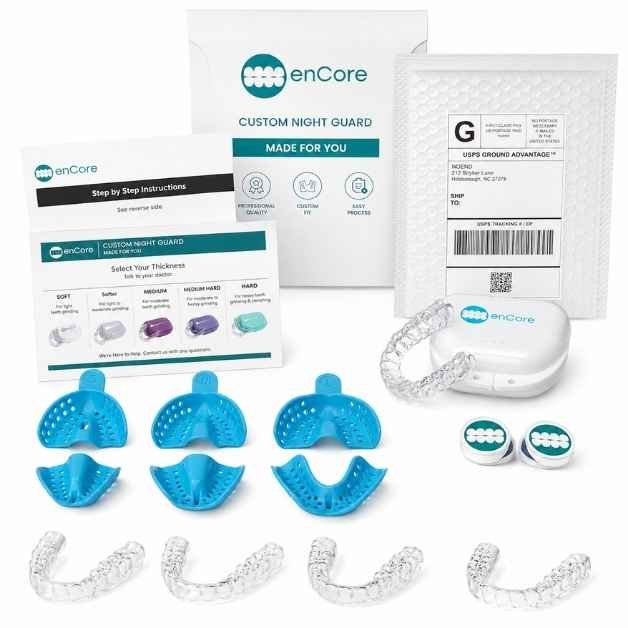
Amazon Price: Check current listing | Material: Rigid custom construction | Thickness: 2mm or 3mm | Type: Custom impression kit | Lab: 30+ years of experience
enCore’s Hard Guard is the most durability-focused option in its custom lineup. Rather than using a soft or dual-layer construction, the appliance is rigid and available in both 2mm and 3mm versions.
That makes it particularly relevant if you’ve repeatedly worn through softer guards and want to move to a rigid custom appliance. The guard is fabricated from your at-home impression, and enCore reviews the impression before manufacturing.
The advantage of rigid construction is that the material is designed to maintain its shape rather than behaving like a soft cushioning guard. But we wouldn’t attach a universal lifespan to it. A person who grinds heavily can eventually wear down any appliance, and individual wear rates vary too much to promise one or two years.
enCore also offers Hybrid, Soft, and Ultra Thin options. If you’re unsure whether a rigid appliance is appropriate for your dental situation, ask your dentist rather than choosing solely because hard sounds more durable.
Remi 2mm — Best Two-Guard Custom Option
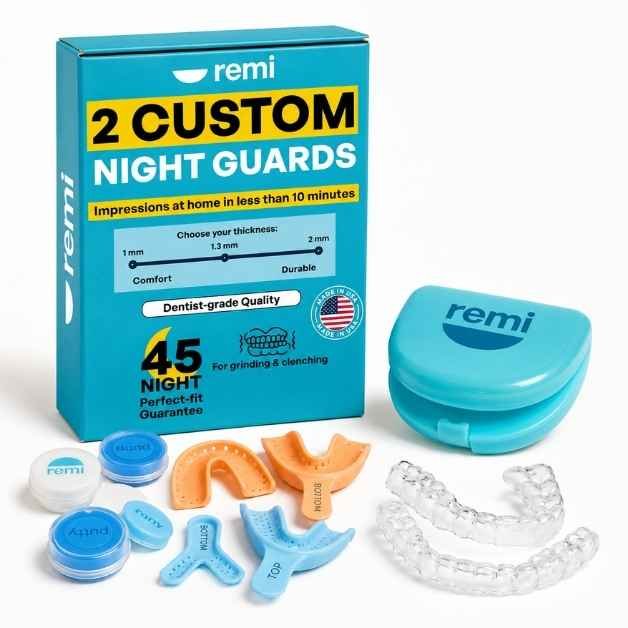
Amazon Price: Check current listing | Material: Dual-laminate | Thickness: 2mm | Guards: 2 per standard order | FDA: Cleared under 510(k) K251778
Remi’s 2mm option is the thickest version in its current lineup and is positioned by the company for heavier grinding. The construction is dual-laminate, combining a firmer outer layer with a softer tooth-facing layer.
The standout advantage for someone who wears guards quickly is simple: the standard package includes two guards. If the first eventually reaches the end of its usable life, you already have another on hand rather than immediately starting a new impression-and-order cycle.
The dual-laminate design is different from enCore’s rigid Hard Guard, so we wouldn’t claim one will last a specific number of months longer than the other. Your own wear pattern is ultimately the better durability test.
Remi also offers replacement options using stored impression information. Check the current terms directly when ordering, since subscription and replacement pricing can change over time.
LunaGuard — Best OTC Durability Warranty
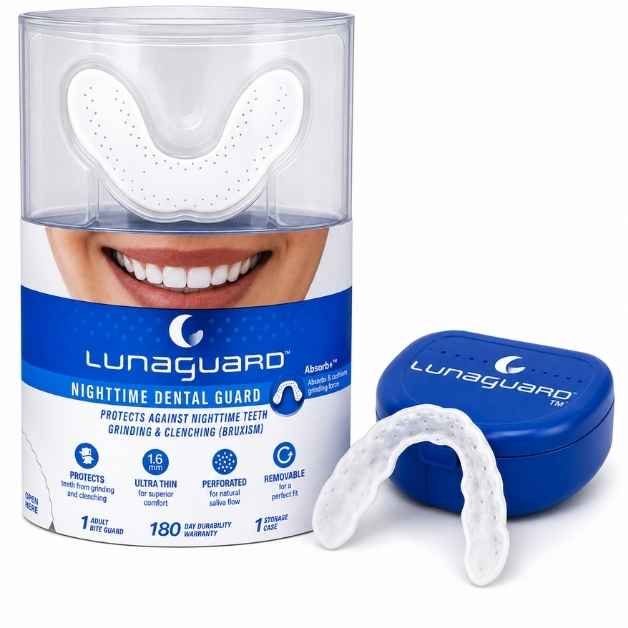
Amazon Price: Check current listing | Material: Moldable thermoplastic | Thickness: 1.6mm | Remoldable: Up to 20× | Durability warranty: 180 days
LunaGuard takes a different route from simply making the guard thicker. It’s a relatively slim 1.6mm moldable appliance made from a durable thermoplastic, and the manufacturer allows it to be reheated and remolded up to 20 times.
The strongest durability claim here isn’t an estimated lifespan from us — it’s the manufacturer’s 180-day durability warranty. If durability is your primary reason for looking beyond basic OTC guards, that’s a useful concrete feature.
Remoldability also matters. A poor first fitting doesn’t necessarily mean the product is wasted, and you can correct the mold instead of accepting an unstable appliance.
LunaGuard is made in the USA and is listed by the manufacturer as BPA-, latex-, and phthalate-free.
If you’re repeatedly destroying OTC guards, however, don’t assume the warranty means LunaGuard will last exactly six months in your mouth. A durability warranty is not the same thing as a predicted personal lifespan.
SOVA Max (2.4mm) — Best Thicker OTC Option
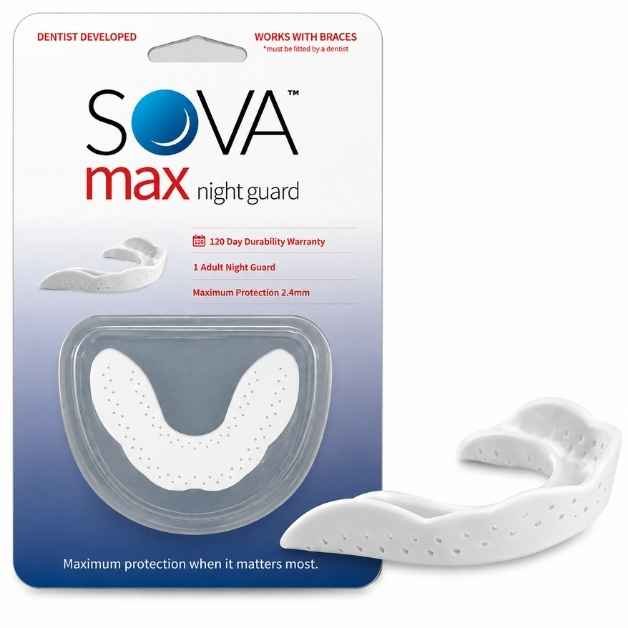
Amazon Price: Check current listing | Material: Diffusix thermoplastic | Thickness: 2.4mm | Remoldable: Up to 20× | Durability warranty: 120 days
SOVA Max is the thicker version of SOVA’s moldable night guard. At 2.4mm, it contains 50% more material than the 1.6mm Aero while retaining the brand’s perforated Diffusix design.
That makes the Max the logical SOVA choice if you’ve already found thinner guards wear too quickly for you or simply prefer more material.
Like the Aero, it can be reheated and remolded up to 20 times. The manufacturer also backs the Max with a 120-day durability warranty.
The trade-off is straightforward: thicker appliances take up more room in the mouth. Some people will prefer that extra material; others will find a thinner design easier to tolerate consistently.
Choose the Max because you want the thicker SOVA design — not because any article can guarantee how many months it will survive your individual grinding pattern.
The Doctor’s NightGuard — Best Two-Layer OTC Option
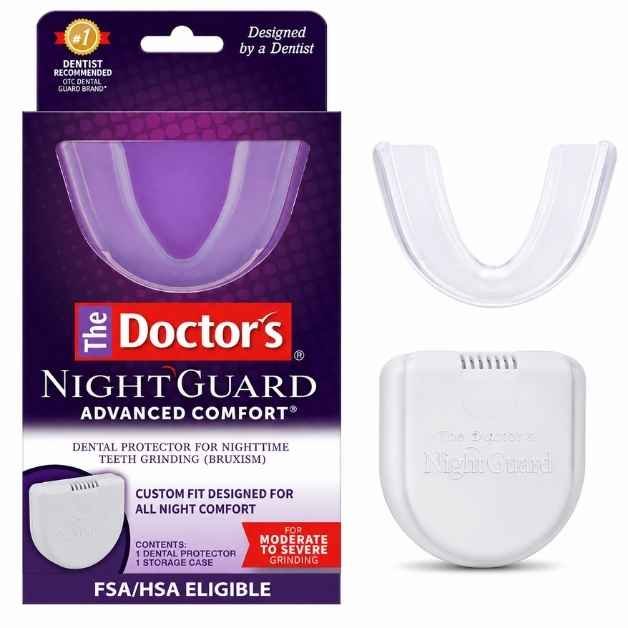
Amazon Price: Check current listing | Material: Patented two-layer construction | Type: Moldable OTC guard
The Doctor’s NightGuard uses a softer cushioning layer together with a firmer supporting layer. That gives it a different construction from basic single-material moldable guards while keeping the upfront commitment below an online custom appliance.
For someone who hasn’t yet tried a more structured two-layer guard, it can be a reasonable stepping stone before moving to custom.
What we wouldn’t do is predict that it will last two months, four months, or any other fixed period for a frequent grinder. If you wear through it rapidly, treat that as useful information about your own wear pattern rather than proof that every person in the same situation needs one particular type of custom guard.
Repeated fast wear is a sensible reason to discuss more durable options with your dentist.
Replacement Cost Math for Frequent Grinders
Durability matters financially because a cheap guard stops being cheap when you repeatedly replace it.
But we shouldn’t attach made-up lifespans to specific products. The table below uses hypothetical examples to show how replacement frequency changes annual cost.
| Example Scenario | Example Cost | Example Replacement Rate | Annualised Cost |
|---|---|---|---|
| Lower-cost OTC example | $20 | Every month | $240/year |
| OTC example | $35 | Every 3 months | $140/year |
| Premium OTC example | $45 | Every 6 months | $90/year |
| Custom example A | $150 | Every 18 months | $100/year |
| Custom example B | $180 | Every 24 months | $90/year |
Important: These are mathematical examples, not current product prices or predicted lifespans. Actual prices and replacement rates vary substantially.
The takeaway isn’t that custom always costs less.
It’s that replacement frequency can completely reverse the upfront-price comparison.
A $20 guard that lasts one month in your particular case costs $240 per year. If another person spends $150 on a custom guard and gets 18 months from it, that works out to $100 per year.
But change the wear rates and the conclusion changes too. If your inexpensive OTC guard lasts a full year, custom may cost considerably more. If you destroy that same guard every few weeks, moving to a more durable design can become economically attractive very quickly.
Your own history is therefore more useful than a generic lifespan chart. Once you’ve replaced a few guards, you know roughly what your current design costs you over time.
For the broader cost comparison including dentist-made guards, see: Night Guard Cost: Dentist vs Online vs OTC.
Frequently Asked Questions
How do I know if I’m a heavy grinder?
There isn’t a simple home test that reliably grades sleep bruxism severity. Signs such as substantial tooth wear, frequent damage to guards, partner-reported grinding, or recurring jaw-muscle symptoms can justify further assessment, but none provides a precise severity score by itself.
Your dentist can assess signs of bruxism and the extent of grinding-related dental damage using your history and examination. In selected cases, additional assessment may be appropriate.
For the broader symptom list, see: Signs You Need a Night Guard.
Do people who wear through guards quickly need a custom guard?
Not automatically. Premium OTC designs may work well for some people.
But repeated rapid wear is a strong practical reason to compare a custom appliance. Custom guards offer individually fabricated fit and access to rigid or hybrid constructions that aren’t available in the same way with basic OTC products.
If you’re repeatedly biting through guards, especially alongside significant tooth wear or dental damage, involve your dentist rather than approaching it only as a shopping problem.
Hard or hybrid — which is better for durability?
A rigid hard guard is designed to maintain its shape and is often positioned by custom labs as the more durability-focused choice. A hybrid combines a firmer exterior with a softer inner layer and may feel more comfortable to some users.
That doesn’t create a universal rule that hard is always better. Your teeth, restorations, bite, comfort, and grinding pattern all matter.
If durability is your main concern and you’re considering a rigid custom appliance, ask your dentist whether that construction is appropriate for you.
Can frequent grinding damage a custom guard?
Yes. Every night guard can eventually wear.
Inspect yours regularly for holes, cracks, substantial thinning, sharp or rough areas, distortion, or a significant change in fit. How quickly those changes occur varies considerably from person to person.
Don’t assume a custom label makes the appliance permanent.
Should frequent grinders see a dentist?
If you’re grinding strongly enough to repeatedly damage appliances or teeth, a dental evaluation is worthwhile. The dentist can assess existing damage, check whether your guard is fitting appropriately, and discuss whether a different appliance design makes sense.
Bruxism can also be associated with factors such as stress, some medications, alcohol or stimulant use, and sleep-related conditions. A guard protects the teeth but doesn’t necessarily address the underlying contributors.
For more on that side of the problem, see: How to Stop Grinding Teeth at Night.

Sources & References
Choosing a Guard When You Wear Through Them Quickly
If durability is your main priority, enCore Hard is the most relevant rigid custom option in our Amazon set, with 2mm and 3mm choices. Remi 2mm offers a different approach: dual-laminate custom construction with two guards in the standard package.
Among OTC options, LunaGuard stands out for its 180-day durability warranty and remoldability, while SOVA Max combines a thicker 2.4mm design with a 120-day durability warranty and up to 20 remolds.
There is no reliable way to promise that any of them will last six months, one year, or two years for you.
The useful pattern is personal. If you’re repeatedly spending money replacing guards, calculate what your current setup actually costs you per year. At some point, a more durable design — including custom — may become cheaper as well as more convenient.
If you’re destroying appliances unusually quickly or already have significant tooth damage, include your dentist in that decision. The goal isn’t simply to find plastic that takes longer to wear through; it’s to protect the teeth appropriately while also looking at the broader bruxism picture.
For the full comparison across all guard types, see: Best Night Guard for Teeth Grinding (2026).