Last updated: August 2026 | By: VerdictLab Editorial Team
The price range for night guards is unusually wide. A basic OTC guard can cost a small fraction of what a dental office charges for a professionally fitted appliance, even though both products sit between your teeth while you sleep.
The difference isn’t just the plastic.
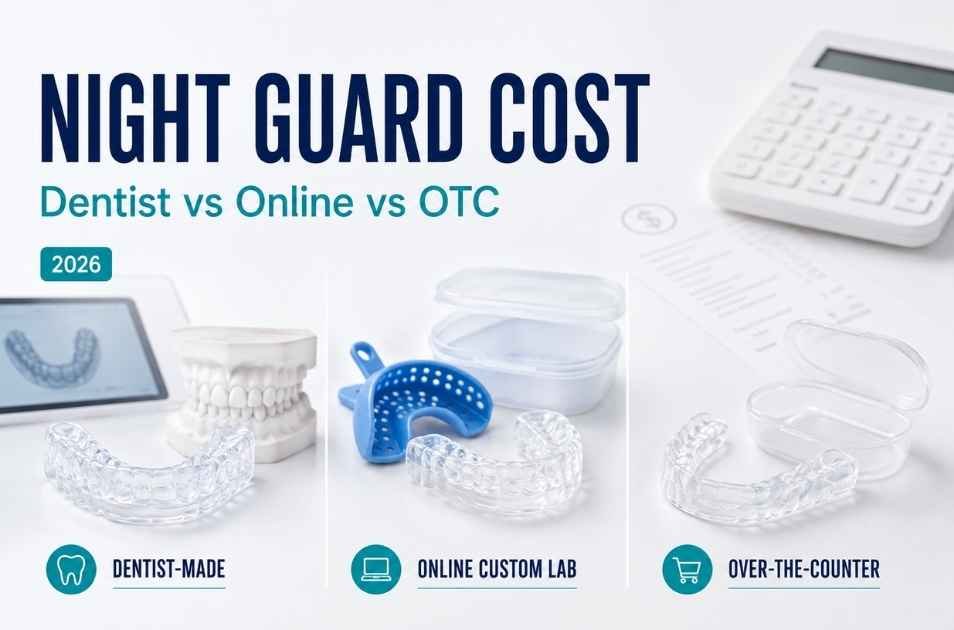
At the dentist, you’re also paying for examination, impression-taking or scanning, appliance selection, fitting, bite adjustment, and follow-up. Online custom labs remove much of that in-person clinical service while still fabricating a guard from an impression. OTC products remove the lab step too.
That makes sticker price useful — but incomplete.
If you replace a cheaper guard frequently, its annual cost can eventually approach or exceed a more expensive option. On the other hand, if an inexpensive OTC guard fits you well and lasts a long time, spending more may not save you anything.
This guide compares the three purchasing routes and shows you how to calculate the cost using your own replacement history instead of relying on generic lifespan promises.
In This Article
Cost Overview
| Tier | Typical Upfront Cost | What You Get | Main Trade-Off |
|---|---|---|---|
| Dentist-made | Often several hundred dollars; can exceed $1,000 | Clinical exam, impression/scan, custom fabrication, fitting, adjustments, follow-up | Highest upfront cost |
| Online custom lab | Usually substantially less than dentist-made | At-home impression kit + custom lab fabrication | No in-person dental examination or chairside fitting |
| OTC | Lowest upfront cost | Boil-and-bite, adjustable, pre-formed, or limited-use guard | Less individualised fit |
Prices vary by provider, product, location, insurance, retailer, and package configuration. Amazon prices can change frequently.
Dentist-Made Night Guards
A dentist-made night guard is usually the most expensive route, but you’re buying more than the appliance itself.
The process commonly starts with an examination. The dentist looks at your teeth, restorations, bite, jaw symptoms, and signs of grinding-related damage. An impression or digital scan is then used to fabricate an appliance specifically for your teeth.
When the finished guard returns from the lab, the dentist can check how it seats, evaluate the bite contacts, make adjustments, and monitor the appliance at future visits.
That clinical oversight is the main difference.
Pricing varies enormously. A relatively straightforward guard from a general dental practice may cost several hundred dollars, while more complex appliances, specialist care, or treatment in higher-cost areas can push the total substantially higher — sometimes above $1,000.
There isn’t one meaningful national sticker price because the service being provided isn’t identical from office to office.
The premium can be worthwhile when your situation is complicated. If you have significant dental work, jaw pain, bite problems, previous appliance difficulties, or unexplained progressing damage, an in-person examination has value that cannot be replicated by simply mailing an impression to a lab.
Online Custom Lab Guards
Online labs use a similar basic fabrication concept: a custom appliance is produced from an impression of your teeth.
The difference is where the clinical steps happen — or don’t happen.
You take the impression yourself at home, return it to the lab, and receive the finished guard by mail. Reputable services review the impression before manufacturing and may ask you to repeat it if the mold isn’t usable.
That removes the dental-office examination and chairside fitting, which is a major reason online custom guards can cost considerably less.
Among the Amazon-available custom options we currently cover:
- enCore
— Soft, Hybrid, Hard, and Ultra Thin custom options. Check current Amazon price. - Remi
— multiple thickness choices with custom impression fabrication. Check current Amazon price and package configuration.
For the full comparison, see: Best Custom Night Guard.
The trade-off is self-service. You make the impression yourself, and there is no dentist examining your teeth, jaw, restorations, or bite before the appliance is manufactured.
That doesn’t make online custom guards inherently poor products. It means you’re buying custom fabrication without the full clinical service surrounding it.
For someone primarily seeking straightforward grinding protection and who does not have a complicated dental situation, that can be an attractive value proposition. If you’re uncertain whether a night guard is appropriate in the first place, the dentist route provides something an online lab cannot: diagnosis and direct examination.
Over-the-Counter Night Guards
OTC products remove the custom lab step entirely.
They include traditional boil-and-bite guards, remoldable thermoplastic designs, adjustable bite-pad guards, pre-formed options, and limited-use products.
The main advantage is obvious: low upfront cost and immediate availability.
Some of the Amazon options covered in our OTC guide include:
- SOVA Aero
— 1.6mm, remoldable up to 20 times. Check current Amazon price. - SOVA Max
— thicker 2.4mm SOVA design. Check current Amazon price. - LunaGuard
— 1.6mm, remoldable, with a 180-day manufacturer durability warranty. Check current Amazon price. - The Doctor’s NightGuard
— moldable two-layer design. Check current Amazon price. - DenTek Professional-Fit
— moldable guard with a fitting system. Check current Amazon price. - HONEYBULL
— multi-pack moldable option. Check current Amazon price.
See: Best OTC Night Guard for the complete comparison.
OTC does not automatically mean disposable or poor quality. Some premium moldable designs offer remoldability and manufacturer durability warranties.
But the fit is still created at home rather than from a dental-lab model of your individual teeth. Whether that’s perfectly adequate or frustrating depends heavily on the product and the person using it.
The other unknown is replacement frequency. Some people get substantial use from an OTC guard. Others wear through the same design rapidly. That’s why an article cannot honestly tell you that OTC will always cost more — or less — over a year.
Annual Cost by Replacement Frequency
This is the part of the comparison that sticker prices hide.
The formula is simple:
Annual cost = price per guard × number of guards you replace in one year
The difficult part is that nobody can reliably predict your replacement frequency before you use the appliance.
So the examples below are deliberately hypothetical. They show how the math changes — not how long a particular brand is expected to last.
| Example | Example Price | Replacement Frequency | Annualised Cost |
|---|---|---|---|
| Scenario A | $20 | Every month | $240/year |
| Scenario B | $25 | Every 3 months | $100/year |
| Scenario C | $40 | Every 6 months | $80/year |
| Scenario D | $150 | Every 18 months | $100/year |
| Scenario E | $180 | Every 2 years | $90/year |
| Scenario F | $600 | Every 3 years | $200/year |
Important: These are arithmetic examples only. They are not current product prices or predicted night-guard lifespans.
What the Math Actually Tells You
A cheaper guard is not automatically cheaper over time.
If you spend $25 and replace it every three months, you’re spending $100 per year.
If another appliance costs $150 but lasts 18 months for you, its annualised cost is also $100.
But the calculation can reverse just as easily.
If your $25 guard lasts a full year, that’s only $25 per year. In that situation, buying a $150 custom appliance purely to “save money” would make no sense unless it offered another benefit you valued — such as better fit or comfort.
Likewise, if you chew through a $25 guard every month, you’re spending $300 per year. That’s when a more durable design can become economically attractive very quickly.
The strongest cost data therefore comes from your own replacement history.
After you’ve used one or two guards, write down:
- what you paid
- when you started using it
- when it developed meaningful wear or stopped fitting properly
That gives you a personal annual-cost estimate far more useful than any generic “this guard lasts X months” claim.
Insurance, HSA, and FSA
Dental Insurance
Dental-insurance coverage for night guards varies substantially.
A plan may cover an occlusal guard under certain conditions, require documentation, apply a deductible or coinsurance, limit how often the appliance can be replaced, or exclude it entirely.
Online-lab and retail purchases may also be treated differently from a dentist-provided appliance. Don’t assume that an Amazon or online custom purchase is either automatically covered or automatically excluded.
The most useful step is to call the insurer before buying and ask:
Also ask about:
- deductible
- coinsurance
- replacement-frequency limits
- pre-authorization requirements
- in-network versus out-of-network rules
If the insurer gives you a reference number for the call, keep it.
HSA and FSA
HSA and FSA rules deserve slightly more caution than simply saying “night guards are eligible.”
IRS rules allow qualified medical and dental expenses when the expense is primarily for the prevention or alleviation of a medical or dental condition. Whether a particular retail or online purchase qualifies — and what documentation is required — can depend on the item and your plan administrator.
If you’re planning to use HSA or FSA funds, verify the specific purchase before ordering.
Some products and sellers explicitly indicate HSA/FSA eligibility. enCore, for example, currently lists HSA/FSA eligibility for its custom guards.
If Amazon identifies a product as HSA/FSA eligible at checkout, that makes the transaction simpler. If it doesn’t, don’t assume that merely saving the receipt guarantees reimbursement. Check with your administrator about eligibility and any documentation they require.
Using eligible pre-tax funds can reduce the effective after-tax cost of a qualified purchase, but the exact benefit varies with your tax situation and account type.
For FSA users, also check your plan’s year-end rules. FSAs are generally subject to use-it-or-lose-it rules, but an employer plan may allow a grace period or a permitted carryover. Don’t buy an appliance you don’t need simply to empty an account.
When the Dentist Route Is Worth the Extra Cost
The online-lab and OTC routes can be much cheaper upfront. That doesn’t mean the dentist route is overpriced in every situation.
Sometimes the clinical service is exactly what you’re paying for.
You have TMD or significant jaw symptoms.
TMD is multifactorial, and evidence for splint therapy is mixed. If jaw pain, locking, progressive limitation, or other substantial symptoms are the reason you’re considering an appliance, professional assessment matters more than simply choosing the highest-rated guard online.
See: Best Night Guard for TMJ.
You have extensive dental work.
Multiple crowns, bridges, veneers, implants, active orthodontics, or complex bite relationships can make appliance selection and fit more important. A dentist can examine those restorations directly and adjust the guard after fitting.
You’ve had problems with a previous guard.
If an appliance has caused new tooth pressure, jaw pain, or a persistent change in how your teeth meet, buying another random design isn’t the best experiment. Have the situation assessed.
You have progressing dental damage or unusually rapid guard wear.
Repeated cracks, substantial enamel wear, restoration failure, or very rapid destruction of appliances are good reasons to involve a dentist. The goal is not simply to keep replacing plastic — it’s to protect the teeth while also looking at the broader bruxism picture.
Your insurance substantially reduces the price.
A dentist-made guard may look expensive at full retail price but very different after insurance benefits. Check actual out-of-pocket cost before deciding that the online route is automatically cheaper.
Frequently Asked Questions
Why do dentist night guards cost so much?
You’re paying for more than the material and laboratory fabrication.
The price can include examination, impression-taking or digital scanning, appliance selection, laboratory work, fitting, bite adjustment, follow-up, and the overhead of providing clinical care.
Online labs remove many of those in-person services, which is one reason their upfront price can be substantially lower.
Is a cheap night guard worth buying?
It can be.
A lower-cost OTC guard may be a perfectly reasonable starting point if it fits comfortably, stays in place, and holds up adequately for your use.
Price alone doesn’t determine whether a guard is appropriate.
If you repeatedly wear through inexpensive guards, can’t achieve a stable fit, or stop wearing them because they’re uncomfortable, that’s when paying more for a better fitting system or custom appliance becomes easier to justify.
A budget multi-pack such as HONEYBULL can make sense for someone specifically looking for a low-cost moldable option, but there is no arbitrary deadline after which everyone must “upgrade.”
How much should I spend on a night guard?
There isn’t a universal number.
Start with the problem you’re trying to solve:
- If low upfront cost matters most, OTC usually wins.
- If OTC fit repeatedly fails you, online custom becomes more attractive.
- If you need examination, bite adjustment, or professional monitoring, the dentist route offers services the cheaper options do not.
- If you replace guards frequently, calculate your actual annual cost before assuming the cheapest sticker price is the cheapest option.
Can I use HSA/FSA funds for an Amazon night guard?
Possibly, but verify the specific item and your plan’s requirements.
Some Amazon products are explicitly flagged as HSA/FSA eligible. If the item isn’t clearly identified, contact your HSA/FSA administrator rather than assuming reimbursement is guaranteed.
Documentation requirements can vary.
Does dental insurance cover night guards?
Some plans do and some don’t.
Coverage may depend on the reason for the appliance, where it is purchased, provider network rules, deductibles, coinsurance, and replacement limits.
Ask specifically whether an occlusal guard/night guard is a covered benefit and what requirements apply.
How often do I need to replace a night guard?
There is no reliable replacement calendar that applies to every person or every material.
Inspect the guard rather than relying solely on age.
Signs that deserve attention include:
- holes or bite-through
- cracks
- major thinning
- sharp or rough areas
- significant distortion
- a noticeable change in fit
If you’re uncertain whether a worn guard is still usable, take it to your dentist.
For care advice, see: How to Clean a Night Guard.

Sources & References
National Institute of Dental and Craniofacial Research — Bruxism
National Institute of Dental and Craniofacial Research — Temporomandibular Disorders
Internal Revenue Service — Publication 502: Medical and Dental Expenses
Internal Revenue Service — Publication 969: HSAs and Other Tax-Favored Health Plans
enCore — Custom Hard Night Guard Product Information
Remi — Current Replacement and Club Information
Where Your Money Goes Furthest
There is no universally cheapest night-guard category.
OTC usually wins upfront. If an inexpensive guard fits well and lasts adequately for you, it can remain the cheapest route.
Online custom can become competitive when fit or repeated replacements become a problem. You’re paying more upfront for an individually fabricated appliance without paying for the full dental-office service.
Dentist-made guards cost more because they include clinical care. That extra expense can be worthwhile when you have complicated dental work, substantial jaw symptoms, bite concerns, previous appliance problems, or progressing damage that needs monitoring.
The most useful calculation is not what somebody else’s guard supposedly costs per year.
It’s yours:
What did you pay, and how long did that specific guard remain comfortable, intact, and usable?
Once you know those two numbers, the cost comparison becomes much more meaningful.
For the full product comparisons: Best Custom Night Guard, Best OTC Night Guard, and Best Night Guard for Teeth Grinding (2026).