Last updated: August 2026 | By: VerdictLab Editorial Team
Night guards are the most commonly prescribed intervention for bruxism. Dentists recommend them. Online dental labs sell thousands of them. Amazon’s “Anti Grinding Teeth Protectors” category has hundreds of listings. But “commonly prescribed” and “proven effective” aren’t the same thing. If you’re about to spend $20–200 on a piece of plastic you’ll wear in your mouth every night, it’s reasonable to ask what it actually does — and what it doesn’t.
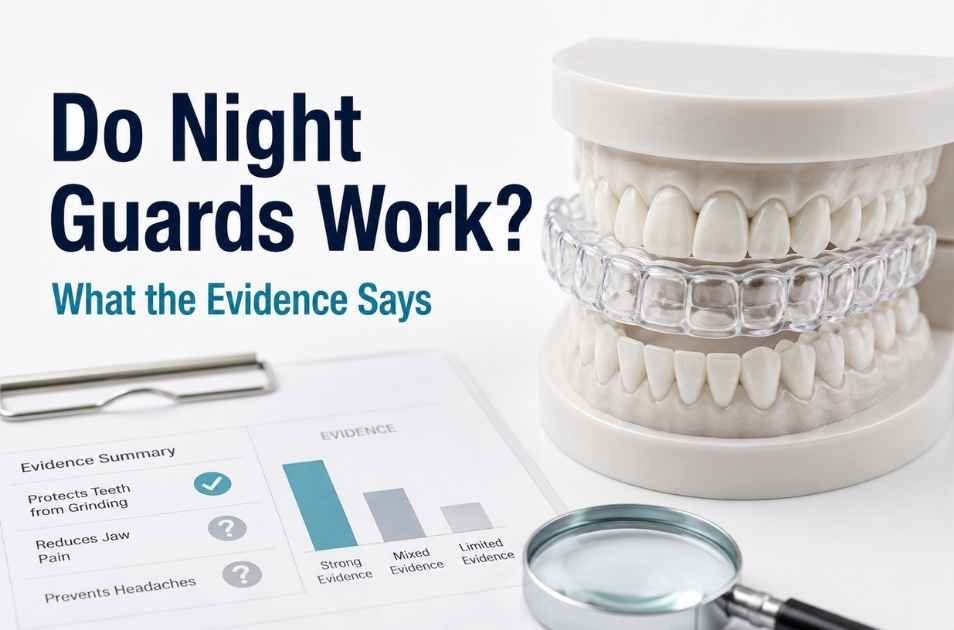
The short version: night guards reliably protect teeth from grinding damage. That much is well established. Where the picture gets murkier is whether they reduce the grinding itself, relieve jaw pain, or improve sleep. The evidence there is more mixed than most product pages will tell you.
What night guards clearly do: protect teeth
This is the strongest and least contested claim. A night guard separates the upper and lower teeth, reducing direct tooth-to-tooth contact during grinding. Instead of enamel wearing against enamel, the guard material takes the friction. Your teeth don’t.
The evidence for this is straightforward enough that it barely requires clinical trials. It’s a mechanical function. Enamel doesn’t regenerate once it’s worn away. A hard acrylic or dual-laminate barrier between the arches prevents the grinding force from flattening cusps, thinning enamel, chipping edges, and eventually cracking teeth. Dentists see the damage pattern in unprotected grinders and the preserved tooth surfaces in patients who wear guards consistently.
This protective function alone justifies a night guard for anyone whose dentist has identified grinding-related wear. The guard doesn’t fix the grinding. It prevents the grinding from destroying your teeth while you and your dental team work on contributing factors. Think of it less as a treatment and more as a seatbelt — it doesn’t stop the crash, but it changes the outcome considerably.
Do they reduce jaw pain and headaches?
This is where “it depends” starts earning its reputation as an honest answer.
Many people who wear night guards report less jaw soreness and fewer morning headaches after a few weeks of consistent use. Dentists observe this regularly in practice. But the clinical research is less conclusive than the anecdotal reports might suggest.
Several studies have found that occlusal splints (the clinical term for night guards) may reduce masticatory muscle pain and improve jaw function in some patients with TMD (temporomandibular disorders). But systematic reviews of the evidence have found the results inconsistent, with study quality often rated as low or moderate. Separating a genuine treatment effect from placebo effects has proven difficult in splint research — the act of wearing an appliance and being monitored may contribute to perceived improvement regardless of the splint itself.
Part of the difficulty is that jaw pain is multifactorial. Bruxism, TMD symptoms, stress, muscle tension, joint issues, and other factors can overlap, so improvement with a splint varies between individuals. A night guard may reduce the mechanical load from grinding, but it doesn’t touch stress, postural, or inflammatory components that may also be contributing. For some people, that mechanical relief is enough to make a noticeable difference. For others, the guard protects the teeth without fully resolving the pain.
The practical takeaway: a night guard may help with jaw pain and headaches, and many users find that it does. But a specific outcome isn’t guaranteed, and anyone whose symptoms persist while wearing a guard should follow up with their dentist rather than assuming the guard “isn’t working.” The guard may be doing its job (protecting teeth) while a separate issue drives the ongoing pain.
Do they stop the grinding itself?
This is the most common misconception worth correcting. Night guards are not reliably shown to stop the underlying bruxism. Grinding or clenching activity may continue while wearing one — the guard changes what happens when you grind (plastic takes the wear instead of enamel), not necessarily whether you grind.
The evidence is mixed. Some research has found short-term reductions in muscle activity when a new guard is first introduced, though this effect often diminishes over weeks as the jaw adapts. Other studies show no significant change in grinding frequency. What is clear is that tooth protection — not bruxism reduction — is the more established and consistent benefit.
This matters because some people buy a night guard expecting it to cure their bruxism. When their partner still hears grinding, or when the guard shows wear marks, they conclude it has failed. In most cases, it hasn’t — it’s doing the job it was designed for. The expectations were mismatched.
If you want to address the underlying bruxism itself, the approaches are different: stress management, behavioural modification, treating contributing sleep disorders, and medication adjustments if a medication is a factor. In selected cases, botulinum toxin injections into the masseter muscles may be considered under professional care, though evidence and long-term guidance for this approach are still evolving. These are conversations for your dentist or physician. A night guard complements them but doesn’t replace them. For more on these approaches, see: How to Stop Grinding Teeth at Night.
Does it matter which type of guard you use?
Both OTC and custom guards can separate the teeth, but fit, coverage, comfort, durability, and suitability vary substantially.
For comfort, fit, and longevity, the differences between guard types matter.
Custom-fitted guards (from a dentist or an online lab like Remi or Encore) conform more precisely to your dental arch. They tend to be thinner, more comfortable, and generally provide a more secure fit. They also last longer — hard acrylic custom guards can survive 1–3 years of nightly use, where a boil-and-bite may compress and lose its shape in 3–6 months.
OTC boil-and-bite guards fit less precisely and feel bulkier in the mouth. But they’re available immediately, cost $10–40, and can provide meaningful protection while you decide whether to invest in something custom. Whether that difference in fit quality affects long-term outcomes depends on the individual — there’s limited clinical research directly comparing the two.
Some studies suggest patients are more likely to wear custom guards consistently because they’re more comfortable. Compliance matters, since a guard left in the drawer — however well-made — protects nothing. But this finding isn’t universal, and individual experience varies.
For the full comparison, see: Custom vs OTC Night Guard: Is Custom Worth It?
Can a night guard make things worse?
In certain situations, yes — though the risks are more about guard quality and fit than about the concept itself.
A poorly fitting guard can shift teeth. Any oral appliance worn for 7–8 hours nightly exerts forces on the dental arch. If the guard fits unevenly — applying more pressure on one side, or covering some teeth while leaving gaps over others — it can gradually shift tooth position over months of use. Custom-fitted guards minimise this risk. Poorly molded boil-and-bite guards or one-size-fits-all stock guards carry more risk. This is one of the stronger arguments for custom over OTC for long-term use.
Material choice may affect muscle activity. Soft and hard splints can affect jaw-muscle activity differently, and studies have reported mixed results. Some clinicians prefer hard or dual-laminate guards for moderate-to-heavy grinders based on clinical experience, while others find soft guards work well for their patients. Material choice should be guided by your grinding pattern, comfort, and professional advice rather than a blanket assumption that one type always performs better.
Possible interaction with sleep apnea. People with diagnosed or suspected obstructive sleep apnea should discuss night-guard use with their dentist or sleep specialist before starting. Some studies suggest that certain occlusal splints may worsen breathing measures in some individuals — the mechanism isn’t fully established, but jaw position and appliance bulk may be contributing factors. This doesn’t mean night guards are unsafe for everyone who snores, but it’s a conversation worth having with your clinician if sleep-disordered breathing is part of your picture.
None of these risks means you shouldn’t use a night guard. They mean a properly fitted guard — checked periodically by your dentist — is meaningfully safer than a random one from a shelf. And they mean a guard isn’t automatically right for every person in every situation without professional input.
What the evidence supports most clearly
Night guards are widely used to reduce direct tooth-to-tooth damage from grinding and clenching. This is the function with the strongest support, and it’s not seriously debated in the dental literature.
Custom-fitted guards generally offer a more precise fit than OTC options, and many clinicians prefer them for long-term nightly use. Whether that translates to better clinical outcomes for every patient isn’t fully established, but comfort and fit quality do affect whether people actually wear the guard consistently.
Night guards are not reliably shown to stop bruxism itself. Tooth protection is the primary established benefit. Some people experience pain and symptom relief, but the evidence for this is variable.
A guard works best as part of a broader approach. Contributing factors — stress, sleep quality, medications, lifestyle — are worth addressing alongside guard use rather than relying on the guard alone.
Periodic dental check-ups are important for anyone wearing a guard long-term, to monitor fit, check for tooth movement, and assess whether the guard is still appropriate as things change.
Frequently Asked Questions
How long does it take for a night guard to work?
For tooth protection, a night guard works immediately — the first night you wear it, your teeth are separated by a barrier. For symptom relief (jaw pain, headaches), the timeline varies. Some people notice improvement within days. Others take weeks. Some find the guard helps their teeth but doesn’t resolve their symptoms, which may need separate attention. There’s no universal timeline to promise.
Will a night guard stop my teeth from shifting?
A night guard is not an orthodontic retainer. It’s designed to separate the teeth during grinding, not to hold teeth in position. If your teeth are shifting, that’s a separate issue to discuss with your dentist or orthodontist. Some guards may incidentally limit minor movement during wear, but this isn’t their function and shouldn’t be relied on.
Do I need a night guard if I only clench, not grind?
Clenching (pressing teeth together without lateral movement) can produce significant jaw muscle fatigue, headaches, and tooth damage. A night guard distributes clenching force across the biting surface rather than concentrating it at a few contact points. Whether you need one depends on whether the clenching is causing damage or symptoms — your dentist can assess this.
Can I just use a sports mouth guard instead?
No. Sports guards use soft, shock-absorbing material designed for sudden impact, not sustained grinding pressure. A soft sports guard can compress under grinding force and lose its shape quickly, and the fit and material properties aren’t suited for nightly dental use. For a detailed comparison, see: Night Guard vs Mouth Guard: What’s the Difference?
My dentist says I grind but I have no symptoms. Do I still need a guard?
That depends on what your dentist finds on examination. If there’s visible wear, thinning enamel, or early cracking, a guard protects against further damage even in the absence of pain. If the grinding is mild and no damage is evident yet, your dentist may recommend monitoring rather than immediate treatment. This is a conversation specific to your teeth and your situation — not one a product review site should answer for you.
Are more expensive guards more effective?
More expensive guards generally fit better, last longer, and are more comfortable — all of which can affect how consistently you wear one. But for the basic function of separating teeth from teeth, price alone doesn’t establish clinical effectiveness. A well-fitting OTC guard worn every night provides real protection. A custom guard may offer a more precise fit and longer lifespan, which can justify the higher cost for some people. The right choice depends on your grinding severity, comfort needs, and budget. For the cost comparison, see: Night Guard Cost: Dentist vs Online vs OTC.
Sources & References
- National Institute of Dental and Craniofacial Research — Bruxism
- National Institute of Dental and Craniofacial Research — TMD (Temporomandibular Disorders)
- Macedo CR et al. — Occlusal splints for treating sleep bruxism (Cochrane Systematic Review, 2007; updated)
- Al-Moraissi EA et al. — Effectiveness of occlusal splint therapy in the management of TMD: systematic review and meta-analysis (Journal of Oral Rehabilitation, 2020)
- Jokubauskas L, Baltrušaitytė A — Relationship between obstructive sleep apnoea syndrome and sleep bruxism: systematic review (Journal of Oral Rehabilitation, 2017)
Related Guides
- Best Night Guard for Teeth Grinding (2026)
- How to Stop Grinding Teeth at Night
- Signs You Need a Night Guard
- Best Night Guard for TMJ
- Custom vs OTC Night Guard: Is Custom Worth It?
- Night Guard vs Mouth Guard: What’s the Difference?
- Best Custom Night Guard (Online Labs Compared)
- Night Guard Cost: Dentist vs Online vs OTC