Last updated: September 2026 | By: VerdictLab Editorial Team
Using HAp toothpaste is not complicated. The brushing mechanics are the same as any toothpaste — apply, brush, spit. If you already brush twice a day with a soft-bristled brush, you already know how to use it. The questions people actually have are about the details: whether to rinse afterward, whether to alternate with fluoride, how much to use, and whether there’s a “wrong” way to do it.
This guide covers the practical routine. For the science behind the ingredient, see: What Is Hydroxyapatite Toothpaste?. For product recommendations, see: Best Hydroxyapatite Toothpaste.
The Basic Routine
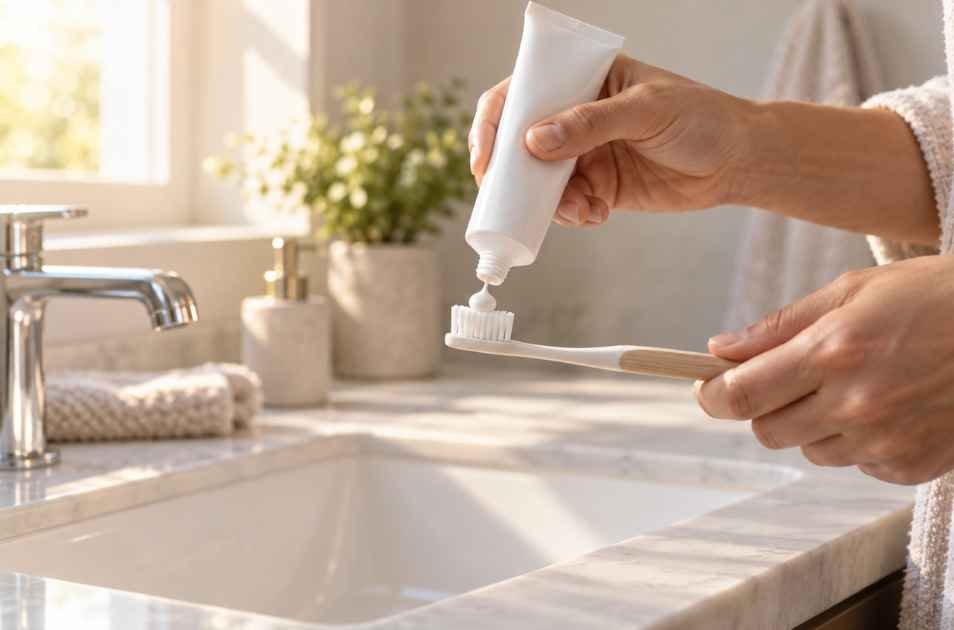
How much: A pea-sized amount for adults. Same as fluoride toothpaste. More doesn’t mean more mineral deposition — it means more waste.
How long: Two minutes, twice a day. The ADA’s standard brushing recommendation applies regardless of the toothpaste ingredient. Set a timer if you tend to rush. Most people brush for about 45 seconds without timing — less than half of what’s recommended.
What brush: A soft-bristled toothbrush — manual or electric. HAp toothpaste doesn’t require a special brush. If you use an electric toothbrush, let the brush do the work. If you use a manual brush, short gentle strokes at a 45-degree angle to the gumline. The brushing technique matters more than the toothpaste brand.
When: Morning and night. If you brush after meals, wait 30 minutes after eating or drinking anything acidic (citrus, coffee, wine) — brushing on acid-softened enamel can cause more wear than the acid itself.
Spit, don’t swallow. All toothpaste — HAp or fluoride — is designed to be spit out. The EU SCCS found that incidentally ingested nano-HAp dissolves in gastric fluid without raising safety concerns, but that’s about accidental exposure, not intentional swallowing.
Should You Rinse After Brushing?
This is the most common question specific to HAp toothpaste, and the answer is less clear-cut than either camp suggests.
The case for not rinsing: Some HAp advocates recommend spitting without rinsing to leave a layer of HAp on the tooth surface, giving the mineral more contact time to deposit into enamel. The logic mirrors the established fluoride advice — the UK’s NHS and many dental professionals recommend not rinsing after fluoride toothpaste to maximize fluoride contact time. Applying the same principle to HAp is reasonable in concept.
The case for rinsing: HAp toothpaste also contains surfactants, flavoring, silica, and other ingredients you may not want sitting on your teeth and gums for hours. Some formulations leave a slight residue or film that’s cosmetically noticeable, particularly for clear aligner wearers. Rinsing removes that residue along with the HAp.
The evidence: No clinical trial has compared rinsing versus not rinsing after HAp toothpaste to determine which produces better clinical outcomes. The recommendation to skip rinsing is an extrapolation from fluoride practice, not a tested protocol for HAp specifically.
The practical answer: If you’re comfortable with a slight residual film and want to maximize contact time, spit without rinsing — especially at night, when the toothpaste has 6–8 hours of uninterrupted contact. If the residue bothers you or you wear clear aligners, a brief light rinse is fine. This is a preference, not a critical decision point. Neither approach will make or break the toothpaste’s effectiveness.
Using HAp Alongside Fluoride
HAp and fluoride are not mutually exclusive. Three common approaches exist:
HAp only (both brushings). The simplest switch. You’re relying entirely on HAp for your toothpaste-delivered protection. This is the approach tested in the Paszynska noninferiority trial. Appropriate for low-to-moderate caries risk adults who’ve decided to go fluoride-free.
Although three fluoride-free HAp trials met study-specific non-inferiority criteria for particular caries outcomes, VerdictLab’s evidence review found that the products, populations, endpoints and margins differed. Your individual cavity risk should therefore guide any decision to replace fluoride completely.
Fluoride only (both brushings). The conventional approach with the deepest evidence base. No change needed. HAp toothpaste is an option, not an obligation.
Alternating (one brushing each). Some people use fluoride in the morning and HAp at night, or vice versa. The rationale: fluoride provides established anticaries protection during the day; HAp provides proposed remineralization during the longer overnight contact period. Whether this combination delivers additive benefit over either ingredient alone hasn’t been clinically established. But it avoids the trade-off of choosing one over the other, which some people find more comfortable than a full switch.
A few products contain both HAp and fluoride in one tube. These exist but are less common. If you use one, you’re getting both mechanisms simultaneously without alternating.
Your dentist can advise on which approach fits your caries risk. For the full comparison, see: Hydroxyapatite vs Fluoride.
Where HAp Toothpaste Fits in a Full Oral Care Routine
Toothpaste is one part of oral hygiene, not the whole thing. A complete routine includes:
Flossing or interdental cleaning — once daily, before brushing. This removes plaque and debris from between teeth where the toothbrush can’t reach. HAp toothpaste doesn’t change this requirement.
Brushing — twice daily, two minutes each, with HAp (or fluoride) toothpaste and a soft-bristled brush.
Tongue cleaning — daily, after brushing. A tongue scraper or brush removes the bacterial coating that contributes to bad breath.
Mouthwash (optional) — if you use one, choose a product compatible with your goals. Alcohol-free mouthwash is generally gentler. If you’re not rinsing after HAp toothpaste, don’t immediately follow with mouthwash — that defeats the purpose of leaving HAp on the tooth surface.
Regular dental visits — every 6 months (or as your dentist recommends). No toothpaste, HAp or otherwise, replaces professional cleaning and examination.
Common Mistakes
Using too much. A pea-sized amount is sufficient. A full brush-length strip is wasteful and doesn’t improve outcomes.
Expecting overnight results. HAp toothpaste works through gradual mineral deposition over weeks. If you’re using it for sensitivity, expect 2–4 weeks of consistent use before noticing a difference. One brushing doesn’t produce a visible change.
Brushing your retainer or aligner with it. HAp toothpaste is for your teeth — not your dental appliances. Toothpaste abrasives (including those in HAp formulas) scratch clear thermoplastic retainers. Clean appliances separately with dish soap, a cleaning tablet, or an ultrasonic cleaner. See: How to Clean a Retainer.
Assuming all HAp toothpastes are identical. Concentration, particle type (nano vs micro), supporting ingredients, and price all vary between brands. A product with an undisclosed concentration is a different purchase proposition from one at a verified 10%. See: HAp Toothpaste Percentages.
Skipping flossing because you upgraded your toothpaste. HAp toothpaste doesn’t reach between teeth. Nothing does except floss, interdental brushes, or a water flosser. Premium toothpaste is not a substitute for interdental cleaning.
Stopping fluoride without considering your risk level. If you have active cavities, dry mouth, or a high caries risk, switching away from fluoride toothpaste is a decision your dentist should be part of. HAp’s noninferiority evidence comes from general populations — high-risk individuals may need the broader evidence base behind fluoride. See: HAp vs Fluoride.
Frequently Asked Questions
How often should I use HAp toothpaste?
Twice daily — the same frequency recommended for any toothpaste. If you’re alternating with fluoride, once daily HAp and once daily fluoride is the common split.
Can I use it with an electric toothbrush?
Yes. HAp toothpaste works with any toothbrush — manual or electric. No special brush is required.
Should I use it before or after flossing?
Floss first, then brush. Flossing loosens debris from between teeth so the toothpaste can reach more surface area during brushing. This applies to HAp and fluoride toothpaste equally.
Can I use HAp toothpaste with mouthwash?
Yes, but timing matters. If you’re skipping the post-brushing rinse to maximize HAp contact time, using mouthwash immediately afterward washes the HAp away. If you want both, either use mouthwash at a different time of day (e.g., after lunch) or accept that the rinse reduces contact time.
Is there a wrong way to use it?
No unique wrong way — the common brushing mistakes (too much pressure, too little time, wrong angle, skipping areas) apply equally to every toothpaste. The HAp-specific mistake is expecting immediate results from a gradual mineral-deposition process. Give it 2–4 weeks of consistent use before evaluating.
