Last updated: September 2026 | By: VerdictLab Editorial Team
Orthodontic patients — people with braces, retainers, clear aligners, or other appliances — are one of the audiences most drawn to hydroxyapatite toothpaste. The logic is intuitive: braces make cleaning harder, enamel around brackets is vulnerable to demineralization (the white spots that sometimes appear after braces come off), and a toothpaste that deposits mineral onto enamel sounds like a good match for that problem.
The logic is reasonable. The evidence behind it is narrower than you’d expect from the marketing. Here’s what applies to orthodontic patients specifically, what doesn’t, and what to discuss with your orthodontist before switching.
Why Orthodontic Patients Are Interested
Demineralization around orthodontic brackets is one of the most common side effects of fixed braces. The brackets create areas that are difficult to clean, plaque accumulates, acid production increases, and the enamel immediately around the bracket starts losing mineral. This shows up as white spot lesions — chalky white patches that are visible the day the braces come off and can persist permanently.
The appeal of HAp toothpaste in this context is remineralization: the idea that brushing with a calcium phosphate mineral might help replace what the enamel is losing around the brackets. Some orthodontic research has explored this concept, and the plausibility is high. But “plausible” and “proven for this specific use” are different evidence levels.
A 24-week randomized non-inferiority trial in orthodontic patients compared fluoride-free microcrystalline HAp toothpaste with 1,400 ppm fluoride toothpaste and met its study-specific non-inferiority criterion for ICDAS lesion development. As detailed in VerdictLab’s clinical evidence review, the result applies to that product, population, endpoint, margin and duration; it does not establish that every HAp toothpaste is equivalent to fluoride during orthodontic treatment.
Fixed Braces (Brackets and Wires)
HAp toothpaste is used the same way as any toothpaste with braces — brush around brackets, under wires, and along the gumline. The physical application doesn’t change. The question is whether HAp provides adequate protection in a higher-risk cleaning environment.
What the evidence supports: HAp toothpaste has been shown to be noninferior to fluoride for cavity prevention in general populations. If you’re a low-to-moderate caries risk individual who cleans thoroughly around brackets, this evidence is relevant — though it wasn’t generated in an orthodontic-specific setting.
What the evidence doesn’t cover: High-risk orthodontic scenarios — poor brushing compliance, high sugar intake, dry mouth during treatment — haven’t been tested with HAp specifically. Fluoride’s evidence base is deeper for these higher-risk situations, and most orthodontists recommend fluoride toothpaste (often at higher concentrations) for patients with active white spot formation.
The practical consideration: orthodontic treatment is temporary but the consequences of demineralization during treatment can be permanent. If you’re going to experiment with HAp toothpaste, the stakes are higher during active bracket treatment than during routine post-treatment maintenance. A conversation with your orthodontist before switching is worth the two minutes it takes.
Some patients use both: a fluoride toothpaste for their primary daily brushing (for the stronger anticaries evidence during active treatment) and an HAp toothpaste as a second brushing or overnight remineralization step. Whether this combination provides additive benefit isn’t clinically proven, but it avoids the trade-off of choosing one over the other during a high-risk treatment period.
Invisalign and Clear Aligners
Clear aligner patients remove their aligners to eat and brush, which eliminates the bracket-specific cleaning challenges. Enamel access is normal during brushing. The toothpaste choice is less constrained than with fixed braces.
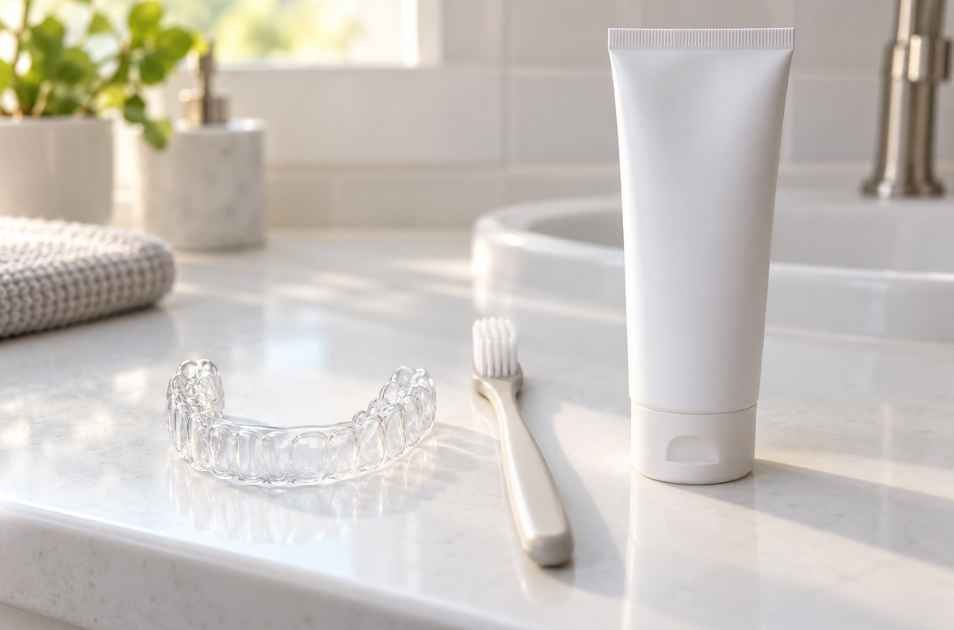
HAp toothpaste is compatible with clear aligner treatment in the sense that you brush normally, spit, rinse, and reinsert. No specific incompatibility between HAp toothpastes and clear aligner materials was found in the literature; aligner manufacturer recommendations and orthodontist instructions should be followed. The toothpaste contacts your teeth during brushing, not the aligner.
One relevant note: some HAp toothpastes leave a slight residue on teeth that’s more noticeable with clear aligners than without them — a faint white film that may transfer to the aligner’s inner surface. This is cosmetic, not a hygiene or safety concern. A thorough rinse after brushing reduces it. If residue persists, switching to a different HAp brand or formula may help, as the effect varies by formulation.
Align Technology (Invisalign’s manufacturer) does not specifically recommend or warn against HAp toothpaste. Their care instructions focus on aligner cleaning, not toothpaste choice. Your orthodontist’s toothpaste recommendation, if they have one, takes precedence.
For the complete Invisalign care guide, see: How to Clean Invisalign and Clear Aligners.
Retainers (Post-Treatment)
Post-treatment retainer wearers are the simplest case. You’re no longer in active orthodontic treatment. The brackets are gone. Your enamel access during brushing is normal. The retainer comes out, you brush your teeth, you clean the retainer separately, you put it back in.
At this stage, toothpaste choice is a personal oral health decision rather than an orthodontic one. The HAp-vs-fluoride comparison applies at its standard level: fluoride has deeper evidence, HAp has shown noninferiority in specific formulations, and your caries risk determines which evidence profile matters more to you.
One important distinction: the toothpaste you use to brush your teeth is not the product you use to clean your retainer. Toothpaste — HAp or fluoride — is generally too abrasive for clear thermoplastic retainers. The AAO recommends cleaning retainers with a soft brush and mild dish soap, not toothpaste. An HAp toothpaste is for your teeth. A cleaning tablet or ultrasonic cleaner is for your retainer. Don’t cross-purpose them.
For the full retainer care guide, see: How to Clean a Retainer. For cleaning products, see: Best Retainer Cleaner.
Night Guards
Night guard wearers often overlap with the HAp audience — both groups tend to be adults interested in dental health beyond basic brushing. The toothpaste-vs-guard cleaning distinction applies here too: brush your teeth with your chosen toothpaste, clean the guard separately with appropriate methods.
Don’t brush your night guard with HAp toothpaste (or any toothpaste). Toothpaste abrasives scratch night guard materials, creating micro-textures that harbour bacteria and accelerate staining. Use the cleaning methods in: How to Clean a Night Guard.
If you grind your teeth (bruxism), the enamel wear from grinding is a different problem from acid-driven demineralization. HAp’s proposed mechanism — depositing mineral into early enamel lesions — addresses acid-driven mineral loss, not mechanical wear from grinding forces. A night guard protects against the mechanical damage. Toothpaste (HAp or fluoride) addresses the chemical environment. They solve different problems and neither replaces the other.
What to Ask Your Orthodontist
If you’re in active orthodontic treatment and considering HAp toothpaste, these questions make the conversation productive:
Am I developing white spots? If yes, your orthodontist may specifically recommend a higher-fluoride or prescription-fluoride toothpaste. This is a higher-risk situation where fluoride’s deeper evidence base may be more appropriate than switching to HAp.
Is my current cleaning adequate? If you’re cleaning well and no demineralization is developing, the toothpaste choice is less critical. A switch to HAp is a lower-stakes decision when your enamel isn’t under active threat.
Can I use HAp as a supplementary step? Some orthodontists are comfortable with patients using HAp as a second brushing (e.g., midday or before bed) while keeping fluoride as the primary toothpaste. This gives both mechanisms without abandoning fluoride during active treatment.
Do you have a preference? Some orthodontists have strong opinions on toothpaste ingredients. Others don’t. Asking directly is faster than guessing.
Frequently Asked Questions
Can I use HAp toothpaste with braces?
Yes, in the sense that HAp toothpaste is used the same way as any toothpaste — brush, spit, rinse. Whether it provides adequate enamel protection during active bracket treatment depends on your caries risk. Discuss with your orthodontist before switching during active treatment.
Should I clean my retainer with HAp toothpaste?
No. Use HAp toothpaste (or any toothpaste) on your teeth. Clean your retainer with a soft brush and mild dish soap, a cleaning tablet, or an ultrasonic cleaner. Toothpaste abrasives scratch clear retainer materials. See: How to Clean a Retainer.
Does HAp prevent white spots from braces?
HAp’s proposed remineralization mechanism is plausible for helping with early demineralization around brackets, but no orthodontic-specific clinical trial has tested this. Fluoride has stronger evidence for white spot prevention during orthodontic treatment. If you’re already developing white spots, follow your orthodontist’s recommendation.
Can I use HAp and fluoride toothpaste together?
Yes. Some patients alternate — using fluoride for one brushing and HAp for another. Some products contain both ingredients. Whether the combination provides additive clinical benefit over either alone hasn’t been firmly established. See: HAp vs Fluoride.
Does HAp toothpaste leave residue on aligners?
Some formulations may leave a faint white film on teeth that transfers to the aligner’s inner surface. This is cosmetic, not harmful. Thorough rinsing after brushing reduces it. The effect varies by product.
