Last updated: September 2026 | By: VerdictLab Editorial Team
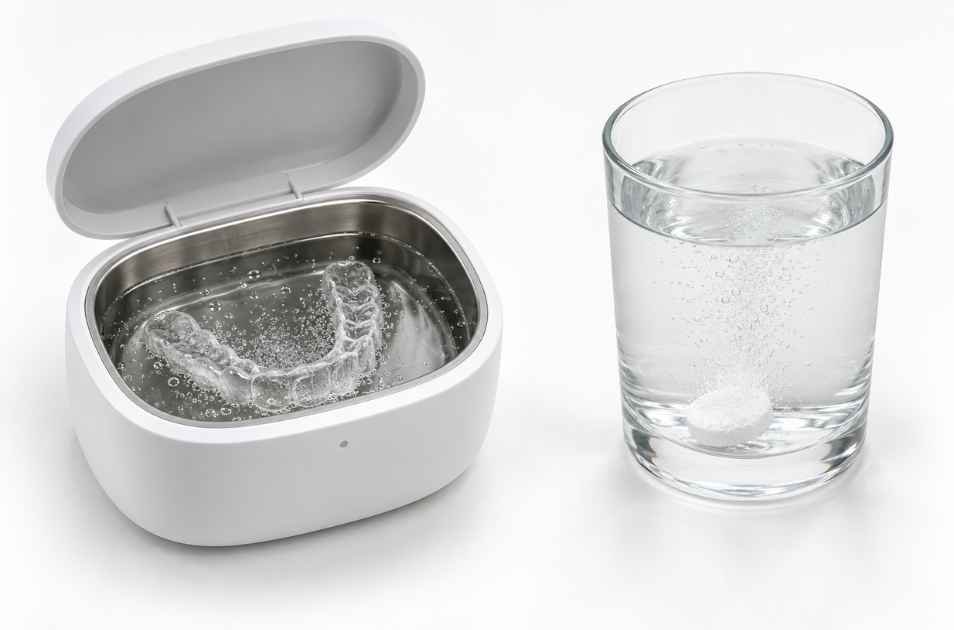
Two products, two approaches to the same problem. An ultrasonic cleaner uses high-frequency vibration to mechanically dislodge debris through cavitation. A cleaning tablet uses effervescent chemistry to dissolve biofilm and organic buildup through soaking. Both claim to deep clean your retainer. Neither is a complete solution on its own.
The question most people are really asking isn’t “which one is better?” — it’s “do I need both, or is one enough?” The answer depends on what you’re trying to accomplish, what your retainer is made of, and how much you’re willing to spend. Here’s how they compare across the endpoints that actually matter.
In This Article
Quick Answer
Neither universally dominates. Tablets are cheaper, simpler, and sufficient for most people’s weekly deep clean. An ultrasonic cleaner reaches surfaces tablets can’t and improves stain/clarity outcomes — but water-only ultrasonic cleaning performed worst in the most relevant clinical study. The combination — a tablet dissolved in ultrasonic tank water — outperformed either method alone in the 2026 clinical research. If you can afford both, use both together. If you’re choosing one, tablets are the more essential purchase.
Side-by-Side Comparison
| Factor | Ultrasonic Cleaner | Cleaning Tablets |
|---|---|---|
| How it cleans | Mechanical — cavitation bubbles dislodge debris from surfaces | Chemical — effervescent agents dissolve biofilm and organic material |
| Upfront cost | $25–$100+ (device purchase) | $0 (just the tablets) |
| Ongoing cost | Electricity only (if water-only) or + tablet cost | ~$0.10–0.25 per tablet |
| Stain removal | Stronger (independent evidence supports optical improvement) | Moderate (dissolves some surface staining) |
| Biofilm reduction | Water-only: weakest; with tablet: strongest | Moderate (~54.5% in one laboratory study) |
| Reaches crevices | Yes — cavitation accesses micro-textures | Limited — relies on chemical contact and diffusion |
| Convenience | Requires device, water, power outlet, cleanup | Cup + water + tablet. Done. |
| Travel-friendly | Bulky; needs power | Individually wrapped; fits anywhere |
| Material risk | Short-term evidence reassuring; long-term data limited | Generally safe when used as labelled; persulfate sensitivity possible |
Cleaning and Biofilm
This is the comparison that matters most — and where the 2026 clinical research provides the clearest guidance.
Sambhavaphol et al. tested four protocols on thermoplastic retainers worn by 11 patients: ultrasonic with water only, ultrasonic with 0.12% chlorhexidine, ultrasonic with a cleaning tablet, and a control. The result that reshapes the entire comparison: ultrasonic with water alone performed worst. The chemical agent — not the ultrasonic vibration — drove the difference in microbial contamination. Ultrasonic with chlorhexidine performed best. Ultrasonic with a tablet outperformed water-only.
Separately, the 2023 PMMA biofilm study tested cleaning tablets against established seven-day biofilm. Retainer Brite removed approximately 54.5% — the most of the three tested tablets, but still only about half. Established biofilm is genuinely difficult to remove by any consumer method.
What this means in practice: a cleaning tablet on its own provides moderate biofilm reduction. An ultrasonic cleaner with water on its own provides the least. The combination — tablet dissolved in ultrasonic tank water — provides the most. If you’re choosing one method, the tablet is more useful for microbial cleaning. If you have both, using them together is meaningfully better than either alone.
Stains and Clarity
This is where the ultrasonic cleaner has its clearest independent advantage.
Huang et al. (2025/2026) found that ultrasonic cleaning restored optical characteristics (clarity and colour) of stained thermoplastic retainer specimens closer to controls than either mechanical brushing or chemical tablet soaking. The cavitation action dislodges pigment particles embedded in the surface — something a passive chemical soak doesn’t do as effectively.
Tablets address surface staining through chemical dissolution. This works for mild discolouration but has limited effect on pigments that have penetrated into the material surface. For retainers that have turned yellow or cloudy from coffee, tea, or wine exposure, an ultrasonic cycle may produce noticeably better cosmetic results than a tablet soak alone.
For the full troubleshooting guide on staining and cloudiness, see: How to Remove White Buildup and Cloudiness From a Retainer.
Convenience
Tablets win this category outright. Drop a tablet in a cup of lukewarm water, add the retainer, wait 15–20 minutes, rinse. No device to set up, fill, empty, or store. No power outlet needed. Individually wrapped tablets fit in a pocket or toiletry bag. The entire process requires zero equipment beyond a cup.
An ultrasonic cleaner requires a countertop location near an outlet, filling and emptying the tank, and occasional cleaning of the tank itself. It’s not complicated, but it’s more steps than a cup-and-tablet setup. For daily or frequent use, the convenience difference compounds. For weekly use, it’s manageable.
Travel favours tablets decisively. Packing an ultrasonic pod, its power cable, and finding an outlet at a hotel is impractical for most trips. Three individually wrapped tablets fit in a ziplock bag and weigh nothing.
Cost
Tablets are dramatically cheaper to start. A 120-count box of Retainer Brite costs roughly the same as the cheapest ultrasonic pod. If you’re choosing one purchase, the tablets stretch further.
Tablet-only annual cost: at one tablet per week, a 120-count box lasts over two years. Per-year cost: roughly $5–15 depending on the brand and pack size.
Ultrasonic-only annual cost: the device costs $25–100+ upfront. No ongoing consumable cost if using water only — but water-only is the least effective approach. Add tablet cost if you’re using the combination method (recommended), which brings annual cost to $30–115+.
Combination annual cost: device ($25–100 one-time) + tablets ($5–15/year). First-year total: $30–115. Subsequent years: just the tablet cost.
If budget determines the decision, tablets alone provide meaningful cleaning at minimal ongoing cost. The ultrasonic device is a one-time investment that adds value primarily through stain removal and crevice access — real benefits, but not essential benefits if cost is the constraint.
Material Safety
Both methods carry low but non-zero material considerations.
Ultrasonic: short-term studies on thermoplastic retainers found no significant changes in surface roughness, colour, or microhardness during ultrasonic cleaning. Align Technology sells an official ultrasonic cleaner for Invisalign. These are positive signals, but long-term data (months to years of daily use) doesn’t exist for most consumer pods. Follow your appliance manufacturer’s instructions.
Tablets: generally safe when used as labelled with compatible appliances. The main concern is persulfate sensitivity — a small percentage of people react to persulfate-containing tablets with tissue irritation or allergic responses. Products like Retainer Brite and Efferdent disclose persulfate content. If you have a known sensitivity, use persulfate-free tablets or skip tablets entirely.
Neither method replaces manufacturer care instructions. If your orthodontist or retainer brand specifies a particular cleaning approach, follow that guidance regardless of what the evidence says about the general category. For the full evidence on ultrasonic material safety, see: Do Ultrasonic Retainer Cleaners Actually Work?
Using Both Together
The evidence points here. The strongest cleaning protocol tested in the 2026 clinical study combined ultrasonic mechanical action with a chemical cleaning agent. The combination addresses both endpoints: cavitation dislodges debris and reaches crevices (mechanical cleaning), while the chemical agent reduces microbial contamination (antimicrobial action).
The practical method: dissolve a cleaning tablet in the ultrasonic tank water, then run the cycle. Or drop the tablet into the filled tank and let it fizz during the cycle. Either way, the appliance is exposed to both cleaning mechanisms simultaneously. This is the approach that outperformed water-only ultrasonic, tablet-only soaking, and the control in the clinical research.
If your ultrasonic cleaner’s manual permits cleaning solutions in the tank (most do), this is the recommended weekly deep-clean protocol. If the manual specifies water-only, soak in a tablet solution separately first, rinse, then run a water-only ultrasonic cycle for the mechanical step.
Who Should Choose Which
Choose tablets alone if:
- Budget is the primary concern
- You travel frequently and need portable cleaning
- Your retainer stays reasonably clean with daily brushing plus weekly tablet soaks
- You don’t have significant staining or cloudiness issues
- You want the simplest possible deep-clean routine
Add an ultrasonic cleaner if:
- Staining or cloudiness persists despite regular tablet soaking
- Your retainer has complex geometry (clasps, crevices, textured surfaces) that manual cleaning misses
- You wear a night guard alongside a retainer and want one device that handles both
- You value the combined cleaning approach supported by clinical evidence
- You’re willing to invest $25–100 upfront for a long-lasting device
Skip both if:
- Your daily routine of brushing with dish soap keeps the retainer clean and odour-free
- Your orthodontist hasn’t recommended any supplementary cleaning
- You swap Invisalign trays every 1–2 weeks and staining/buildup doesn’t develop in that timeframe
For product recommendations: Best Ultrasonic Retainer Cleaner and Best Retainer Cleaning Tablets. For the complete product comparison across all categories, see: Best Retainer Cleaner.
Frequently Asked Questions
Can I use tablets instead of an ultrasonic cleaner?
Yes. Tablets alone provide meaningful biofilm reduction and are sufficient for most people’s weekly deep-clean needs. An ultrasonic cleaner adds stain removal and crevice access, but it’s not necessary for basic retainer hygiene. The AAO’s recommended routine (daily brushing + periodic cleaning products) doesn’t require a device.
Is an ultrasonic cleaner worth it if I already use tablets?
It depends on your situation. If your retainer stays clean, clear, and odour-free with daily brushing and weekly tablet soaks, the device adds convenience rather than necessity. If you struggle with persistent staining, cloudiness, or odour despite tablet use, the ultrasonic action addresses the mechanical cleaning that tablets can’t fully accomplish.
Which is better for odour?
Odour comes from bacterial biofilm. Tablets address it through chemical dissolution of the biofilm. Ultrasonic cleaning with water alone is less effective at reducing odour-causing bacteria. The combination (tablet + ultrasonic) addresses both the bacteria and the physical debris they anchor to. For persistent odour, see: How to Remove Bad Smell From a Retainer.
Which is better for stains?
Ultrasonic cleaning. The Huang et al. study found ultrasonic treatment restored optical characteristics more effectively than either mechanical brushing or chemical tablet soaking for stained thermoplastic retainer specimens. If cosmetic clarity is your concern, an ultrasonic cleaner adds more value than tablets alone. For the full troubleshooting guide, see: How to Remove White Buildup and Cloudiness From a Retainer.
Do I need to buy a tablet AND an ultrasonic cleaner?
No. Tablets alone are sufficient for most people. The ultrasonic cleaner is an optional upgrade. The combination is the strongest approach based on current evidence, but a tablet-only routine is a significant improvement over brushing alone — and far better than the water-only ultrasonic approach that some product marketing implies is sufficient.

Sources & References
- Sambhavaphol P et al. — Effectiveness of household ultrasonic cleaning with chemical agents on thermoplastic retainers (AJODO, 2026)
- Huang X et al. — Effects of cleaning protocols on surface roughness and optical properties of thermoplastic orthodontic retainers (Clinical Oral Investigations, 2025/2026)
- Cleaning performance of commercial orthodontic cleaning tablets regarding biofilm removal on PMMA test specimens (2023)
- American Association of Orthodontists — How to Clean Your Retainer
Related Guides
- Best Ultrasonic Retainer Cleaner
- Best Retainer Cleaning Tablets
- Best Retainer Cleaner: Devices, Tablets and Foams
- Do Ultrasonic Retainer Cleaners Actually Work?
- How to Clean a Retainer
- How to Clean Invisalign and Clear Aligners
- How to Remove White Buildup From a Retainer
- How to Remove Bad Smell From a Retainer