Last updated: September 2026 | By: VerdictLab Editorial Team
Boka, RiseWell and Davids are the three brands most people encounter when they start shopping for hydroxyapatite toothpaste. All three are fluoride-free, all three use HAp as their headline ingredient, and all three position themselves as premium alternatives to conventional toothpaste. The similarities end there.
They differ in what they disclose (RiseWell tells you its concentration; Boka doesn’t), what type of HAp they use (nano, micro, or both), how they price their products, and what supporting ingredients they include. This comparison focuses on those differences — because the things all three share (fluoride-free, HAp-based, premium-priced) don’t help you choose between them.
For the foundational evidence behind HAp toothpaste, see: What Is Hydroxyapatite Toothpaste?. For concentration interpretation, see: HAp Toothpaste Percentages.
Head-to-Head Comparison
| Attribute | Boka Ela Mint | RiseWell Original | RiseWell PRO | Davids Hydroxi |
|---|---|---|---|---|
| HAp Type | Nano-HAp | Micro-HAp | Nano + Micro | Nano-HAp |
| Concentration Disclosed? | No (proprietary) | Yes — 10% | Yes — 15% (5% nano + 10% micro) | Not independently verified |
| HAp Source Disclosed? | Western Europe lab (per brand) | Mine in France | Fluidinova (nano) + French mine (micro) | Not disclosed |
| Fluoride | No | No | No | No |
| Sensitivity Ingredient | HAp (proposed tubule occlusion) | HAp | HAp (nano component targets sensitivity) | HAp + marketed for sensitivity |
| Notable Extras | Xylitol | Xylitol, essential oils | Xylitol, essential oils | EWG Verified, metal tube |
| SLS-Free | Yes | Yes | Yes | Yes |
| Tube Size | 4 oz | 4 oz | 4 oz | 4 oz |
| Retail Availability | Amazon, Target, brand site | Amazon, brand site, retailers | Amazon, brand site | Amazon, brand site |
| Clinical Trial of This Product? | No published trial | No published trial | No published trial | No published trial |
Specifications from manufacturer product pages and help centers as of September 2026. Prices fluctuate — check Amazon for current pricing.
Boka Ela Mint
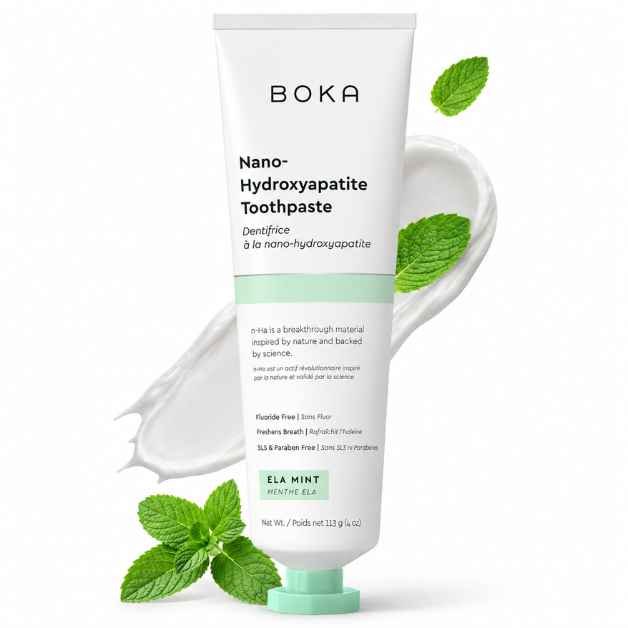
Boka is the most widely recognized HAp toothpaste brand in the US — the one most people try first when they hear about hydroxyapatite. It uses nano-HAp, is fluoride-free and SLS-free, and includes xylitol as a supporting ingredient. The Ela Mint flavor is the flagship product.
The transparency gap. Boka explicitly declines to disclose its nano-HAp concentration, calling it proprietary. Independent reviewers have estimated it somewhere in the 10–15% range based on ingredient-list ordering, but that’s guesswork — ingredient ordering alone can’t pin down an exact percentage, and Boka hasn’t confirmed any estimate. This means you can’t verify whether the amount in the tube matches the 10% concentration tested in the Paszynska clinical trial. It might. You just can’t check.
The NAD/NARB context. In 2025, the BBB’s National Advertising Division recommended Boka discontinue certain remineralization and whitening claims, finding that the evidence presented didn’t adequately support those specific advertising statements. This was a ruling about advertising claims, not product safety or effectiveness — but it’s worth knowing when evaluating the brand’s marketing language.
Best for: People who want the most widely available, widely reviewed HAp toothpaste and are comfortable with an undisclosed concentration. The brand’s retail footprint (Amazon, Target, Whole Foods) makes it the easiest to find in person.
RiseWell Original Mineral Toothpaste
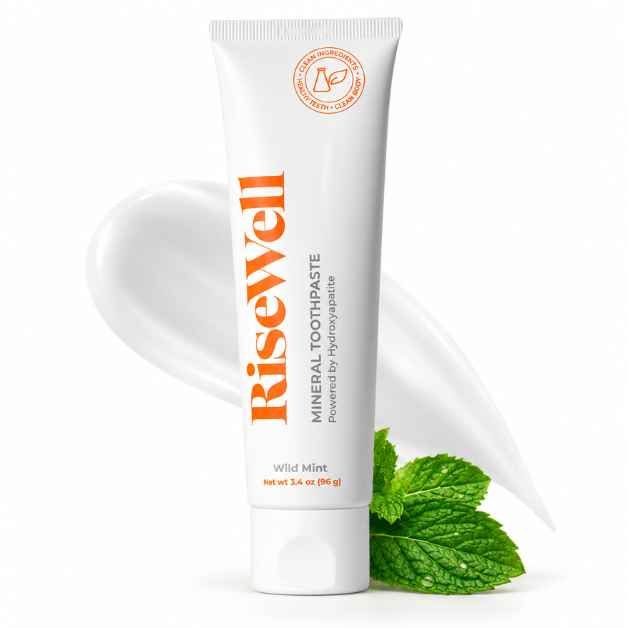
RiseWell is the most transparent brand in this comparison. The Original uses 10% micro-hydroxyapatite, sourced from a mine in France. Both the concentration and the source are disclosed on the product page — something neither Boka nor Davids does as clearly.
Micro, not nano. RiseWell Original uses micro-HAp (particles larger than 1 μm), not nano-HAp (particles under 100 nm). This is a meaningful distinction. The Paszynska adult trial tested a nano-HAp formulation. The EU SCCS safety opinion specifically assessed nano particles. Micro-HAp has its own research base, particularly around remineralization, but the studies don’t always interchange with nano-HAp results. RiseWell’s concentration (10%) matches the trial, but the particle type differs.
The formula. SLS-free, fluoride-free, with xylitol and essential oils. Some users note that RiseWell doesn’t foam as much as conventional toothpaste due to the absence of SLS — this is a formulation feature, not a performance issue, though it takes a few days to adjust to.
Best for: People who prioritise ingredient transparency and want to know exactly what concentration they’re getting. The 10% disclosed concentration, named source, and detailed FAQ make RiseWell the easiest brand to evaluate against the published evidence.
RiseWell PRO Mineral Toothpaste
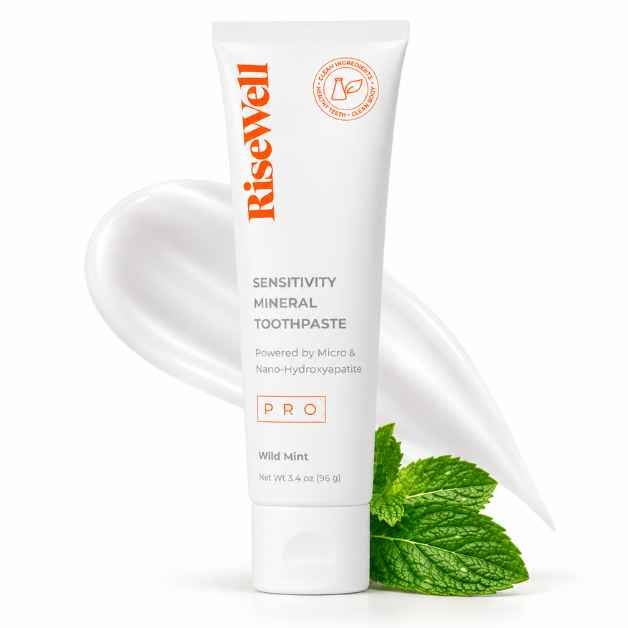
RiseWell PRO is the premium tier — the first US toothpaste to combine both nano and micro-HAp in one formula. The total stated concentration is 15%: 5% NanoXIM CarePaste (sourced from Fluidinova, the manufacturer whose material was assessed by the EU SCCS) plus 10% micro-HAp from the same French source as the Original.
The nano source matters. Fluidinova produces the NanoXIM material that was submitted for the SCCS safety assessment. That’s a stronger supply-chain signal than an unspecified “nano-HAp” from an unnamed lab. It doesn’t mean the PRO formula was individually assessed by the SCCS — it means the nano-HAp ingredient comes from the assessed manufacturer.
The concentration caveat. “15% HAp” sounds like 50% more than “10% HAp.” But 5% NanoXIM CarePaste is 5% of a commercial HAp dispersion — the actual nano-HAp mineral content from that component is a fraction of 5%, not 5% pure nano-HAp. The “15%” is accurate as a description of total HAp-containing ingredients by weight. It’s potentially misleading as a comparison to the 10% figure in the Paszynska trial, which tested a different formulation. No clinical trial has tested the PRO’s combined formula.
Best for: People who want the highest disclosed HAp concentration available, specifically want nano-HAp for sensitivity, and value that the nano component comes from the SCCS-assessed manufacturer. The premium price reflects the dual-particle formulation and Fluidinova sourcing.
Davids Hydroxi Sensitive+Whitening
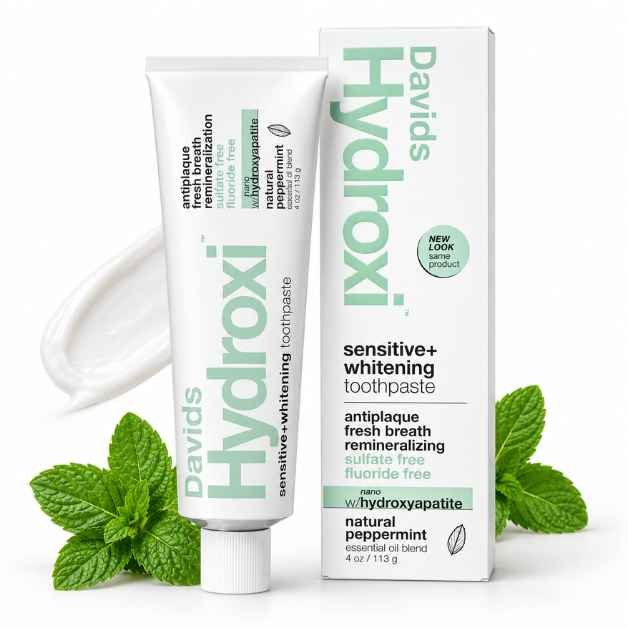
Davids approaches the HAp category from a sustainability and clean-ingredients angle. The toothpaste comes in a recyclable metal tube, is EWG Verified, and uses nano-HAp. It’s marketed for both sensitivity and whitening.
Concentration. Davids lists nano-hydroxyapatite on its ingredient list and markets the product around the ingredient, but VerdictLab has not independently verified a specific disclosed percentage from the manufacturer’s official materials. If Davids discloses a concentration, it may appear on updated product pages or in direct manufacturer communication — check the current listing.
The packaging differentiator. The recyclable metal tube is unique among these four products and matters to buyers who weigh environmental impact alongside oral care. Most HAp toothpastes come in standard plastic tubes. Davids’ metal tube is a genuine distinguishing feature, even if it has nothing to do with the toothpaste’s clinical performance.
Made in USA. Davids manufactures in the US (California), which is a supply-chain differentiator for some buyers. The “Made in USA” claim is verifiable from the brand’s own materials.
Best for: People who value sustainability (metal tube, EWG Verified), want a US-made nano-HAp toothpaste, and are less focused on concentration disclosure than on the brand’s overall ingredient and sourcing philosophy.
Which One Should You Choose?
Choose based on what matters most to you:
Transparency: RiseWell (Original or PRO) — disclosed concentration, particle type, and source for every HAp component.
Availability: Boka — widest retail footprint, easiest to find in stores.
Highest HAp concentration: RiseWell PRO — 15% combined (with the nano-dispersion caveat above).
SCCS-assessed nano source: RiseWell PRO — NanoXIM from Fluidinova, the assessed manufacturer.
Sustainability: Davids — recyclable metal tube, EWG Verified, Made in USA.
Budget: Compare current Amazon pricing — all four are in the premium toothpaste range ($8–$16/tube), but multi-packs often reduce the per-tube cost.
None of these products has been tested in a published clinical trial as the specific retail formula. The clinical evidence for HAp toothpaste comes from other formulations — Paszynska et al. tested a specific 10% HAp toothpaste made by Dr. Wolff (BioRepair/Karex). These brands use the same active ingredient category, but not the same product. This is true of the entire HAp retail market, not a flaw specific to any one brand.
For the full product roundup across more brands, see: Best Hydroxyapatite Toothpaste.
Frequently Asked Questions
Is Boka or RiseWell better?
Neither is objectively better — they make different trade-offs. RiseWell is more transparent (disclosed concentration and source). Boka is more widely available and has larger brand recognition. If concentration transparency matters to you, RiseWell wins. If retail convenience and community size matter more, Boka wins.
Is RiseWell PRO worth the premium over Original?
The PRO adds nano-HAp (from Fluidinova, the SCCS-assessed manufacturer) to the Original’s micro-HAp base, raising the total stated concentration to 15%. Whether that extra cost translates to meaningfully better clinical outcomes hasn’t been established by a published trial comparing the two. The PRO is positioned for people with sensitivity concerns who specifically want nano-HAp. If you don’t have sensitivity issues, the Original provides the same disclosed 10% micro-HAp concentration at a lower price.
Why doesn’t Boka disclose its percentage?
Boka says the concentration is proprietary. This is a common practice in consumer products, not unique to Boka. It does mean you can’t independently verify the amount against clinical evidence. Independent reviewers have estimated 10–15% from ingredient ordering, but that’s an estimate, not a confirmed figure.
Does Davids disclose its concentration?
VerdictLab has not independently verified a specific percentage from Davids’ official materials as of September 2026. Check the current product page or contact Davids directly for the latest disclosure.
Have any of these been clinically tested?
No published clinical trial was identified that tested any of these four specific retail products. The clinical evidence for HAp toothpaste comes from other formulations (notably the Paszynska trials using a Dr. Wolff product). All four brands use hydroxyapatite as an ingredient category — but the ingredient and the product are different levels of evidence.
This distinction is central to VerdictLab’s structured evidence review: results should remain specific to the tested product, population and outcome and should not automatically be transferred to another retail formulation.

Sources & References
- Boka — Nano-Hydroxyapatite Percentage (Help Center)
- RiseWell — Original Mineral Toothpaste (product page FAQ: 10% micro-HAp)
- RiseWell — PRO Mineral Toothpaste (15% combined: 5% NanoXIM + 10% micro)
- Davids — Hydroxi Sensitive+Whitening Peppermint (product page)
- BBB National Programs — NAD/NARB Decision: Essor Group (Boka), 2025
- Paszynska E et al. — Caries-preventing effect of a hydroxyapatite-toothpaste in adults (Frontiers in Public Health, 2023)
- EU SCCS — Scientific Opinion on Hydroxyapatite (nano), Submission IV (2025)