Last updated: August 2026 | By: VerdictLab Editorial Team
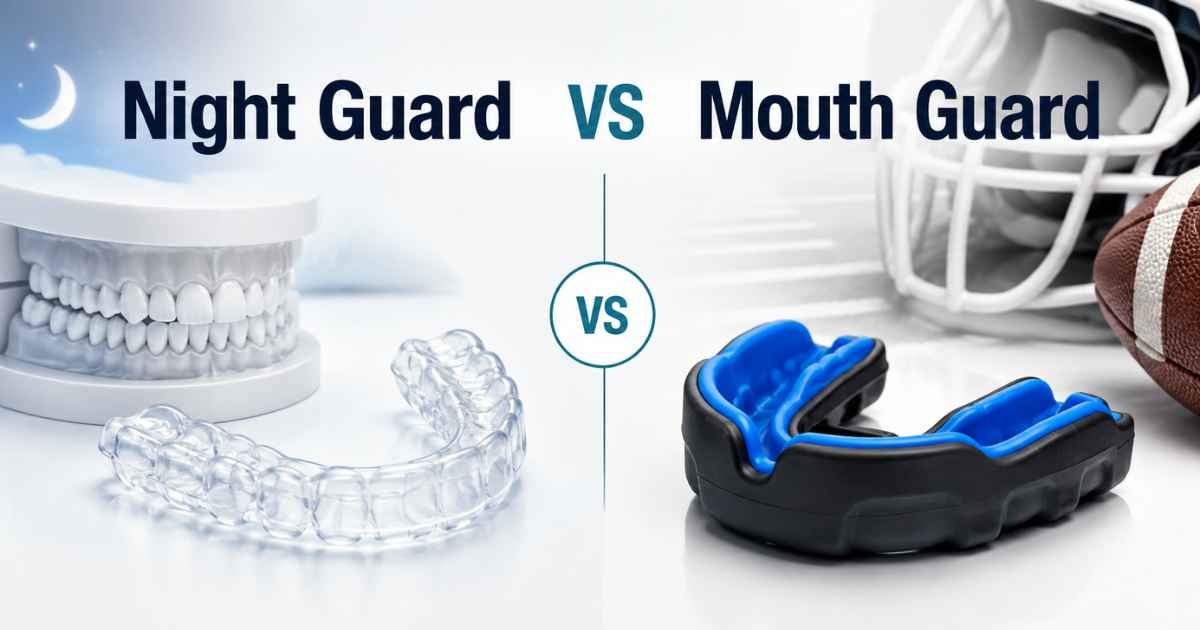
They look almost identical sitting in a case. Both are made of plastic or rubber. Both go over your teeth. Both come with the vague label “mouth guard” on Amazon listings. But a night guard and a sports mouth guard are designed for fundamentally different problems — and using the wrong one doesn’t just fail to help. It can actively make things worse.
A night guard absorbs and distributes the slow, sustained grinding force of bruxism. A sports mouth guard absorbs sudden impact. The materials, thickness, fit, and function are different in ways that matter. Here’s the breakdown.
In This Article
Quick Comparison Table
| Feature | Night Guard (Dental Guard) | Sports Mouth Guard |
|---|---|---|
| Purpose | Protects teeth from grinding/clenching during sleep | Protects teeth, jaw, and soft tissue from impact during sports |
| Force Type | Slow, sustained pressure (grinding) | Sudden impact (collision, fall, blow) |
| Material | Hard acrylic, dual-laminate, or thermoplastic | Soft, shock-absorbing EVA or silicone |
| Thickness | 1–3mm (thin enough to sleep in) | 3–6mm (bulky for maximum shock absorption) |
| Fit | Precise — custom-molded or boil-and-bite | Looser — stock, boil-and-bite, or semi-custom |
| Covers | Usually upper teeth only | Usually upper teeth only (some cover both) |
| Worn When | During sleep (or daytime for clenching) | During sports activity |
| Price Range | $12–$200 (OTC to custom lab) | $2–$50 (stock to boil-and-bite) |
| Breathing | Designed for nose breathing during sleep | Designed for mouth breathing during exertion |
What Is a Night Guard?
A night guard — also called a dental guard, occlusal splint, or bite guard — is a device worn over the upper teeth (sometimes lower) during sleep to prevent damage from bruxism. Bruxism is the medical term for grinding or clenching your teeth, and it affects an estimated 10–25% of adults. Most people who grind don’t know they’re doing it until a dentist spots the wear patterns or a partner hears it.
The guard creates a physical barrier between upper and lower teeth. When you grind, the teeth press against the guard material instead of against each other. This prevents enamel wear, tooth fractures, and the jaw muscle fatigue that causes morning headaches and TMJ pain.
Night guards come in three material categories, each suited to a different severity of grinding:
Soft guards are made from flexible EVA or silicone. They’re the most comfortable to wear but the least durable — light grinders chew through them in 3–6 months. Best for clenching (pressing teeth together without lateral movement) rather than grinding (lateral movement).
Hard guards are made from rigid acrylic or copolyester. They last the longest — often 1–3 years with proper care — and provide the most protection for severe grinders. The trade-off is a longer adjustment period. They feel noticeably foreign in your mouth for the first week.
Dual-laminate (hybrid) guards combine a soft inner layer (for comfort against the teeth) with a hard outer layer (for durability against grinding). This is the most popular category for moderate-to-heavy grinders — the best balance of comfort and protection.
For the full comparison of current night guard options, see: Best Night Guard for Teeth Grinding (2026).
What Is a Sports Mouth Guard?
A sports mouth guard is a thick, shock-absorbing device worn during athletic activity to protect teeth, gums, lips, and jaw from impact injuries. Contact sports (football, hockey, boxing, MMA, rugby, lacrosse) essentially require them. Non-contact sports with collision risk (basketball, soccer, baseball, skateboarding) strongly benefit from them.
Sports guards are designed around a fundamentally different physics problem. A night guard handles slow, sustained force — the steady pressure of jaw muscles clenching for hours. A sports mouth guard handles sudden, high-energy impact — an elbow to the face, a ball strike, a fall onto concrete. These are different force profiles requiring different material responses.
Sports guards use soft, thick EVA (ethylene-vinyl acetate) or similar shock-absorbing materials, typically 3–6mm thick. The bulk is the point — the material needs enough volume to absorb and distribute a sudden impact across the entire dental arch rather than concentrating it on a single tooth. They also extend further along the gums and sometimes include lip protection.
Three types exist:
Stock mouth guards are pre-formed, one-size-fits-all. They’re cheap ($2–10), available at any sporting goods store, and fit poorly. Better than nothing, but barely. Most athletes find them uncomfortable enough that they stop wearing them.
Boil-and-bite guards soften in hot water, then mold to your teeth when you bite down. These are the standard for recreational athletes — $10–30, available everywhere, and provide a reasonable fit. Brands like Shock Doctor and Under Armour dominate this category.
Custom sports guards are made by a dentist from an impression of your teeth. The fit is precise, the protection is superior, and they cost $200–500. Professional and serious competitive athletes typically use custom guards.
5 Key Differences That Actually Matter
1. Material hardness
This is the most important distinction. Night guards — especially for moderate-to-severe grinding — use hard or dual-laminate materials that resist the lateral abrasion of grinding. A soft material would compress and deform under sustained grinding pressure, losing its shape within weeks and potentially encouraging more clenching (your jaw muscles detect the soft material and bite harder).
Sports mouth guards use soft, flexible materials that compress on impact to absorb shock. A hard night guard used during sports would transmit impact force directly to the teeth instead of absorbing it — the opposite of what you want.
2. Thickness and profile
Night guards range from 1mm (ultra-thin daytime guards) to 3mm (heavy grinder protection). They’re designed to be thin enough that you can sleep comfortably with one in your mouth for 7–8 hours. Bulky material keeps you awake.
Sports guards range from 3mm to 6mm. The extra thickness provides the shock-absorption volume needed for impact protection. You wouldn’t sleep in one — and you shouldn’t try. The bulk interferes with breathing during sleep and can worsen jaw positioning.
3. Fit precision
Night guards require a precise fit because they’re worn for extended periods and need to maintain proper jaw alignment. A poorly fitting night guard can shift teeth over time, alter your bite, or cause TMJ symptoms rather than relieve them. Custom night guards (from a dental lab or dentist) are molded to an exact impression of your teeth. Even OTC night guards use boil-and-bite molding for a semi-custom fit.
Sports guards need a secure fit (so they don’t fall out during play), but millimetre precision is less critical. They’re worn for 1–3 hours of activity, not 8 hours of sleep. A slightly loose sports guard is annoying but not harmful.
4. Breathing design
Night guards are designed for nose breathing during sleep. They sit close to the teeth without obstructing the airway. Some premium guards (like SOVA) include perforations that allow airflow through the guard itself.
Sports guards are designed for mouth breathing during exertion. Many include breathing channels or a thinner front section that allows airflow while you’re running, playing, and panting. Wearing a sports guard during sleep can restrict airflow and worsen snoring or sleep apnea symptoms.
5. Coverage area
Night guards typically cover just the biting surfaces of the upper teeth. Some cover the lower teeth instead (particularly for anterior bruxism). They don’t extend far along the gums because gum coverage adds bulk without improving grinding protection.
Sports guards extend further along the gums and may include labial (lip-side) flanges. This wider coverage protects soft tissue from cuts and lacerations during impact — a concern in sports but not during sleep.
What Happens If You Use the Wrong One
Using a sports mouth guard for grinding
This is the more common mistake — and the more harmful one. People buy a cheap sports mouth guard from a sporting goods store, figure “it goes over my teeth, so it should work for grinding,” and wear it to bed.
Three problems develop:
The soft material encourages more clenching. Your jaw muscles detect the compressible material and respond by biting harder — the same reflex that makes you chew gum more aggressively than you’d chew nothing. Several dental studies have documented this effect. A soft sports guard can actually increase grinding force rather than reduce it.
The guard deforms quickly. A material designed to absorb sudden impact can’t handle 8 hours of sustained grinding pressure. The guard loses its shape within days to weeks, creating an uneven biting surface that can shift your jaw alignment.
The bulk interferes with sleep. A 4–6mm sports guard is significantly thicker than a 1–2mm night guard. It restricts airflow, promotes mouth breathing, and for people with any degree of sleep apnea or snoring, it can measurably worsen breathing during sleep.
Using a night guard for sports
Less common but equally problematic. A thin, hard acrylic night guard provides zero shock absorption. An impact that a sports guard would distribute across the entire arch gets concentrated at the point of contact. The night guard can crack, and the fractured pieces become a secondary injury risk inside your mouth. Hard night guards are explicitly labelled “not for use as a sports mouthpiece” for this reason.
If you need both — protection from grinding at night and protection during sports — you need two separate devices. No single guard does both jobs well.
Which Do You Need?
You need a night guard if:
- You grind or clench your teeth during sleep (your dentist or partner may have told you)
- You wake up with jaw pain, headaches, or sore teeth
- Your dentist has noticed worn enamel, flattened tooth surfaces, or cracked teeth
- You have TMJ symptoms — clicking jaw, limited opening, ear pain
- You clench during the day when stressed (a daytime guard exists for this)
See: Signs You Need a Night Guard for a more detailed symptom guide.
You need a sports mouth guard if:
- You play contact sports (football, hockey, boxing, rugby, lacrosse, MMA)
- You play collision-risk sports (basketball, soccer, baseball, skateboarding)
- Your league or coach requires one
- You’ve previously chipped or knocked out a tooth during activity
You might need both if: you grind at night AND play contact sports. Buy a night guard for sleeping and a sports guard for playing. The two devices serve different purposes and should never be used interchangeably.
If you’re not sure whether you grind, ask your dentist at your next check-up. They can spot the wear patterns in minutes. For more on whether a night guard would actually help your specific situation, see: Do Night Guards Work? What the Evidence Says.
Frequently Asked Questions
Can I use a boil-and-bite sports guard as a night guard?
No. A boil-and-bite sports guard uses soft, thick EVA material designed for impact absorption, not grinding resistance. It will compress under sustained grinding, lose its shape quickly, and may actually increase clenching force because your jaw muscles respond to the soft material by biting harder. Buy a purpose-made night guard instead — even a $12 OTC option is better than a repurposed sports guard.
My night guard says “not for use as a sports mouthpiece.” Why?
Because hard acrylic night guards provide zero shock absorption. An impact during sports would transfer directly through the guard to your teeth, and the guard itself can crack and create sharp fragments inside your mouth. Night guards are designed for slow, sustained pressure — not sudden impact.
Why are night guards so much more expensive than sports guards?
Material cost and precision. Night guards use higher-grade materials (dental-grade acrylic, thermoplastic polymers) and require a more precise fit because they’re worn for 7–8 hours every night. Custom night guards from dental labs cost $70–200 online and $300–1,000 from a dentist. Sports guards use cheaper EVA and need less precision, so they cost $2–50. For a cost breakdown, see: Night Guard Cost: Dentist vs Online vs OTC.
Are there guards that work for both grinding and sports?
Some manufacturers market “dual-purpose” guards, but no single device optimises for both grinding resistance (hard, thin, precise) and shock absorption (soft, thick, cushioning). These are opposite material requirements. A dual-purpose guard compromises on both. You’re better off with two dedicated devices.
Which type of night guard is best for me?
That depends on how heavily you grind. Soft guards for light clenching, dual-laminate (hybrid) for moderate grinding, and hard acrylic for severe bruxism. Custom lab guards (like Remi or Encore) provide the best fit. OTC boil-and-bite guards (like DenTek or SOVA) are a reasonable starting point. For the full comparison, see: Best Night Guard for Teeth Grinding (2026). For custom vs OTC specifically, see: Custom vs OTC Night Guard: Is Custom Worth It?
Can children use night guards?
Children do grind their teeth — paediatric bruxism is common, especially during ages 6–12 when permanent teeth are coming in. However, OTC adult night guards don’t fit children’s mouths properly. If your child grinds, consult a paediatric dentist first. They may recommend monitoring rather than a guard, since many children naturally outgrow bruxism. If a guard is needed, it should be dentist-fitted to accommodate a growing jaw.
The Bottom Line
Night guards protect against grinding. Sports mouth guards protect against impact. Same mouth, different problems, different solutions. Using a sports guard for grinding is the more common — and more harmful — mistake, because the soft material can actually increase clenching force and deform under sustained pressure.
If you grind your teeth, invest in a purpose-made night guard. If you play contact sports, invest in a purpose-made sports guard. If you do both, buy both. There is no effective shortcut.
For the full comparison of night guards by type, material, and price, see our complete guide to the best night guards of 2026.
Related Guides
- Best Night Guard for Teeth Grinding (2026)
- Signs You Need a Night Guard
- Do Night Guards Work? What the Evidence Says
- Custom vs OTC Night Guard: Is Custom Worth It?
- Best Custom Night Guard (Online Labs Compared)
- Best OTC Night Guard
- Night Guard Cost: Dentist vs Online vs OTC
- How to Stop Grinding Teeth at Night
Sources & References
- National Institute of Dental and Craniofacial Research (NIDCR) — Bruxism
- American Dental Association — Athletic Mouth Protectors (Mouthguards)
- The Efficacy of Occlusal Splints in the Treatment of Bruxism — Systematic Review
- Effectiveness of Mouthguards for Prevention of Orofacial Injuries in Sports — Systematic Review and Meta-Analysis