Last updated: August 2026 | By: VerdictLab Editorial Team
Ultrasonic retainer cleaners are marketed with language that ranges from reasonable (“deep clean”) to extravagant (“sterilizes 99.99% of bacteria”). The devices are real — small pods that fill with water, vibrate at ultrasonic frequencies, and claim to clean your retainer better than brushing or soaking alone. What’s less clear is which of those claims hold up under scrutiny, and which are marketing dressed up as science.
The answer depends on what you mean by “work.” Ultrasonic cavitation can dislodge debris and improve some cleaning outcomes. That part is supported. But stain removal, biofilm removal, microbial reduction, and material preservation are different endpoints — and the evidence for each is different. A device that genuinely cleans is not the same as one that sterilises, even if the Amazon listing uses both words interchangeably.
This is what the independent research actually shows.
In This Article
- Quick Verdict
- How Ultrasonic Cleaning Works
- The Water-Only Problem
- Stains and Clarity
- Biofilm and Bacteria
- Material Safety
- Invisalign and Vivera Compatibility
- What Frequency Does and Doesn’t Tell You
- Does UV Add Anything?
- Using Tablets in an Ultrasonic Tank
- Cleaning, Sanitising, Disinfecting, Sterilising
- Practical Safe-Use Protocol
- Limitations
- FAQ
Quick Verdict
Do they work?
Ultrasonic retainer cleaners are legitimate mechanical cleaning tools. They can dislodge debris, improve stain and clarity outcomes, and supplement a daily cleaning routine. But their effectiveness depends on the cleaning medium (water alone is insufficient for meaningful microbial reduction), the appliance material, and the specific endpoint being measured. They should not be described as sterilisers, and “kills 99.9% of bacteria” is a manufacturer marketing claim — not an independently verified result for most consumer pods.
How Ultrasonic Cleaning Works
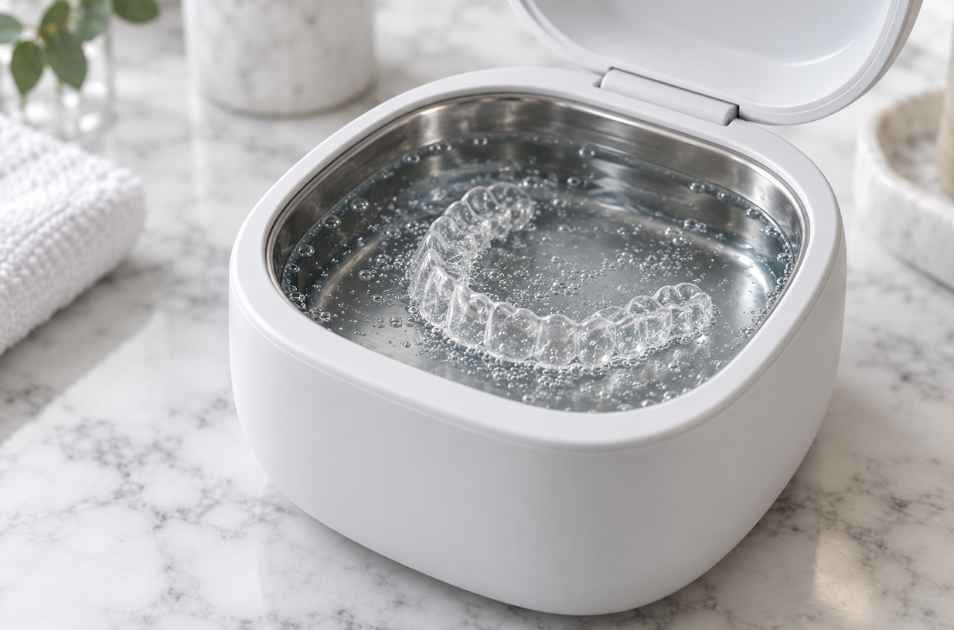
Ultrasonic cleaners generate high-frequency sound waves — typically in the 40–52 kHz range for consumer dental pods — that travel through a liquid medium (usually water). These sound waves create millions of microscopic bubbles through a process called cavitation. The bubbles form and collapse rapidly, producing tiny but intense pressure waves at the surface of whatever is submerged in the tank.
This mechanical action dislodges debris from surfaces, including crevices and textures that a toothbrush bristle can’t physically reach. The CDC classifies ultrasonic cleaners as mechanical cleaning devices — in the same broad category as manual scrubbing and automated washers — and uses them in medical-instrument processing for exactly this purpose: removing soil before a separate disinfection or sterilisation step.
That last distinction matters. In clinical settings, ultrasonic cleaning is the first step in a multi-step reprocessing chain. It removes physical contamination so that chemical or thermal disinfection can work effectively on the remaining microorganisms. Ultrasonic cleaning alone — without a subsequent antimicrobial step — does not achieve disinfection or sterilisation in clinical instrument processing. The same principle applies to consumer retainer pods, regardless of what the product listing claims.
The Water-Only Problem
This is the single most important finding for anyone considering an ultrasonic cleaner, and the one that manufacturer marketing almost never mentions.
A 2026 clinical crossover study by Sambhavaphol et al., published in the American Journal of Orthodontics and Dentofacial Orthopedics, tested four cleaning protocols on thermoplastic retainers (Essix ACE) worn by 11 patients. The protocols included ultrasonic cleaning with water only, ultrasonic with 0.12% chlorhexidine, ultrasonic with a retainer-cleaning tablet, and a control. The result that should shape how you think about these devices: ultrasonic cleaning with water alone performed worst among the four tested protocols for microbial contamination. The chemical agent used alongside the ultrasonic cleaner mattered far more than the ultrasonic action itself.
The combination of ultrasonic cleaning with 0.12% chlorhexidine produced the lowest contamination in that study. Ultrasonic with a cleaning tablet also outperformed water-only. The ultrasonic vibration contributed to cleaning — it was not useless — but without a compatible chemical agent, the cavitation alone wasn’t enough to meaningfully reduce microbial load.
This doesn’t mean ultrasonic cleaners are worthless. It means the way most people use them — fill with plain water, drop in the retainer, press the button — is the least effective configuration. Adding a compatible cleaning tablet or solution to the tank water substantially changes the outcome.
Stains and Clarity
Where ultrasonic cleaning shows its clearest advantage is in stain removal and optical restoration — making cloudy or discoloured retainers look cleaner and more transparent.
Huang et al. (2025/2026), published in Clinical Oral Investigations, studied the effects of different cleaning protocols on standardised stained thermoplastic retainer specimens. Ultrasonic cleaning restored optical characteristics (clarity and colour) closer to control specimens than either mechanical brushing or chemical tablet soaking alone. Mechanical brushing removed stains but introduced visible linear abrasions — scratches that can make the retainer look worse over time and may harbour bacteria. Chemical tablets left some residue.
Susarchick et al. (2022), studying 400 copolyester (Essix ACE) specimens, found that ultrasonic treatment generally enhanced cleaning effectiveness and improved light transmittance, particularly in stained conditions. The cosmetic improvement was measurable under controlled laboratory conditions.
The practical takeaway: if your retainer has turned cloudy, yellowish, or stained, ultrasonic cleaning may improve its appearance more effectively than scrubbing — and with less risk of scratching the surface. This is a genuinely useful benefit. It’s also a cosmetic/optical endpoint, not a microbial one. A retainer that looks cleaner isn’t necessarily more hygienic unless the cleaning protocol also addressed bacteria.
For more on cloudy retainers specifically, see: How to Remove White Buildup and Cloudiness From a Retainer.
Biofilm and Bacteria
Biofilm — the sticky, structured community of bacteria that colonises any oral appliance — is harder to remove than loose debris or surface stains. It adheres to the appliance surface and resists simple rinsing. This is where cleaning claims need the most scrutiny.
The Sambhavaphol et al. clinical study showed that chemical-assisted ultrasonic cleaning reduced microbial contamination more than water-only ultrasonic. That’s encouraging for the combination approach. But the study used specific chemicals (0.12% chlorhexidine, a prescription-strength antimicrobial) under controlled conditions with a specific retainer material. Generalising to every consumer pod with every tap-water fill exceeds what the data supports.
A separate 2023 ex-vivo study (PMID 37266911) tested commercial orthodontic cleaning tablets — including Retainer Brite — against established seven-day biofilm on PMMA specimens. Retainer Brite removed more biofilm than the two comparator tablets (Kukis and Dontodent), but the mean removal was only about 54.5%. None of the tablets achieved complete biofilm removal from established colonies. This is useful context for understanding what “cleaning tablets” actually accomplish: they help, but they don’t eliminate mature biofilm on their own.
The honest position: ultrasonic cleaning can contribute to biofilm reduction, particularly when combined with a compatible chemical agent. It’s a meaningful cleaning tool, not a magic box. Established biofilm on a long-neglected appliance probably won’t be fully removed by a single five-minute ultrasonic cycle with or without a tablet.
Material Safety
A reasonable concern: does ultrasonic vibration damage the thin thermoplastic material that retainers and clear aligners are made from?
The available short-term evidence is reassuring but limited. The Sambhavaphol et al. study found no significant changes in colour, surface roughness, or microhardness of Essix ACE thermoplastic retainers during the study’s ultrasonic cleaning phases. Huang et al. similarly found that ultrasonic cleaning produced less measured surface damage than mechanical brushing in their laboratory protocol.
The caveat: these are short-term observations on specific materials under controlled conditions. They cannot prove that daily ultrasonic cleaning over months or years is universally safe for every retainer material, every aligner brand, every guard thickness, and every water temperature. Materials vary. Pod vibration intensities vary. The research answers “short-term, no obvious damage to this specific material” — not “guaranteed safe for everything forever.”
The practical rule: follow your appliance manufacturer’s care instructions. If they specifically permit ultrasonic cleaning, proceed. If they don’t mention it, use room-temperature water, limit cycle duration to the pod’s shortest setting initially, and inspect the appliance afterward for any visible changes. If the manufacturer explicitly warns against ultrasonic cleaning, that instruction overrides general research findings.
Invisalign and Vivera Compatibility
Align Technology — the manufacturer of Invisalign and Vivera retainers — now sells its own ultrasonic cleaner, powered by Zima Dental, through the official Invisalign store. The device is specifically intended to clean Invisalign clear aligners and Invisalign/Vivera retainers in a five-minute cycle, with Cleaning Crystals+ available as an optional deeper-cleaning addition.
This is significant because it establishes manufacturer support for ultrasonic cleaning of those specific appliances with that specific device. Align Technology has more data on the material properties and tolerances of its own products than any third-party reviewer. Their willingness to sell an ultrasonic cleaner bearing the Invisalign name is a strong compatibility signal — for that device and those appliances.
What it does not establish is that every third-party ultrasonic pod on Amazon is equally safe for Invisalign. Different pods vibrate at different frequencies, with different intensities, at different temperatures. The official Invisalign cleaner was presumably validated against Invisalign materials. A generic 45 kHz pod with no Invisalign-specific testing wasn’t. The compatibility signal extends to the category concept (ultrasonic cleaning can be safe for these aligners) but not automatically to every specific product.
If you wear Invisalign or Vivera retainers and want to use an ultrasonic cleaner, the official device is the only one with explicit manufacturer support. Using a third-party pod isn’t necessarily harmful — the short-term material research is generally reassuring — but the compatibility certainty is lower.
What Frequency Does and Doesn’t Tell You
Consumer retainer cleaners operate between roughly 40 kHz and 52 kHz. Some manufacturers market higher frequency as inherently better or safer — “52 kHz is gentler on your aligner” or “higher frequency means deeper cleaning.” This framing is misleading.
Frequency determines the size of the cavitation bubbles. Higher frequencies produce smaller bubbles, which collapse with less individual energy. Lower frequencies produce larger bubbles with more aggressive individual collapse. Both can clean effectively. Neither frequency is “proven safer” for retainers based on the available comparative evidence.
No study identified in this review established that 52 kHz is materially safer than 42 kHz for thermoplastic dental appliances, or that either frequency is categorically superior for cleaning outcomes. The Sambhavaphol clinical study used a household ultrasonic cleaner without reporting frequency as a differential variable — because cleaning agent mattered far more than frequency in that study’s results.
Frequency is a specification, not a safety score. Treat it the way you’d treat the wattage of a light bulb — relevant to the device’s operation, not a one-dimensional measure of quality. Tank capacity, cycle duration, water temperature, and — above all — whether you use a cleaning agent alongside the water matter more for your retainer than whether the label says 42 or 52 kHz.
Does UV Add Anything?
Many ultrasonic retainer pods include a UV-C light feature, marketed as providing additional “sanitisation” or “sterilisation.” The concept isn’t baseless — UV-C light at appropriate wavelengths (around 254 nm) can inactivate microorganisms by damaging their DNA. This is established physics used in water treatment, air purification, and hospital surface disinfection.
Whether the UV feature in a specific consumer retainer pod delivers a meaningful antimicrobial benefit is a different question. Germicidal UV effectiveness depends on wavelength, dose (intensity × time), distance from the target, and whether the light actually reaches all surfaces — including the inner surfaces of a retainer sitting in a liquid-filled tank. Soil and liquid between the UV source and the surface reduce effectiveness. Exact wavelength verification for most consumer pods is not provided in their marketing materials.
No strong independent clinical evidence was identified establishing that the UV feature in consumer retainer pods provides a significant incremental benefit beyond ultrasonic cleaning with a compatible chemical agent. The feature may contribute some antimicrobial action. It may also contribute very little. Without product-specific testing data that goes beyond manufacturer self-reporting, the honest assessment is: potential supplementary mechanism, unproven incremental real-world benefit for most pods.
A UV feature shouldn’t be a reason to skip using a cleaning tablet or solution. And it definitely shouldn’t be a reason to accept “sterilises” as an accurate description of what the device does.
Using Tablets in an Ultrasonic Tank
Given that chemical-assisted ultrasonic cleaning outperformed water-only cleaning in the most directly relevant clinical research, adding a cleaning tablet to the tank water is a logical improvement. Some pod manufacturers explicitly recommend or permit this. Others are silent on it.
The practical approach: if your ultrasonic cleaner’s manual says tablets or cleaning solutions are compatible, use them. Dissolve the tablet in the tank water before starting the cycle, or let it fizz during the cycle — either approach puts the chemical agent in contact with the appliance while cavitation does the mechanical work. The combination addresses both physical debris (ultrasonic) and microbial contamination (chemical agent) simultaneously.
If the manual doesn’t mention tablets, a conservative approach is to dissolve the tablet in a separate cup, soak the retainer briefly, then transfer to the ultrasonic tank with plain water for the mechanical cleaning step. This avoids any theoretical concern about tablet chemistry interacting with the pod’s tank coating while still providing chemical-assisted cleaning.
Not every tablet is compatible with every appliance material. Check both the tablet label (does it list your appliance type?) and your appliance manufacturer’s instructions (do they permit tablet use?). The general care guidance from the AAO supports periodic use of retainer-cleaning solutions or tablets, so the concept isn’t controversial — the specifics of which tablet with which pod with which appliance type is where individual checking matters.
For the comparison of ultrasonic devices versus tablets as standalone cleaning methods, see: Ultrasonic Retainer Cleaner vs Cleaning Tablets.
Cleaning, Sanitising, Disinfecting, Sterilising
These words are not interchangeable, and the way they’re used on product listings is frequently misleading. VerdictLab uses them consistently across all articles, following CDC definitions:
Cleaning means physically removing soil, debris, and organic material from a surface. Brushing your retainer with soap, soaking it in a cleaning solution, and running it through an ultrasonic pod are all cleaning methods. CDC explicitly classifies ultrasonic cleaners as mechanical cleaning devices.
Sanitising means reducing germs to a level considered acceptable under a defined standard or context. It’s a weaker claim than disinfecting — it reduces microbial load without necessarily eliminating all pathogens.
Disinfecting means eliminating many or all pathogenic microorganisms on an inanimate object, generally not including bacterial spores. This is a stronger claim that requires evidence of specific antimicrobial action.
Sterilising means destroying or eliminating all forms of microbial life — bacteria, viruses, fungi, and spores. This is an absolute claim and the strongest possible hygiene assertion. It requires specific validated processes (autoclaving, chemical sterilants, verified high-level methods) and does not apply to any consumer retainer pod on the market.
When an Amazon listing says a retainer pod “sterilises” your appliance, that claim is not supported by the independent evidence reviewed here. Consumer ultrasonic pods are cleaning devices. Some may contribute to microbial reduction, especially with a compatible chemical agent. None has been independently shown to achieve sterilisation as the term is properly defined.
Practical Safe-Use Protocol
Based on the available evidence, here’s a reasonable approach to using an ultrasonic retainer cleaner:
Check your appliance manufacturer’s instructions first. If they specifically permit or recommend ultrasonic cleaning, proceed. If they warn against it, follow their guidance regardless of what this or any other article says. Manufacturer instructions for your specific appliance material override general research findings.
Use a compatible cleaning agent in the tank. The 2026 clinical research is clear: water-only ultrasonic cleaning was the least effective protocol. Add a retainer-cleaning tablet or manufacturer-recommended solution to the tank water. This is where the meaningful antimicrobial improvement comes from.
Use room-temperature or lukewarm water. Hot water can warp thermoplastic retainers and clear aligners. Unless your pod’s manual specifically instructs otherwise, room temperature is the safe default.
Follow the device’s preset cycle. Don’t improvise longer cycles, higher temperatures, or cleaning agents the manual doesn’t mention. More isn’t necessarily better, and longer exposure to vibration or inappropriate chemistry could affect your appliance.
Don’t skip daily manual cleaning. An ultrasonic pod is a supplement to your daily routine, not a replacement for it. The AAO recommends rinsing your retainer with lukewarm water after removal and gently brushing it daily with a dedicated soft toothbrush and mild dish soap. The ultrasonic cycle — weekly or a few times a week — adds deeper cleaning that manual methods may miss.
Inspect your appliance after cleaning. Look for any changes in fit, clarity, texture, or structural integrity. If you notice warping, increased roughness, or a change in how the retainer seats on your teeth, stop using the ultrasonic cleaner and consult your orthodontist.
For the full daily retainer care guide, see: How to Clean a Retainer.
Limitations of the Current Evidence
The research base for ultrasonic cleaning of dental appliances is small and recent. The most directly relevant clinical study (Sambhavaphol et al.) had 11 participants and tested one specific retainer material with specific chemical agents over short phases. The materials studies used laboratory specimens under controlled conditions that may not reflect years of daily home use.
No long-term study has tracked the effects of daily ultrasonic cleaning on retainer material properties over 6–12 months. No large-scale randomised trial has compared ultrasonic cleaning to manual cleaning for clinically relevant outcomes (infection rates, retainer failure, orthodontic relapse). The evidence supports the mechanism and shows promising short-term results, but it’s not yet deep enough to make strong universal recommendations.
Product-specific testing data is largely absent from the public domain. Individual pod manufacturers may have internal testing, but most consumer devices on Amazon lack published, independent validation of their specific cleaning claims. This makes brand-specific “which pod is best” comparisons difficult to ground in evidence rather than specifications and user reports.
VerdictLab will update this article as new research is published. The field is active — the 2025–2026 studies cited here are the first directly relevant clinical and materials studies for this specific application, and more are likely to follow.
Frequently Asked Questions
Do ultrasonic retainer cleaners kill bacteria?
Ultrasonic cavitation is a mechanical cleaning process — it dislodges debris and can disrupt some surface bacteria. But “kill” implies antimicrobial action, and the independent evidence shows that the cleaning medium matters more than the vibration. Ultrasonic cleaning with water alone performed worst in the most relevant clinical study. Adding a compatible chemical agent (a cleaning tablet or antimicrobial solution) to the tank water is where meaningful microbial reduction comes from.
Are ultrasonic cleaners safe for clear retainers?
Short-term studies on thermoplastic retainer materials (Essix ACE) found no significant changes in surface roughness, colour, or microhardness during ultrasonic cleaning phases. Align Technology sells an official ultrasonic cleaner for Invisalign and Vivera. These are positive signals, but they don’t prove that every pod at every frequency with every water temperature is safe for every clear retainer brand. Check your specific appliance manufacturer’s instructions.
Do I need to add a tablet, or is water enough?
The evidence strongly favours adding a compatible cleaning agent. The 2026 clinical study found that water-only ultrasonic cleaning was the least effective protocol for reducing contamination. A retainer-cleaning tablet or manufacturer-recommended solution in the tank water substantially improves outcomes. If your pod’s manual permits tablet use, use one.
Is 42 kHz or 52 kHz better?
No available evidence establishes either frequency as superior for retainer cleaning or safety. Higher frequency produces smaller cavitation bubbles; lower frequency produces larger ones with more aggressive collapse. Both can clean effectively. The cleaning agent you use, the water temperature, and the cycle duration matter more than the frequency number on the label.
Does the UV feature actually do anything?
UV-C light can inactivate microorganisms under suitable conditions (appropriate wavelength, dose, and direct exposure). Whether the UV feature in a specific consumer pod delivers meaningful incremental benefit beyond ultrasonic cleaning with a chemical agent is unproven for most devices. It’s a potential supplementary mechanism, not a reason to skip proper cleaning.
Can an ultrasonic cleaner replace brushing my retainer?
No. The AAO recommends daily rinsing and gentle brushing with a dedicated toothbrush and mild dish soap as the foundation of retainer care. An ultrasonic cleaner supplements this routine by reaching areas manual cleaning may miss and improving stain/clarity outcomes. It doesn’t replace the daily basics.
Is it safe for my night guard?
Night guards come in different materials — hard acrylic, soft EVA, dual-laminate — and each responds differently. The short-term evidence on thermoplastic materials is generally reassuring, but night guard materials vary more widely than retainer materials. Check your guard manufacturer’s care instructions. For the full night guard cleaning guide, see: How to Clean a Night Guard.

Sources & References
- Sambhavaphol P et al. — Effectiveness of household ultrasonic cleaning with chemical agents on thermoplastic retainers: a clinical study (American Journal of Orthodontics and Dentofacial Orthopedics, 2026)
- Huang X et al. — Effects of cleaning protocols on surface roughness and optical properties of thermoplastic orthodontic retainers (Clinical Oral Investigations, 2025/2026)
- Susarchick L et al. — The effects of staining and cleaning on the color and light transmittance changes of a copolyester retainer material with different surface textures (Materials, 2022)
- Investigation of the cleaning performance of commercial orthodontic cleaning tablets regarding biofilm removal on PMMA test specimens: an ex vivo study (2023)
- CDC — Cleaning (Guideline for Disinfection and Sterilization in Healthcare Facilities)
- CDC — Introduction, Methods, Definition of Terms (Disinfection and Sterilization)
- Align Technology — Invisalign Ultrasonic Cleaning Station Bundle (Official Store)
- American Association of Orthodontists — How to Clean Your Retainer
Related Guides
- Best Ultrasonic Retainer Cleaner (2026)
- Best Retainer Cleaner: Devices, Tablets and Foams
- Best Retainer Cleaning Tablets
- Ultrasonic Retainer Cleaner vs Cleaning Tablets
- How to Clean a Retainer
- How to Clean Invisalign and Clear Aligners
- How to Remove White Buildup From a Retainer
- How to Remove Bad Smell From a Retainer
- Can You Use Denture Cleaner on a Retainer?
- How to Clean a Night Guard