Last updated: September 2026 | By: VerdictLab Editorial Team
A retainer that isn’t cleaned regularly becomes a reservoir for the bacteria, plaque, and mineral deposits it was supposed to protect your teeth from. The appliance sits against your teeth for hours — all night for a nighttime retainer, most of the day for a full-time wear schedule — collecting everything your mouth produces: saliva, food particles, and the biofilm that forms continuously on any oral surface.
The cleaning routine is simple. The mistakes people make — hot water, toothpaste, skipping days — are simpler. And the consequences of neglect (odour, buildup, staining, and an appliance that becomes unhygienic faster than it wears out) are entirely avoidable.
This guide covers daily maintenance, weekly deep cleaning, material-specific advice for clear and Hawley retainers, and the things that damage retainers more than dirty ones do.
In This Guide
Know Your Retainer Type
Cleaning advice depends on what your retainer is made of. The two main types respond differently to heat, chemicals, and abrasion.
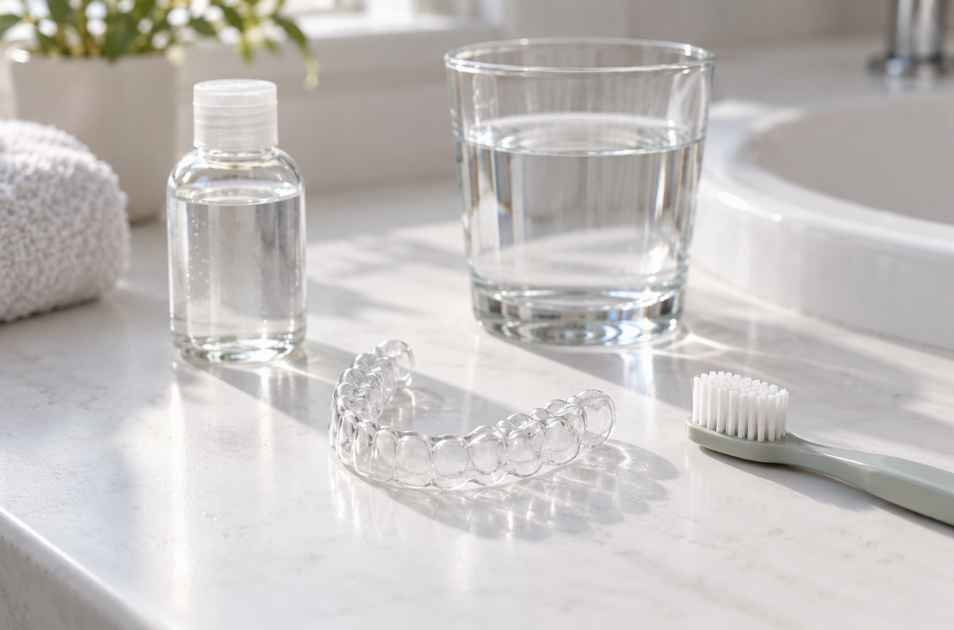
Clear thermoplastic retainers (Essix-type, Vivera, and most clear aligners like Invisalign) are made from thin, transparent plastic — typically a copolyester or polypropylene material. They’re the most common type prescribed after orthodontic treatment. They’re also the most sensitive to heat, abrasion, and harsh chemicals. Hot water warps them. Toothpaste scratches them. Alcohol-based products can degrade them.
Hawley retainers are the traditional design: an acrylic plate with metal wire clasps that hook around the teeth. The acrylic is more durable than clear thermoplastic and less sensitive to mild abrasion, but it can crack if dropped and stain if not cleaned regularly. The metal components need attention too — mineral buildup can accumulate around the wire-acrylic junctions.
Permanent (bonded) retainers are fixed wires cemented to the back of the front teeth. They’re not removable and can’t be cleaned with the methods in this guide — they need to be cleaned in place with your regular brushing and flossing routine, plus professional cleanings. If your only retainer is bonded, this article isn’t the one you need.
If you’re not sure which type you have, your orthodontist’s office can tell you. For Invisalign-specific care, which has some differences from generic clear retainers, see: How to Clean Invisalign and Clear Aligners.
Daily Cleaning Routine
Do this every time you remove the retainer. For nighttime retainers, that means every morning. For full-time retainers, it means after every extended wear period.
Rinse immediately. Run the retainer under lukewarm water as soon as you take it out of your mouth. This removes loose saliva and debris before it dries and hardens. Don’t use hot water — even briefly — on a clear thermoplastic retainer. Warm is fine. Hot warps.
Brush gently with a soft-bristled toothbrush and mild dish soap. Use a separate toothbrush dedicated to retainer cleaning — not the one you brush your teeth with. A small amount of unscented, mild dish soap is the cleaning agent the AAO supports for daily use. Brush all surfaces: the outer side, the inner side that contacts your teeth, and any crevices where debris collects.
Skip the toothpaste. This is counterintuitive — toothpaste cleans teeth, so it should clean a retainer too. But most toothpastes contain mild abrasives (silica, calcium carbonate, baking soda) designed to scrub enamel, which is the hardest substance in the human body. Clear retainer plastic is much softer. Those same abrasives create microscopic scratches on the retainer surface, and scratched surfaces harbour more bacteria and stain faster. Unless your retainer manufacturer specifically says toothpaste is safe for their product, avoid it.
Rinse thoroughly and let it air-dry. After brushing, rinse all the soap off under running water. Set the retainer on a clean surface (a paper towel works) and let it dry completely before putting it in its case. A damp retainer sealed in a case creates a warm, moist environment that encourages bacterial growth — exactly the conditions you just cleaned it to avoid.
This takes about 60 seconds. It’s the single most important thing you can do for retainer hygiene. The weekly deep clean matters too, but it can’t compensate for skipping the daily routine.
Weekly Deep Clean
Once a week, give the retainer a more thorough soak to address the buildup that daily brushing leaves behind. Several methods work — pick the one that fits your retainer type and your orthodontist’s guidance.
Retainer cleaning tablets
Drop a retainer-cleaning tablet (such as Retainer Brite or a product explicitly labelled for retainers and aligners) into a cup of lukewarm water. Add the retainer and follow the timing on the tablet packaging — usually 15–20 minutes. The effervescent action helps dissolve biofilm and mineral deposits that brushing alone misses.
Check the tablet label before using it on your specific appliance. Products labelled for retainers, clear aligners, and dental appliances are the appropriate choice. Not every denture-cleaning tablet is formulated identically — some contain ingredients that may not be suitable for all retainer materials. For more on this question, see: Can You Use Denture Cleaner on a Retainer?
Some cleaning tablets contain persulfates, which can cause allergic reactions in sensitive individuals. If you have a known persulfate sensitivity, look for a persulfate-free formulation or use one of the alternative methods below.
Diluted white vinegar
Mix equal parts white vinegar and lukewarm water. Soak the retainer for 15–20 minutes. The mild acidity helps dissolve mineral deposits. Rinse thoroughly and brush gently afterward to remove any loosened residue. This is a simple, inexpensive option, though the retainer may taste faintly acidic on first wear — a thorough rinse before wearing handles that.
Don’t soak for extended periods (hours or overnight) unless your manufacturer specifically says it’s safe. Different retainer materials respond differently to prolonged acid exposure.
Hydrogen peroxide
Some manufacturers allow short soaks in standard 3% hydrogen peroxide (the drugstore concentration). Compatibility and timing vary by material — check your retainer’s care instructions. When permitted, a 10–15 minute soak followed by a thorough rinse provides antimicrobial action without the acidity of vinegar.
After any deep-clean method, brush the retainer again with your dedicated soft toothbrush and rinse thoroughly under lukewarm water. Let it air-dry completely before storing.
For the full comparison of cleaning tablets versus ultrasonic devices, see: Ultrasonic Retainer Cleaner vs Cleaning Tablets. For cleaning product recommendations, see: Best Retainer Cleaner.
What Not to Use
Retainer materials — particularly clear thermoplastic — are more sensitive to heat and chemicals than they appear. The AAO and most orthodontic authorities advise against the following:
Hot or boiling water. Thermoplastic retainers warp at temperatures well below boiling. Even hot tap water can distort a clear retainer enough to change its fit. Once warped, the retainer can’t be reshaped — it needs replacing. Always use lukewarm or room-temperature water. This applies to dishwashers too — the heat cycle will ruin a clear retainer.
Toothpaste. The abrasives in most toothpastes scratch the retainer surface, creating micro-grooves that harbour bacteria and accelerate staining. If your specific retainer manufacturer says a particular non-abrasive toothpaste is safe for their product, follow their guidance. Otherwise, mild dish soap is the AAO-supported alternative.
Alcohol-based mouthwash. Products like Listerine contain alcohol that can dry out, discolour, and degrade some retainer materials over time. If you want an antimicrobial soak, use a purpose-made retainer cleaning tablet or one of the methods in the deep-clean section above — not mouthwash.
Bleach. Even diluted. Bleach is too harsh for retainer materials, can leave a residual taste that’s difficult to remove, and may irritate oral tissue. The AAO explicitly warns against it.
Harsh detergents and strong chemicals. Anything beyond mild dish soap introduces unnecessary risk to the retainer material. If it wouldn’t be gentle enough for fine glassware, it’s not gentle enough for a retainer.
Abrasive tools. Stiff brushes, scouring pads, and aggressive scrubbing can scratch and weaken retainer material. Use a soft-bristled toothbrush with gentle pressure. If deposits won’t come off with gentle methods, see the stains section below rather than scrubbing harder.
How Often to Clean
Daily brushing: every time you remove the retainer. Non-negotiable. This is the foundation that every other cleaning method builds on. A retainer that gets daily brushing and rinsing will stay cleaner over its lifetime than one that gets weekly deep cleans but skips the daily routine.
Deep cleaning: once or twice a week for most people. If you notice buildup developing faster than your weekly soak handles — common in areas with hard water, or if you drink coffee, tea, or red wine regularly — increase to twice a week. Your retainer will tell you: if it’s developing a visible film, cloudiness, or odour between deep cleans, clean it more often.
Ultrasonic cleaning (if you use one): a few times a week or as a supplement to your weekly deep clean. An ultrasonic cleaner is not a daily replacement for brushing — it’s an additional step that can reach areas manual cleaning misses. See the ultrasonic section below for details.
After illness: clean the retainer thoroughly (daily brush + deep soak) after recovering from any illness, particularly anything involving the mouth or respiratory system. Replace the storage case.
Cleaning the Case
Most people clean the retainer and forget the case. Then they put a freshly cleaned retainer into a case that hasn’t been washed in weeks — and wonder why the retainer smells again the next morning.
Wash the case at least once a week with warm water and a small amount of dish soap. Use a brush to reach the corners and the lid’s inner surface. Rinse thoroughly and let it air-dry completely before putting the retainer back in. If the case has ventilation holes, make sure they’re not clogged with dried residue.
Replace the case periodically — every few months, or whenever it develops a persistent odour, visible discolouration, or any sign of mould. Cases are cheap and replaceable. A dirty case recontaminates a clean retainer every time you put it away.
When you’re not wearing the retainer, keep the case in a clean, room-temperature location — not in direct sunlight, not near a heat source, and not somewhere a curious pet can reach. Dogs are attracted to the saliva residue on retainer cases and will chew through both the case and the retainer inside it.
Should You Use an Ultrasonic Cleaner?
Ultrasonic retainer cleaners — small pods that vibrate at 40–52 kHz, creating microscopic cavitation bubbles — can supplement your daily routine by reaching crevices and textures that a toothbrush misses. The short-term evidence on material safety is generally reassuring for thermoplastic retainers, and Align Technology sells an official ultrasonic cleaner for Invisalign and Vivera appliances, which is a meaningful manufacturer compatibility signal.
The most important finding from the research: ultrasonic cleaning with water alone performed worst among tested protocols in a 2026 clinical study on thermoplastic retainers. The cleaning medium mattered more than the vibration. Adding a compatible cleaning tablet or solution to the tank water substantially improved outcomes.
An ultrasonic cleaner is not a necessity for retainer care. The AAO’s recommended routine — daily rinsing, gentle brushing with dish soap, and periodic cleaning tablets — handles the fundamentals without one. An ultrasonic pod is an optional convenience tool that can improve stain removal and reach what manual cleaning leaves behind, particularly for appliances with complex geometry or persistent buildup.
If you’re considering one, check your retainer manufacturer’s instructions first. For the full evidence on how ultrasonic cleaners perform, see: Do Ultrasonic Retainer Cleaners Actually Work?. For product comparisons, see: Best Ultrasonic Retainer Cleaner.
Stains, Mineral Deposits, and Cloudiness
Even with consistent cleaning, retainers can develop discolouration, white buildup, or a cloudy appearance over time. These have different causes and different remedies.
Yellow or brownish staining typically comes from food and drink exposure — coffee, tea, red wine, turmeric — or from tobacco use. A cleaning tablet soak is the first-line treatment. For stubborn stains, some research suggests ultrasonic cleaning may restore optical clarity more effectively than manual scrubbing, with less risk of scratching the surface.
White chalky deposits are usually mineral buildup from saliva or hard water. A diluted white vinegar soak (equal parts vinegar and lukewarm water, 15–20 minutes) can dissolve mild mineral deposits. For hardened buildup that doesn’t respond to gentle methods, consult your orthodontist before attempting aggressive removal — scraping or abrasive cleaning can permanently damage the retainer surface.
Cloudiness can mean several things: removable surface deposits, permanent surface scratches from abrasive cleaning, or material degradation from age or chemical exposure. The first step is trying a gentle cleaning soak — if the cloudiness clears, it was removable buildup. If it doesn’t, the retainer’s surface may be permanently altered, and replacement may be the appropriate next step.
For the full troubleshooting guide, see: How to Remove White Buildup and Cloudiness From a Retainer.
When to Contact Your Orthodontist
Most retainer cleaning is straightforward home care. But some situations warrant professional input.
Persistent odour despite thorough cleaning. If the retainer smells even after a deep clean and case replacement, bacteria may be embedded in surface damage that home methods can’t reach. Your orthodontist can assess whether the retainer needs replacing. For troubleshooting steps first, see: How to Remove Bad Smell From a Retainer.
Visible cracks, chips, or warping. A damaged retainer can irritate soft tissue, fit unevenly, or fail to maintain tooth position. Don’t continue wearing a retainer with visible structural damage — contact your orthodontist for evaluation.
Changed fit. If the retainer feels tighter, looser, or doesn’t seat the way it used to, something has changed — either the retainer has deformed or your teeth have shifted. Either way, your orthodontist needs to know.
Irritation, sores, or allergic reaction. Mouth irritation from a retainer can indicate a fit problem, a material reaction, or a sensitivity to cleaning products (persulfate allergy from cleaning tablets is documented). Stop wearing the retainer and consult your orthodontist or dentist.
You’re unsure about a cleaning method. If you’re not sure whether a product, device, or cleaning approach is safe for your specific retainer material, ask your orthodontist’s office. They can confirm compatibility in seconds. A damaged retainer costs far more to replace than the time a phone call takes.
Frequently Asked Questions
Can I use toothpaste on my retainer?
The AAO advises against it for most retainers. Toothpaste abrasives can scratch clear thermoplastic retainers, creating micro-grooves that harbour bacteria and accelerate staining. Use a soft-bristled toothbrush with mild dish soap instead. If your retainer manufacturer specifically says a non-abrasive toothpaste is safe for their product, follow their guidance.
How often should I clean my retainer?
Rinse and brush daily — every time you remove it. Deep clean (tablet soak, vinegar soak, or ultrasonic) once or twice a week. If you notice buildup, odour, or cloudiness developing between deep cleans, increase the frequency. Consistency matters more than intensity: a retainer brushed daily stays cleaner than one deep-cleaned weekly but skipped on the other six days.
Can I soak my retainer overnight?
This depends on the product and the retainer material. Some cleaning tablet labels specify short soak times (15–20 minutes), and prolonged exposure to the chemistry may affect certain materials. Don’t soak in vinegar or hydrogen peroxide overnight unless your manufacturer specifically says it’s safe. If you want an overnight soak, use plain lukewarm water — it won’t clean actively, but it keeps the retainer moist without chemical exposure risk.
Is it safe to use denture cleaning tablets on my retainer?
“Denture cleaner” is a category, not a single formulation. Some products — like Efferdent’s Retainer Clean & Bright — are explicitly labelled for retainers, clear aligners, and night guards. Others are formulated specifically for denture materials and may not be appropriate for clear thermoplastic retainers. Use the exact product label and your appliance manufacturer’s instructions to determine compatibility. For the full analysis, see: Can You Use Denture Cleaner on a Retainer?
What if my retainer smells bad even after cleaning?
Persistent odour usually means bacteria have colonised surface damage that routine cleaning can’t reach. Try a thorough deep clean (tablet soak + gentle brushing). Clean or replace the storage case — a dirty case recontaminates a clean retainer. If odour persists despite these steps, the retainer surface may be permanently compromised and replacement may be needed. See: How to Remove Bad Smell From a Retainer.
My retainer has a white film on it. What is it?
Most likely mineral deposits from saliva or hard water. A diluted white vinegar soak (15–20 minutes) often dissolves mild buildup. If it’s hardened and doesn’t respond to gentle soaking, don’t scrub aggressively — you’ll scratch the surface. Consult your orthodontist. See: How to Remove White Buildup and Cloudiness From a Retainer.
How do I clean a Hawley retainer differently from a clear retainer?
Hawley retainers (acrylic plate with metal wire) are more tolerant of gentle brushing than clear thermoplastic retainers. The daily routine is similar — lukewarm water, soft brush, mild dish soap. Pay attention to the wire-acrylic junctions where buildup accumulates. Hawley retainers are less sensitive to mild abrasion than clear retainers, but the acrylic can still crack from dropping or crack from extreme temperature changes. Don’t use hot water on the acrylic plate.
Do I need to clean a retainer I only wear at night?
Yes — every morning when you take it out. Your mouth produces saliva and bacteria continuously during sleep. A nighttime retainer accumulates the same biofilm as a full-time retainer; it just does it in an 8-hour window instead of a 22-hour one. The daily rinse-and-brush routine applies regardless of wear schedule.

Sources & References
- American Association of Orthodontists — How to Clean Your Retainer
- Sambhavaphol P et al. — Effectiveness of household ultrasonic cleaning with chemical agents on thermoplastic retainers (AJODO, 2026)
- Huang X et al. — Effects of cleaning protocols on surface roughness and optical properties of thermoplastic orthodontic retainers (Clinical Oral Investigations, 2025/2026)
- Efferdent — Retainer Clean & Bright (product label and appliance compatibility)
Related Guides
- Do Ultrasonic Retainer Cleaners Actually Work?
- Best Retainer Cleaner: Devices, Tablets and Foams
- Best Ultrasonic Retainer Cleaner
- Best Retainer Cleaning Tablets
- Ultrasonic Retainer Cleaner vs Cleaning Tablets
- How to Clean Invisalign and Clear Aligners
- How to Remove White Buildup From a Retainer
- How to Remove Bad Smell From a Retainer
- Can You Use Denture Cleaner on a Retainer?
- How to Clean a Night Guard