Last updated: September 2026 | By: VerdictLab Editorial Team
“10% nano-hydroxyapatite” is the number you’ll see most often in the HAp toothpaste category. Some brands disclose their percentage. Others call it proprietary. A few claim higher concentrations. And almost none explain what the percentage actually means — or whether it matches the concentration studied in clinical trials.
This guide explains how to read HAp toothpaste labels, what the disclosed percentages tell you, what they don’t, and how to compare a retail product to the research it’s implicitly trading on.
What a Disclosed HAp Percentage Actually Means
When a toothpaste label says “10% hydroxyapatite,” it typically means 10% by weight of the finished formula is hydroxyapatite mineral. A 4 oz (113 g) tube at 10% would contain roughly 11.3 g of HAp.
That sounds straightforward. It isn’t, for three reasons.
Finished-formula concentration versus ingredient dispersion
First, the percentage can refer to different things. “10% HAp” could mean 10% of the total formula weight is hydroxyapatite, or it could mean the formula contains a proprietary ingredient that is itself an HAp dispersion — so the actual HAp mineral concentration in the tube is lower than the stated percentage. If a product uses “5% NanoXIM CarePaste” (a commercial HAp dispersion), the finished-formula HAp mineral content depends on the concentration of HAp within that dispersion, not the percentage of the dispersion added. RiseWell’s PRO line discloses this distinction: 5% NanoXIM CarePaste plus 10% micro-HAp, for a combined stated concentration of 15% — but the nano-HAp mineral content from the NanoXIM component is a fraction of that 5%.
Second, particle type matters alongside concentration. 10% nano-HAp and 10% micro-HAp are not the same formulation even at the same percentage. The particles have different sizes, surface areas, and interaction profiles with tooth surfaces. The clinical trials tested specific formulations, not just a concentration number.
Third, “proprietary” is not a synonym for “zero.” When a brand like Boka declines to disclose its HAp concentration (“for proprietary purposes, we’re unable to share the exact % of nHA in our products”), that’s a business decision about competitive information. It doesn’t mean the product contains a negligible amount — it means you can’t verify the amount against the clinical evidence. Undisclosed is a different label from zero, and both are different from verified.
How Concentrations Appear in Human Research
The most-cited clinical evidence for HAp toothpaste comes from Paszynska et al. (2023), which tested a toothpaste containing 10% hydroxyapatite against 1,450 ppm sodium fluoride in adults over 18 months. The HAp concentration in that study was a defined, verified formulation — not a self-reported label claim from a retail product.
The 10% figure has become a de facto marketing benchmark. Brands that disclose 10% are implicitly claiming their product matches the concentration in this trial. Brands that disclose higher concentrations (like RiseWell PRO’s 15%) are implicitly claiming their product exceeds it. Neither claim means the retail product was the one actually tested in the study — the formulation, particle characteristics, and supplementary ingredients may all differ.
The EU SCCS assessed nano-HAp safety at concentrations up to 29.5% in toothpaste. That’s a safety ceiling, not an efficacy recommendation. A product at 29.5% is not “three times more effective” than one at 10% — the SCCS evaluated safety, not dose-response for clinical effectiveness. No human caries trial has tested concentrations near that ceiling.
A 2022 laboratory study (Shang et al.) tested 10% versus 1% nano-HAp in non-abrasive toothpastes and found the 10% concentration produced significantly greater whitening effects (color change) on bovine enamel. This supports a concentration-effect relationship for that specific cosmetic endpoint under laboratory conditions — it doesn’t establish a universal minimum for every clinical outcome.
VerdictLab’s clinical-trial review reinforces that concentration cannot be interpreted alone: findings apply to the complete tested product, population, comparator and outcome, rather than establishing 10% as a universal effectiveness threshold.
Why Percentage Alone Does Not Determine Effectiveness
Concentration is one variable. Particle type (nano vs micro), particle shape (rods vs spheres), particle source (synthetic vs mined), coating status, supporting ingredients (xylitol, silica, potassium nitrate), and the overall formula pH all affect how the toothpaste interacts with tooth surfaces.
A recent in-vitro study highlighted by Ask the Dentist (2025) compared eight remineralizing toothpastes and found that a 3.1% nano-HAp formulation (Fygg, using NanoXIM) outperformed several products with higher stated concentrations on remineralization endpoints. The study was manufacturer-funded and in-vitro (not clinical), but it illustrates the point: particle quality and formulation matter, not just the number on the label.
This doesn’t mean percentage is irrelevant. It means percentage without context — without knowing the particle type, the supporting formula, and whether the exact product has been clinically tested — is insufficient to predict clinical performance. Two toothpastes both labeled “10% HAp” may perform differently if one uses rod-shaped nano-HAp from a characterized source and the other uses uncharacterized micro-HAp powder.
Label Comparison: What Each Brand Discloses
The table below captures what each major US brand publicly states about its HAp concentration. “Disclosed” means the manufacturer provides the information on its product page or in response to direct inquiry. “Not disclosed” means the brand has explicitly declined or the information is not publicly available.
| Product | HAp Type | Stated Concentration | Concentration Basis | Source / Date | Direct Clinical Match |
|---|---|---|---|---|---|
| RiseWell Original | Micro-HAp | 10% | Finished formula (per manufacturer FAQ) | risewell.com product page, Sept 2026 | Concentration matches trials; particle type differs (micro vs nano in Paszynska) |
| RiseWell PRO | Nano + Micro | 15% combined (5% NanoXIM + 10% micro) | Manufacturer disclosure (product page + blog) | risewell.com PRO page, Sept 2026 | Nano component sourced from Fluidinova (SCCS-assessed manufacturer); no trial of this combined formula |
| Davids Hydroxi Sensitive+Whitening | Nano-HAp | Not independently verified by VerdictLab | Check current label/manufacturer materials | davids-usa.com, Sept 2026 | No published trial of this specific product |
| Boka Ela Mint | Nano-HAp | Not disclosed (proprietary) | N/A — brand explicitly declines | Boka help center, Sept 2026 | No published trial of this specific product |
Table reflects publicly available manufacturer disclosures as of September 2026. Concentrations are manufacturer-stated, not independently verified by VerdictLab. “Direct clinical match” means whether a published clinical trial tested this exact retail product — not whether the product uses the same ingredient category.
RiseWell is the most transparent: it discloses concentration, particle type, and source (micro-HAp from a French mine for Original; NanoXIM from Fluidinova for the nano component in PRO). Boka is the least transparent on concentration, though it discloses that it uses nano-HAp. Davids uses nano-HAp but VerdictLab has not independently verified a specific percentage from the manufacturer.
For the full brand comparison, see: Boka vs RiseWell vs Davids.
How to Check a Product Label
If you’re comparing HAp toothpastes, these are the questions to answer from the label or manufacturer’s website:
Does the brand disclose the HAp percentage? If yes, note whether it refers to the finished formula or a proprietary ingredient blend. If no, note that the concentration is unverified — not that it’s zero.
Is the HAp nano, micro, or unspecified? This affects which research and which safety assessments apply. The SCCS safety opinion covers specified nano particles. The Paszynska adult trial tested a specific formulation. Matching “nano” or “micro” to a product requires the brand to disclose it.
Does the product have any independent clinical testing? A disclosed concentration that matches a published trial’s concentration is suggestive — but only if the formulation, particle characteristics, and supporting ingredients also match. Most retail products have not been individually tested in published clinical trials.
What else is in the formula? Silica (abrasive), potassium nitrate (sensitivity), xylitol (antibacterial), and other ingredients all contribute to the toothpaste’s overall performance. HAp concentration is one variable, not the whole story.
For particle-type distinctions, see: Nano vs Micro Hydroxyapatite Toothpaste. For the full safety framework, see: Is Hydroxyapatite Toothpaste Safe?
Frequently Asked Questions
Is a higher percentage always better?
Not necessarily. The most robust clinical evidence comes from a 10% formulation. A 2022 lab study found 10% outperformed 1% for whitening endpoints, suggesting concentration matters at the extremes. But recent in-vitro research also found a 3.1% formulation outperforming higher-concentration products on remineralization, suggesting particle quality and formulation matter at least as much as percentage. Higher is not automatically better — and no clinical trial has tested the full concentration range to establish an optimal dose.
Is 10% a proven minimum for every use?
No. 10% is the concentration used in the strongest clinical trial (Paszynska et al. 2023). It’s a reasonable reference point, not a universal minimum. Products at lower concentrations may still provide benefits — or they may not. The evidence base for concentrations below 10% is thinner, and for concentrations above 10%, no clinical trial has established additional benefit.
Can ingredient order on the label reveal the exact amount?
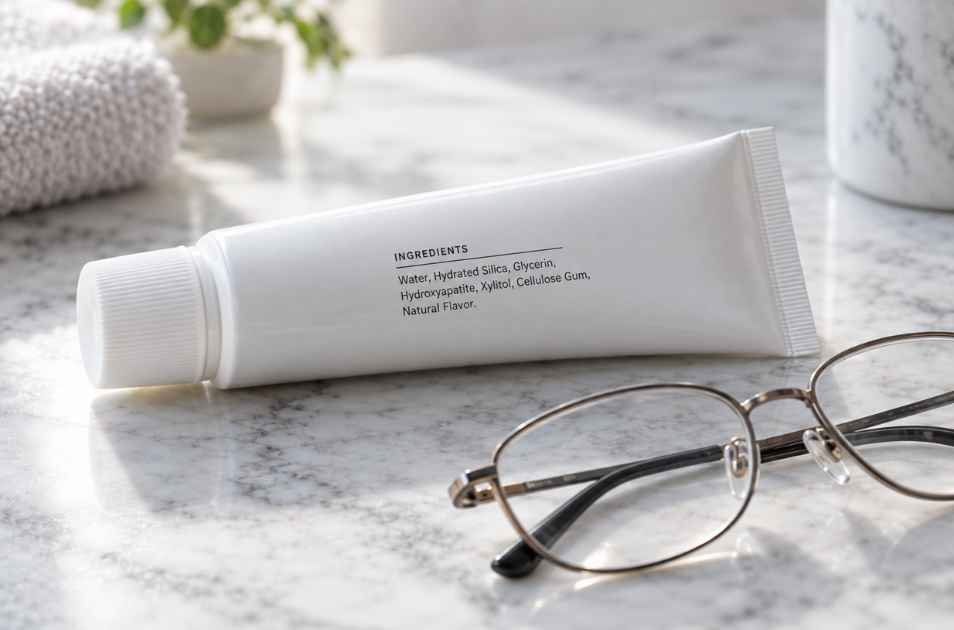
No. US cosmetic labeling requires ingredients to be listed in descending order of predominance, but this only tells you the relative ranking, not the exact percentage. An ingredient listed third could be 8% or 3% — the label doesn’t say. Reverse-engineering a precise concentration from ingredient order is guesswork, not verification.
Is an undisclosed percentage proof a product is ineffective?
No. Undisclosed means you can’t verify the concentration against the clinical evidence. It doesn’t prove the product contains too little HAp. It does mean you’re taking the manufacturer’s word that the amount is effective without being able to check. Whether that level of trust is acceptable is a personal purchasing decision.

Sources & References
- Paszynska E et al. — Caries-preventing effect of a hydroxyapatite-toothpaste in adults (Frontiers in Public Health, 2023)
- EU SCCS — Scientific Opinion on Hydroxyapatite (nano), Submission IV (SCCS/1677/25, final June 2025)
- Shang R et al. — Tooth whitening with an experimental toothpaste containing hydroxyapatite nanoparticles (BMC Oral Health, 2022)
- Boka — What is the percentage of Nano-Hydroxyapatite? (Help Center)
- RiseWell — Hydroxyapatite Toothpaste (Original, product page FAQ)
- RiseWell — PRO Mineral Toothpaste (product page with concentration disclosure)
- Davids — Hydroxi Sensitive+Whitening Peppermint (product page)