Category: Night Guard

  • How to Clean a Night Guard (Without Ruining It)

    How to Clean a Night Guard (Without Ruining It)

    Editorial transparency: VerdictLab earns a commission when you purchase through our links — this never influences our ratings or recommendations. As an Amazon Associate I earn from qualifying purchases. Full disclosure.

    Last updated: August 2026  |  By: VerdictLab Editorial Team

    A night guard that isn’t cleaned properly becomes a petri dish you put in your mouth every night. Warm, moist, and enclosed, it can provide an ideal environment for bacteria and fungi, while plaque and mineral deposits can accumulate on the surface. The guard itself may still be structurally fine, but the biofilm growing on it introduces problems you bought the guard to avoid: bad breath, gum irritation, and an unpleasant taste that makes you not want to wear it.

    The good news is that cleaning a night guard takes about 30 seconds in the morning and a few minutes once a week. The routine is simple. The mistakes people make are simpler — and avoidable once you know what damages the material.

    One important caveat upfront: cleaning instructions vary by material and brand. If your night guard came with specific care instructions from the manufacturer, follow those first. The guidance below covers general best practices that apply to most guards.


    Daily Cleaning (Every Morning)

    Do this immediately after removing the guard, before the saliva dries and hardens into a film. It takes 30 seconds.

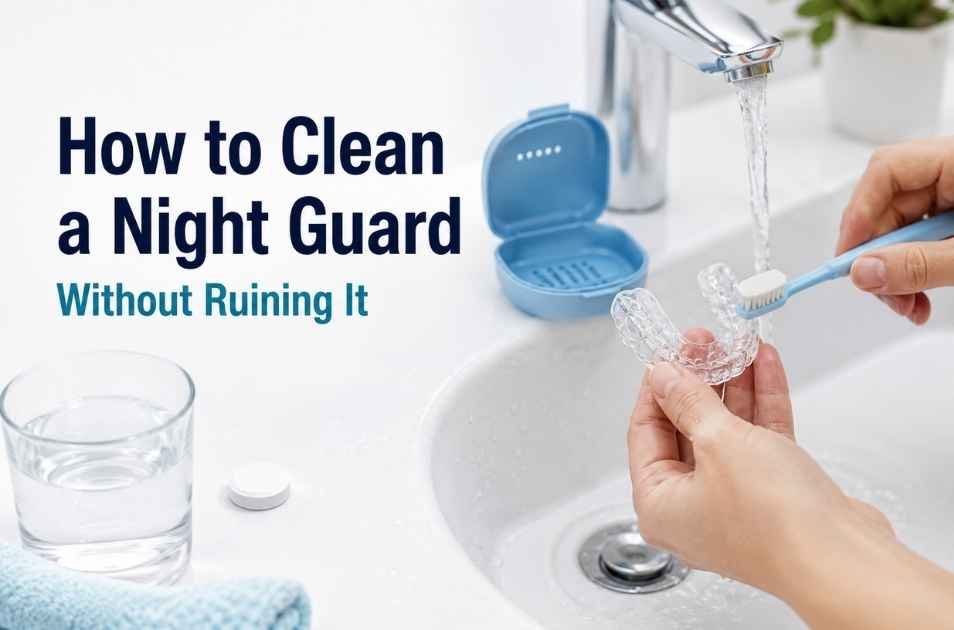
    Rinse the guard under cool or lukewarm running water. While the water runs over it, use a soft-bristled toothbrush — not the one you brush your teeth with, a separate one — to gently scrub all surfaces. The outside, the inside that contacts your teeth, and the biting surface. Unless your guard’s manufacturer specifically says toothpaste is safe, skip it — abrasive or whitening toothpastes can scratch some guard materials. Water and the brush are enough. A drop of unscented liquid dish soap is fine if you want a cleaning agent.

    That’s it. Rinse, brush, set it somewhere to dry. The mechanical action of the bristles removes the overnight biofilm before it has a chance to mineralise. If you skip this step regularly, you’ll notice a white or yellowish buildup within a few weeks that becomes increasingly difficult to remove.

    Some people rinse with cold water only, no brush. This is better than nothing but not as effective — water alone doesn’t dislodge the sticky bacterial film the way bristles do. The brush matters more than anything you add to the water.


    Weekly Deep Clean

    Once a week, give the guard a more thorough soak. Two approaches work well.

    Option A: White vinegar soak

    Mix equal parts white vinegar and cool water in a cup. Submerge the guard and let it sit for 15–30 minutes. The mild acidity helps dissolve mineral deposits and reduce surface bacteria. After soaking, rinse thoroughly under running water and scrub with your dedicated soft toothbrush to remove any loosened residue. Let it air-dry completely before storing. If your guard’s care instructions advise against vinegar, use a cleaning tablet instead.

    Vinegar is cheap, available everywhere, and works for most guard materials. The guard may taste faintly acidic for the first wear after soaking — a thorough rinse before bed handles that.

    Option B: Cleaning tablets

    Drop a denture or retainer cleaning tablet into a glass of cool water, add the guard, and follow the timing on the tablet packaging (usually 15–20 minutes). These tablets — like Retainer Brite — are formulated to dissolve biofilm and calcium deposits on dental appliances. Rinse and brush after soaking.

    Cleaning tablets are a convenient option for deeper cleaning and odour control, especially when buildup develops faster than brushing alone can manage. They cost roughly $0.20–0.25 per tablet depending on pack size. Whether that premium over free vinegar is worth it depends on how much buildup your guard accumulates — some people’s saliva mineralises faster than others.

    Option C: Hydrogen peroxide

    Some manufacturers allow short soaks in standard 3% hydrogen peroxide (the drugstore concentration) as a disinfecting option. Compatibility and timing vary by material, so check your guard’s care instructions first. When permitted, a 10–15 minute soak followed by a thorough rinse provides antimicrobial action without the acidity of vinegar. Don’t use higher concentrations.

    Pick one method and stay consistent. Weekly soaking prevents the kind of buildup that requires aggressive scrubbing later.


    What Not to Use on a Night Guard

    Night guard materials — whether hard acrylic, dual-laminate, or thermoplastic — are more sensitive to heat and chemicals than they look. These are the common mistakes:

    Hot water. This is the number-one killer of boil-and-bite and thermoplastic guards. Hot water softens the material and warps the fit. A guard that’s been through one hot rinse may no longer seat properly on your teeth. Always use cool or lukewarm water. Never put a night guard in the dishwasher, and never clean it with water from a kettle or a hot tap turned all the way up.

    Toothpaste (in most cases). Most toothpastes contain mild abrasives — silica, calcium carbonate, baking soda — designed to scrub enamel clean. Those same abrasives can scratch the surface of a night guard, creating microscopic grooves where bacteria settle. Some manufacturers do allow non-abrasive, non-whitening toothpastes on their specific guards — check your care instructions. When in doubt, use a brush with water only, or add a drop of unscented dish soap.

    Alcohol-based mouthwash. Soaking a guard in Listerine or similar alcohol-based mouthwash degrades certain guard materials over time, particularly softer thermoplastics. The alcohol can also dry out the material, making it more brittle. If you want to soak in something antimicrobial, use the hydrogen peroxide method above or a dedicated retainer cleaning tablet.

    Bleach. Even diluted. Bleach degrades guard material, leaves a residual taste that’s difficult to remove, and can irritate oral tissue. There’s no reason to use it when gentler methods work.

    UV sanitisers (as a replacement for cleaning). Some brands sell UV-C light boxes marketed for retainer and night guard sterilisation. UV can work as a supplementary sanitising step — reducing surface bacteria after a proper clean. But it doesn’t remove the physical biofilm or mineral deposits that harbour bacteria in the first place. If your ultrasonic cleaner or storage case includes a UV feature, there’s no harm in using it as an extra step. Just don’t rely on UV alone and skip the brushing and soaking that do the actual cleaning.


    Cleaning Products Worth Buying

    You don’t need specialised products to keep a night guard clean. A soft toothbrush and cool water handle daily maintenance. But two products can make the weekly routine easier or help when basic cleaning falls short.

    Retainer Brite Cleaning Tablets
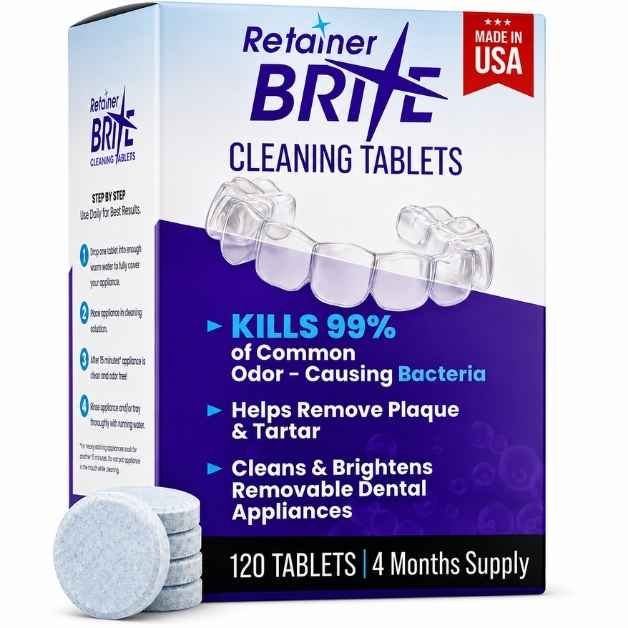
    Retainer Brite cleaning tablets for night guards and retainers

    One of the most widely used cleaning tablets for dental appliances — retainers, night guards, and bruxism appliances. Each tablet fizzes for about 15 minutes, dissolving the kind of protein and mineral buildup that brushing alone leaves behind. One note: Retainer Brite contains potassium persulfate, so avoid it if you have a known persulfate allergy.

    Check Price on Amazon

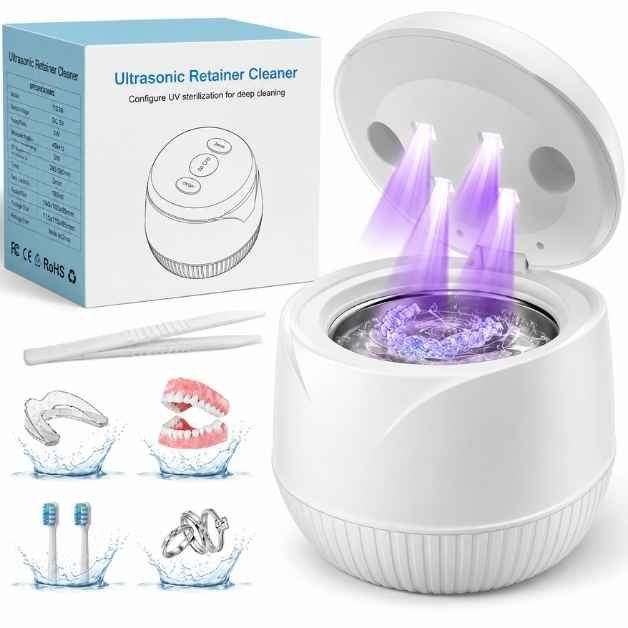
    Ultrasonic Retainer Cleaner

    Ultrasonic retainer and night guard cleaner 200ml

    A small ultrasonic bath that vibrates at 45kHz, creating microscopic cavitation bubbles that reach into crevices a toothbrush can’t access. Fill the 200mL tank with water (add a cleaning tablet for extra effectiveness), drop in the guard, and run the cleaner using one of its preset cycles according to the device instructions.

    An ultrasonic cleaner is an optional convenience tool, not a necessity. Daily brushing and weekly soaking handle the essentials. But if you’ve noticed persistent odour, visible buildup that scrubbing doesn’t shift, or if your guard has complex geometry (hybrid materials, textured inner surfaces), an ultrasonic cleaner can reach what manual cleaning misses. It doesn’t replace rinsing and brushing — it supplements them. These range from $25–40 and last for years.

    Check Price on Amazon


    Storage and Drying

    Where you put the guard after cleaning matters as much as the cleaning itself.

    Let it air-dry completely before storing. A damp guard sealed in a case is a humid, enclosed space — ideal for bacterial and fungal growth. After your morning cleaning, set the guard on a clean surface (a paper towel works) and let it dry fully before putting it in its case. This usually takes 30–60 minutes. If you leave for work before it’s dry, leave the case open on the bathroom counter and close it when you get home.

    Use a ventilated case. Most guards come with a storage case. The good ones have ventilation holes. If yours doesn’t, either leave the lid slightly cracked or poke a few small holes in it. A sealed, unventilated case traps moisture and accelerates the growth of everything you just cleaned off.

    Keep it away from heat. Don’t leave the case on a windowsill in direct sunlight, near a radiator, on a car dashboard, or anywhere temperatures rise above room level. Heat warps thermoplastic and dual-laminate guards. Hard acrylic is more heat-resistant but not immune.

    Keep it away from pets. Dogs are attracted to the saliva residue on night guards and will chew through one in minutes. This is more common than you’d expect — dentists and dental lab customer service teams have heard this story thousands of times. Store it somewhere a curious pet can’t reach.


    If You Have Hard Water

    Hard water — water with high mineral content, typically calcium and magnesium — accelerates buildup on night guards. If your taps leave white deposits on faucets and showerheads, the same minerals are depositing on your guard. You’ll notice a white or chalky film developing faster than it would with soft water.

    Two adjustments help. First, increase the weekly deep clean to twice a week. Second, use distilled or filtered water for your soaking solution rather than tap water. The soak is supposed to dissolve deposits, not add more. For daily rinsing, tap water is fine — the brush does the real work. But the soak benefits from cleaner water.

    If mineral buildup has already hardened on the guard, try the standard diluted vinegar soak (equal parts vinegar and cool water) for 30 minutes, then scrub with a soft brush. A cleaning tablet soak is another option. If deposits don’t come off with gentle methods, the guard’s surface may be permanently roughened — which means bacteria have more places to hide, and it may be time for a replacement. Don’t escalate to aggressive chemical treatments on an expensive custom guard without checking with the manufacturer or your dentist first.


    When to Replace Your Night Guard

    Even with perfect cleaning, night guards wear out. The material degrades from nightly grinding, the fit loosens as the guard compresses, and microscopic surface damage accumulates over time. Replacement frequency depends on the material, how aggressively you grind, how well you maintain it, and what the manufacturer recommends.

    OTC boil-and-bite guards — roughly every 3–6 months. These use softer materials that compress and lose their shape faster. If it feels noticeably looser than when you first molded it, or if you can see bite-through marks, it’s done.

    Custom lab guards (soft) — roughly every 6–12 months. Better material quality extends life, but soft guards still compress under sustained grinding.

    Custom lab guards (hybrid or hard) — roughly every 1–3 years, though the range is wide. Heavy grinders may wear through one in under a year. Light grinders sometimes get 3+ years from a single guard. Inspect it regularly and ask your dentist to check the fit at your appointments.

    Signs it’s time: visible holes, cracks, or bite-through marks; a fit that’s noticeably looser than when new; persistent odour that doesn’t resolve with deep cleaning; visible discolouration that won’t soak off; rough or pitted surfaces that feel different under your tongue.

    For the full comparison of guard types and their expected lifespan, see: Best Night Guard for Teeth Grinding (2026). For cost considerations when replacing, see: Night Guard Cost: Dentist vs Online vs OTC.


    Frequently Asked Questions

    Can I use toothpaste to clean my night guard?

    Generally, no. Most toothpastes contain abrasives that can scratch guard surfaces, creating micro-grooves where bacteria settle. Some manufacturers do permit non-abrasive, non-whitening toothpastes on their specific products — check your care instructions. When in doubt, use a soft toothbrush with water only, or add a drop of unscented liquid dish soap.

    How often should I deep-clean my night guard?

    Once a week is sufficient for most people. If you have hard water, live in a humid climate, or notice buildup developing faster than weekly cleaning handles, increase to twice a week. Daily cleaning (rinse + brush) should happen every morning without exception.

    Is it safe to soak a night guard in mouthwash?

    Alcohol-based mouthwash (Listerine, etc.) can degrade certain guard materials over time and dry out the plastic. If you want an antimicrobial soak, use 3% hydrogen peroxide or a retainer cleaning tablet instead. These are formulated for dental appliances; mouthwash is formulated for tissue.

    My night guard smells bad even after cleaning. What should I do?

    Persistent odour usually means bacteria have embedded in surface damage that routine cleaning can’t reach. Try a 30-minute soak in equal parts white vinegar and cool water, followed by a thorough scrub. An ultrasonic cleaner can sometimes rescue a guard at this stage by reaching crevices manual cleaning misses. If the smell returns within a day or two despite these methods, the guard material is likely degraded beyond recovery and needs replacing.

    Can I put my night guard in the dishwasher?

    No. Dishwasher temperatures (typically 50–75°C / 120–170°F) will warp thermoplastic and dual-laminate guards. Even hard acrylic guards aren’t rated for dishwasher heat. Cool or lukewarm water only, every time.

    Should I clean the case too?

    Yes — and most people forget. Wash the case weekly with warm water and a drop of dish soap. Let it air-dry completely before putting the guard back in. A clean guard in a dirty case picks up bacteria from the case surface overnight. If the case develops a persistent odour or visible mould, replace it.



    Beyond Brushing Oral Health Guide Book
    Get the Free Oral Health Guide
    Download Beyond Brushing — a practical 30,000+ word guide to healthier teeth, gums, and fresher breath after 45.
    Marketing email consent
    • No spam • Unsubscribe anytime


    Sources & References


    Medically reviewed
    Reviewed September 18, 2026
    Reviewed for dental accuracy, clinical claims and safety information. Product selection and rankings remain the responsibility of the VerdictLab Editorial Team.
  • 9 Signs You May Need a Night Guard

    9 Signs You May Need a Night Guard

    Last updated: August 2026  |  By: VerdictLab Editorial Team

    Note: This article is for informational purposes. If you suspect you’re grinding your teeth, see your dentist for a proper evaluation. They can confirm bruxism in minutes by checking your tooth surfaces and jaw muscles — and rule out other conditions that produce similar symptoms.

    Most people who grind their teeth have no idea they’re doing it. Bruxism happens during sleep, which means you’re unconscious for the entire performance. The grinding itself doesn’t wake you up. There’s no alarm. You just accumulate damage — to your enamel, your jaw muscles, your sleep quality — night after night, often for years, until something finally hurts enough to send you to a dentist.

    By that point, the wear is usually visible on your teeth. Enamel doesn’t grow back.

    The earlier you catch it, the less damage accumulates. These are the signs dentists and sleep specialists use to identify bruxism — roughly ordered from the most obvious to the ones people tend to dismiss or attribute to something else.


    1. Your partner hears it

    The earliest warning often comes from someone who shares your bed. Grinding produces an audible sound — a rhythmic scraping or clicking that’s distinct from snoring. Bed partners frequently describe it as unsettling, like someone slowly chewing on gravel.

    If someone has told you that you grind your teeth at night, take it seriously. Teeth grinding has a specific, recognisable sound, and a partner reporting it is a strong reason to get evaluated. Your dentist can then examine your teeth and jaw muscles to confirm whether bruxism is actually causing damage.

    If you sleep alone, this signal doesn’t exist for you. Which makes the remaining signs more important.


    2. Morning jaw pain or stiffness

    Your jaw muscles — the masseters, specifically — are among the strongest muscles in your body relative to their size. When they clench and grind for hours during sleep, they fatigue the way any overworked muscle does. The result is soreness, stiffness, or a tired feeling in the jaw when you wake up. It usually fades within an hour or two of being awake, which is why many people dismiss it as “sleeping funny.”

    The pattern matters more than any single morning. Occasional jaw stiffness could be from sleeping with your face pressed into a pillow. Jaw stiffness most mornings, especially if it’s bilateral (both sides), points strongly toward bruxism.


    3. Morning headaches

    A dull, bilateral headache centred at the temples when you wake up is one of the most common bruxism symptoms — and one of the most frequently misattributed. People blame dehydration, poor sleep, stress, caffeine withdrawal, or their pillow before they consider their jaw.

    The temporalis muscle — the large fan-shaped muscle at the side of your head — contracts during grinding. Hours of sustained contraction can produce a tension-type headache localised at the temples, often described as a pressing, band-like ache that sometimes wraps around the forehead. Morning headaches have many possible causes, though, so this sign alone doesn’t confirm grinding.

    If you’re waking up with frequent headaches, see your doctor to rule out other conditions. If nothing else explains them, mention it to your dentist — bruxism is worth checking for, especially if other signs on this list are present too.


    4. Worn, flattened, or chipped teeth

    This is the sign your dentist spots — usually before you notice it yourself. Bruxism wears down the biting surfaces of teeth over time, producing a characteristic flattened appearance. Canines lose their points. Molars lose their cusps. The edges of front teeth develop tiny chips or become translucent where enamel has thinned.

    Enamel is the hardest substance in the human body, harder than bone. But it’s not indestructible. Tooth-on-tooth grinding wears it down over time, and so can acid erosion, aggressive brushing, and diet. What makes bruxism-related wear distinctive is the pattern — flattened biting surfaces, evenly worn cusps, damage that your dentist recognises as mechanical rather than chemical.

    Run your tongue across your lower front teeth. If the biting edges feel flat or uneven — or if you can see that they’re shorter than they used to be — it’s worth mentioning to your dentist. They can determine whether the wear pattern is consistent with grinding or caused by something else.


    5. Tooth sensitivity that your dentist can’t explain

    Grinding thins enamel. Thinner enamel means less insulation between the nerve inside the tooth and the temperature of what you’re eating. The result is sensitivity to hot and cold that develops gradually, across multiple teeth, without any cavities to explain it.

    Sensitivity from a cavity is usually localised — one tooth, one spot. Sensitivity from bruxism tends to be broader — several teeth, both sides, especially the molars and premolars where grinding force concentrates. If your dentist says “your teeth look fine, no cavities” but you’re wincing at cold water, grinding-related enamel thinning is a likely explanation.


    6. Jaw clicking, popping, or limited opening

    These are TMJ (temporomandibular joint) symptoms. The jaw joint sits just in front of your ear, and bruxism can contribute to problems there — fatiguing the muscles that control jaw movement and adding stress to the joint and its surrounding structures.

    A click or pop when you open your mouth wide is actually common and often harmless on its own. Plenty of people have a clicking jaw that’s been there for years and causes no problems. But clicking accompanied by pain, a jaw that occasionally “locks,” or a gradual reduction in how wide you can open your mouth is worth getting evaluated. TMJ disorders are multifactorial — grinding can coexist with or aggravate them, even if it isn’t the sole cause.

    For more on the TMJ connection, see: Best Night Guard for TMJ.


    7. Earaches with no infection

    The TMJ sits millimetres from the ear canal. When the joint is inflamed from grinding, the pain radiates into the ear in a way that feels indistinguishable from an ear infection — a deep, dull ache, sometimes accompanied by a feeling of fullness or muffled hearing.

    People visit their GP or ENT for this, get told their ears are clear, and leave confused. Unexplained ear pain has many possible causes, but jaw-muscle tension and TMJ problems are among the more common ones — and they’re frequently missed in general practice. If you’ve had persistent ear pain investigated and found no infection, it’s worth mentioning to your dentist. They can check whether your jaw muscles or joint might be contributing.


    8. Tongue indentations or cheek damage

    Check the sides of your tongue in a mirror. If you see scalloped indentations along the edges — a wavy pattern that matches the shape of your teeth — your tongue is being pressed against your teeth during sleep. This happens during clenching, which is a form of bruxism that doesn’t involve lateral grinding movement but does involve sustained pressure.

    Similarly, check the inside of your cheeks. Chewed-up tissue, white ridges along the bite line, or small sores on the inner cheek surface can indicate that you’re biting or pressing your cheeks against your teeth during sleep. Neither of these on its own confirms bruxism, but combined with jaw pain or headaches, the picture becomes clear.


    9. Disrupted sleep you can’t explain

    This one is subtle and easy to miss. Bruxism doesn’t wake you up fully — you don’t bolt upright and think “I was grinding.” But sleep bruxism is associated with brief arousals during the night, and some research suggests it may reduce overall sleep quality even when you’re not consciously aware of it. The result can look like waking up tired despite getting 7–8 hours, feeling unrefreshed, or waking multiple times without a clear reason.

    If you’ve addressed the obvious sleep disruptors — caffeine timing, screen exposure, room temperature, consistent schedule — and you’re still sleeping poorly, bruxism is worth investigating. A sleep study can confirm it definitively, but a dental exam is the faster and cheaper first step.


    What to do if you recognise these signs

    See your dentist first. They can confirm bruxism in a single appointment by examining your tooth wear patterns, checking your jaw muscles for tenderness, and looking at the soft tissue inside your mouth. This is faster, cheaper, and more accessible than a sleep study — though your dentist may refer you for one if they suspect a sleep disorder is contributing.

    Don’t self-diagnose from a list on the internet. Every sign above can also be caused by something else. Headaches have dozens of causes. Jaw pain can be muscular. Tooth sensitivity can be from acid erosion, not grinding. The purpose of this list is to prompt a conversation with your dentist, not to replace one.

    A night guard is the most common next step. If your dentist confirms that grinding is causing or threatening damage, a night guard protects the teeth by absorbing the force instead of your enamel. Some people also find that a properly fitted guard helps with jaw soreness and morning headaches, though results vary by individual. It doesn’t stop the underlying bruxism — you’ll still grind — but the guard takes the damage instead of your teeth. Meanwhile, you and your dentist can work on contributing factors like stress, medications, caffeine, alcohol, or sleep-related issues.

    For the full breakdown of guard types and how to choose, see: Best Night Guard for Teeth Grinding (2026). For the evidence on effectiveness, see: Do Night Guards Work?


    How many signs before you should worry?

    One sign alone — particularly a partner hearing you grind — is enough reason to bring it up with your dentist. The more signs you recognise from this list, the more reason to schedule that appointment sooner rather than later. No checklist confirms a diagnosis on its own, but jaw pain plus headaches, or worn teeth plus sensitivity, are the kind of combinations that make a dentist reach for the examination gloves quickly.

    The people who benefit most from early detection are the ones who catch it before significant enamel loss. A night guard at the “jaw pain and headaches” stage prevents you from reaching the “cracked molar and $1,200 crown” stage. Dental work to repair grinding damage is expensive and irreversible. A night guard costs $12–200 depending on type. The math is simple.

    For causes and remedies beyond a night guard, see: How to Stop Grinding Teeth at Night.


    Frequently Asked Questions

    Can you grind your teeth without knowing it?

    Yes — and most people do. Sleep bruxism is unconscious by definition. You don’t feel it happening, and it rarely wakes you up. The signs are all indirect: jaw pain, headaches, worn teeth, a partner’s report. Many people grind for years before a dentist identifies the damage at a routine check-up.

    Is teeth grinding the same as clenching?

    They’re both classified as bruxism but involve different jaw movements. Grinding is lateral — your jaw moves side to side, scraping upper and lower teeth against each other. Clenching is vertical — your jaw presses upper and lower teeth together without lateral movement. Both damage teeth and fatigue jaw muscles. Some people do both. A night guard protects against either form.

    Can stress cause teeth grinding?

    Stress is the most commonly cited trigger. Anxiety, work pressure, life changes, and emotional tension all correlate with increased bruxism frequency and intensity. But stress isn’t the only factor — medications (particularly SSRIs), sleep disorders, alcohol, caffeine, and smoking are all associated with increased bruxism. Addressing stress alone may reduce grinding but often doesn’t eliminate it entirely. A night guard provides protection regardless of the cause. For the full picture, see: How to Stop Grinding Teeth at Night.

    Should I go to my dentist or my doctor?

    Start with your dentist. They can confirm bruxism faster than a GP because they’re looking directly at the evidence — your tooth surfaces, jaw muscles, and oral tissue. A GP may refer you to a dentist anyway. If your dentist suspects a sleep disorder (like sleep apnea) is contributing to the grinding, they’ll refer you to a sleep specialist for further evaluation.

    At what point is grinding “bad enough” for a night guard?

    Whether you need a night guard depends on what your dentist finds — the severity of the grinding, any existing damage, your symptoms, and your risk factors. Not everyone with mild bruxism needs a guard immediately. But when grinding is causing visible wear, cracking teeth, or producing persistent jaw symptoms, a guard is the most straightforward way to stop the damage from compounding. Light grinders typically do well with a soft or thin guard. Moderate grinders with a hybrid. Heavy grinders with a hard guard. The cost of even a premium custom guard ($100–200 online) is a fraction of the dental work required to repair what grinding breaks. For guard options by severity, see: Best Night Guard for Teeth Grinding (2026).


    Beyond Brushing Oral Health Guide Book
    Get the Free Oral Health Guide
    Download Beyond Brushing — a practical 30,000+ word guide to healthier teeth, gums, and fresher breath after 45.
    Marketing email consent
    • No spam • Unsubscribe anytime


    Medically reviewed
    Reviewed September 15, 2026
    Reviewed for dental accuracy, clinical claims and safety information. Product selection and rankings remain the responsibility of the VerdictLab Editorial Team.
  • Night Guard vs Mouth Guard: What’s the Difference?
    Night Guard vs Mouth Guard: What’s the Difference?
    Last updated: August 2026  |  By: VerdictLab Editorial Team

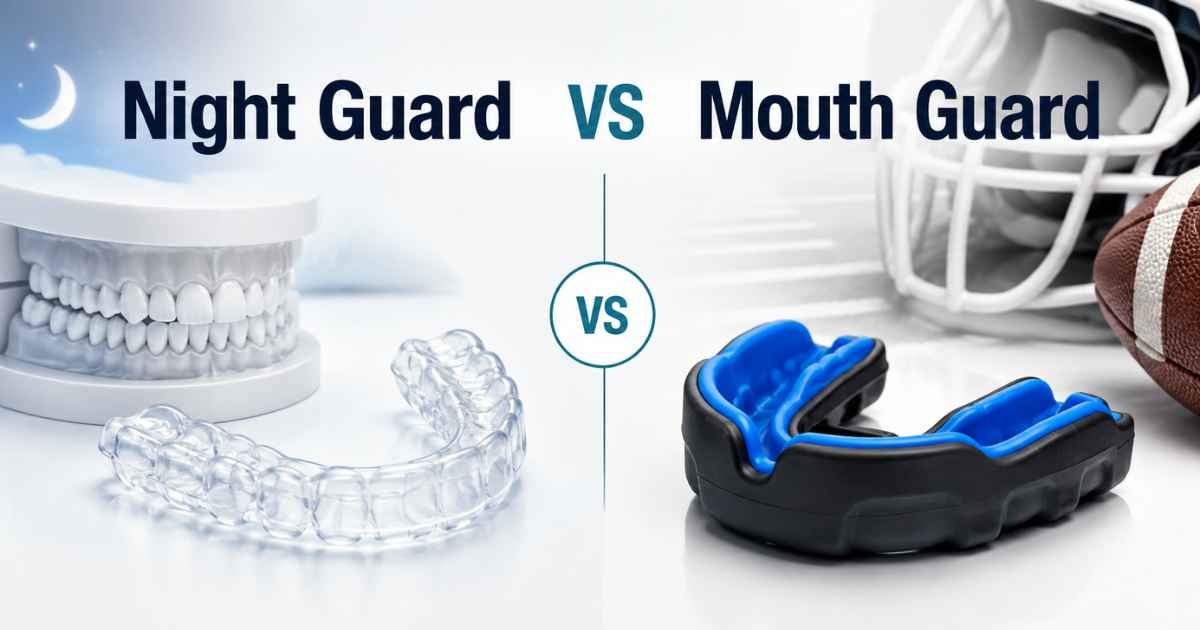
    They look almost identical sitting in a case. Both are made of plastic or rubber. Both go over your teeth. Both come with the vague label “mouth guard” on Amazon listings. But a night guard and a sports mouth guard are designed for fundamentally different problems — and using the wrong one doesn’t just fail to help. It can actively make things worse.

    A night guard absorbs and distributes the slow, sustained grinding force of bruxism. A sports mouth guard absorbs sudden impact. The materials, thickness, fit, and function are different in ways that matter. Here’s the breakdown.


    Quick Comparison Table

    Feature Night Guard (Dental Guard) Sports Mouth Guard
    Purpose Protects teeth from grinding/clenching during sleep Protects teeth, jaw, and soft tissue from impact during sports
    Force Type Slow, sustained pressure (grinding) Sudden impact (collision, fall, blow)
    Material Hard acrylic, dual-laminate, or thermoplastic Soft, shock-absorbing EVA or silicone
    Thickness 1–3mm (thin enough to sleep in) 3–6mm (bulky for maximum shock absorption)
    Fit Precise — custom-molded or boil-and-bite Looser — stock, boil-and-bite, or semi-custom
    Covers Usually upper teeth only Usually upper teeth only (some cover both)
    Worn When During sleep (or daytime for clenching) During sports activity
    Price Range $12–$200 (OTC to custom lab) $2–$50 (stock to boil-and-bite)
    Breathing Designed for nose breathing during sleep Designed for mouth breathing during exertion


    What Is a Night Guard?

    A night guard — also called a dental guard, occlusal splint, or bite guard — is a device worn over the upper teeth (sometimes lower) during sleep to prevent damage from bruxism. Bruxism is the medical term for grinding or clenching your teeth, and it affects an estimated 10–25% of adults. Most people who grind don’t know they’re doing it until a dentist spots the wear patterns or a partner hears it.

    The guard creates a physical barrier between upper and lower teeth. When you grind, the teeth press against the guard material instead of against each other. This prevents enamel wear, tooth fractures, and the jaw muscle fatigue that causes morning headaches and TMJ pain.

    Night guards come in three material categories, each suited to a different severity of grinding:

    Soft guards are made from flexible EVA or silicone. They’re the most comfortable to wear but the least durable — light grinders chew through them in 3–6 months. Best for clenching (pressing teeth together without lateral movement) rather than grinding (lateral movement).

    Hard guards are made from rigid acrylic or copolyester. They last the longest — often 1–3 years with proper care — and provide the most protection for severe grinders. The trade-off is a longer adjustment period. They feel noticeably foreign in your mouth for the first week.

    Dual-laminate (hybrid) guards combine a soft inner layer (for comfort against the teeth) with a hard outer layer (for durability against grinding). This is the most popular category for moderate-to-heavy grinders — the best balance of comfort and protection.

    For the full comparison of current night guard options, see: Best Night Guard for Teeth Grinding (2026).


    What Is a Sports Mouth Guard?

    A sports mouth guard is a thick, shock-absorbing device worn during athletic activity to protect teeth, gums, lips, and jaw from impact injuries. Contact sports (football, hockey, boxing, MMA, rugby, lacrosse) essentially require them. Non-contact sports with collision risk (basketball, soccer, baseball, skateboarding) strongly benefit from them.

    Sports guards are designed around a fundamentally different physics problem. A night guard handles slow, sustained force — the steady pressure of jaw muscles clenching for hours. A sports mouth guard handles sudden, high-energy impact — an elbow to the face, a ball strike, a fall onto concrete. These are different force profiles requiring different material responses.

    Sports guards use soft, thick EVA (ethylene-vinyl acetate) or similar shock-absorbing materials, typically 3–6mm thick. The bulk is the point — the material needs enough volume to absorb and distribute a sudden impact across the entire dental arch rather than concentrating it on a single tooth. They also extend further along the gums and sometimes include lip protection.

    Three types exist:

    Stock mouth guards are pre-formed, one-size-fits-all. They’re cheap ($2–10), available at any sporting goods store, and fit poorly. Better than nothing, but barely. Most athletes find them uncomfortable enough that they stop wearing them.

    Boil-and-bite guards soften in hot water, then mold to your teeth when you bite down. These are the standard for recreational athletes — $10–30, available everywhere, and provide a reasonable fit. Brands like Shock Doctor and Under Armour dominate this category.

    Custom sports guards are made by a dentist from an impression of your teeth. The fit is precise, the protection is superior, and they cost $200–500. Professional and serious competitive athletes typically use custom guards.


    5 Key Differences That Actually Matter

    1. Material hardness

    This is the most important distinction. Night guards — especially for moderate-to-severe grinding — use hard or dual-laminate materials that resist the lateral abrasion of grinding. A soft material would compress and deform under sustained grinding pressure, losing its shape within weeks and potentially encouraging more clenching (your jaw muscles detect the soft material and bite harder).

    Sports mouth guards use soft, flexible materials that compress on impact to absorb shock. A hard night guard used during sports would transmit impact force directly to the teeth instead of absorbing it — the opposite of what you want.

    2. Thickness and profile

    Night guards range from 1mm (ultra-thin daytime guards) to 3mm (heavy grinder protection). They’re designed to be thin enough that you can sleep comfortably with one in your mouth for 7–8 hours. Bulky material keeps you awake.

    Sports guards range from 3mm to 6mm. The extra thickness provides the shock-absorption volume needed for impact protection. You wouldn’t sleep in one — and you shouldn’t try. The bulk interferes with breathing during sleep and can worsen jaw positioning.

    3. Fit precision

    Night guards require a precise fit because they’re worn for extended periods and need to maintain proper jaw alignment. A poorly fitting night guard can shift teeth over time, alter your bite, or cause TMJ symptoms rather than relieve them. Custom night guards (from a dental lab or dentist) are molded to an exact impression of your teeth. Even OTC night guards use boil-and-bite molding for a semi-custom fit.

    Sports guards need a secure fit (so they don’t fall out during play), but millimetre precision is less critical. They’re worn for 1–3 hours of activity, not 8 hours of sleep. A slightly loose sports guard is annoying but not harmful.

    4. Breathing design

    Night guards are designed for nose breathing during sleep. They sit close to the teeth without obstructing the airway. Some premium guards (like SOVA) include perforations that allow airflow through the guard itself.

    Sports guards are designed for mouth breathing during exertion. Many include breathing channels or a thinner front section that allows airflow while you’re running, playing, and panting. Wearing a sports guard during sleep can restrict airflow and worsen snoring or sleep apnea symptoms.

    5. Coverage area

    Night guards typically cover just the biting surfaces of the upper teeth. Some cover the lower teeth instead (particularly for anterior bruxism). They don’t extend far along the gums because gum coverage adds bulk without improving grinding protection.

    Sports guards extend further along the gums and may include labial (lip-side) flanges. This wider coverage protects soft tissue from cuts and lacerations during impact — a concern in sports but not during sleep.


    What Happens If You Use the Wrong One

    Using a sports mouth guard for grinding

    This is the more common mistake — and the more harmful one. People buy a cheap sports mouth guard from a sporting goods store, figure “it goes over my teeth, so it should work for grinding,” and wear it to bed.

    Three problems develop:

    The soft material encourages more clenching. Your jaw muscles detect the compressible material and respond by biting harder — the same reflex that makes you chew gum more aggressively than you’d chew nothing. Several dental studies have documented this effect. A soft sports guard can actually increase grinding force rather than reduce it.

    The guard deforms quickly. A material designed to absorb sudden impact can’t handle 8 hours of sustained grinding pressure. The guard loses its shape within days to weeks, creating an uneven biting surface that can shift your jaw alignment.

    The bulk interferes with sleep. A 4–6mm sports guard is significantly thicker than a 1–2mm night guard. It restricts airflow, promotes mouth breathing, and for people with any degree of sleep apnea or snoring, it can measurably worsen breathing during sleep.

    Using a night guard for sports

    Less common but equally problematic. A thin, hard acrylic night guard provides zero shock absorption. An impact that a sports guard would distribute across the entire arch gets concentrated at the point of contact. The night guard can crack, and the fractured pieces become a secondary injury risk inside your mouth. Hard night guards are explicitly labelled “not for use as a sports mouthpiece” for this reason.

    If you need both — protection from grinding at night and protection during sports — you need two separate devices. No single guard does both jobs well.


    Which Do You Need?

    You need a night guard if:

    • You grind or clench your teeth during sleep (your dentist or partner may have told you)
    • You wake up with jaw pain, headaches, or sore teeth
    • Your dentist has noticed worn enamel, flattened tooth surfaces, or cracked teeth
    • You have TMJ symptoms — clicking jaw, limited opening, ear pain
    • You clench during the day when stressed (a daytime guard exists for this)

    See: Signs You Need a Night Guard for a more detailed symptom guide.

    You need a sports mouth guard if:

    • You play contact sports (football, hockey, boxing, rugby, lacrosse, MMA)
    • You play collision-risk sports (basketball, soccer, baseball, skateboarding)
    • Your league or coach requires one
    • You’ve previously chipped or knocked out a tooth during activity

    You might need both if: you grind at night AND play contact sports. Buy a night guard for sleeping and a sports guard for playing. The two devices serve different purposes and should never be used interchangeably.

    If you’re not sure whether you grind, ask your dentist at your next check-up. They can spot the wear patterns in minutes. For more on whether a night guard would actually help your specific situation, see: Do Night Guards Work? What the Evidence Says.


    Frequently Asked Questions

    Can I use a boil-and-bite sports guard as a night guard?

    No. A boil-and-bite sports guard uses soft, thick EVA material designed for impact absorption, not grinding resistance. It will compress under sustained grinding, lose its shape quickly, and may actually increase clenching force because your jaw muscles respond to the soft material by biting harder. Buy a purpose-made night guard instead — even a $12 OTC option is better than a repurposed sports guard.

    My night guard says “not for use as a sports mouthpiece.” Why?

    Because hard acrylic night guards provide zero shock absorption. An impact during sports would transfer directly through the guard to your teeth, and the guard itself can crack and create sharp fragments inside your mouth. Night guards are designed for slow, sustained pressure — not sudden impact.

    Why are night guards so much more expensive than sports guards?

    Material cost and precision. Night guards use higher-grade materials (dental-grade acrylic, thermoplastic polymers) and require a more precise fit because they’re worn for 7–8 hours every night. Custom night guards from dental labs cost $70–200 online and $300–1,000 from a dentist. Sports guards use cheaper EVA and need less precision, so they cost $2–50. For a cost breakdown, see: Night Guard Cost: Dentist vs Online vs OTC.

    Are there guards that work for both grinding and sports?

    Some manufacturers market “dual-purpose” guards, but no single device optimises for both grinding resistance (hard, thin, precise) and shock absorption (soft, thick, cushioning). These are opposite material requirements. A dual-purpose guard compromises on both. You’re better off with two dedicated devices.

    Which type of night guard is best for me?

    That depends on how heavily you grind. Soft guards for light clenching, dual-laminate (hybrid) for moderate grinding, and hard acrylic for severe bruxism. Custom lab guards (like Remi or Encore) provide the best fit. OTC boil-and-bite guards (like DenTek or SOVA) are a reasonable starting point. For the full comparison, see: Best Night Guard for Teeth Grinding (2026). For custom vs OTC specifically, see: Custom vs OTC Night Guard: Is Custom Worth It?

    Can children use night guards?

    Children do grind their teeth — paediatric bruxism is common, especially during ages 6–12 when permanent teeth are coming in. However, OTC adult night guards don’t fit children’s mouths properly. If your child grinds, consult a paediatric dentist first. They may recommend monitoring rather than a guard, since many children naturally outgrow bruxism. If a guard is needed, it should be dentist-fitted to accommodate a growing jaw.


    Beyond Brushing Oral Health Guide Book
    Get the Free Oral Health Guide
    Download Beyond Brushing — a practical 30,000+ word guide to healthier teeth, gums, and fresher breath after 45.
    Marketing email consent
    • No spam • Unsubscribe anytime


    The Bottom Line

    Night guards protect against grinding. Sports mouth guards protect against impact. Same mouth, different problems, different solutions. Using a sports guard for grinding is the more common — and more harmful — mistake, because the soft material can actually increase clenching force and deform under sustained pressure.

    If you grind your teeth, invest in a purpose-made night guard. If you play contact sports, invest in a purpose-made sports guard. If you do both, buy both. There is no effective shortcut.

    For the full comparison of night guards by type, material, and price, see our complete guide to the best night guards of 2026.


    Medically reviewed
    Reviewed September 20, 2026
    Reviewed for dental accuracy, clinical claims and safety information. Product selection and rankings remain the responsibility of the VerdictLab Editorial Team.