Last updated: August 2026 | By: VerdictLab Editorial Team
A custom night guard usually costs considerably more upfront than an OTC guard. Both are designed to create a barrier between your upper and lower teeth. So what does the extra money actually buy you — and when is it worth paying?
The answer isn’t universal. For some people, an inexpensive OTC guard is a perfectly reasonable starting point. For others, a Remi or enCore custom guard makes more sense because the individually fabricated fit is more comfortable, more stable, or simply easier to wear consistently.
The decision depends less on the sticker price than on fit, comfort, how quickly you wear through guards, your dental situation, and whether you’re likely to use one long-term.
This is the comparison.
In This Article
Head-to-Head Comparison Table
| Feature | Custom (Online Lab) | OTC |
|---|---|---|
| Upfront cost | Higher | Lower |
| Fit method | Dental impression → lab fabrication | Boil-and-bite, adjustable, pre-formed, or disposable |
| Fit precision | Individually fabricated from your impression | Varies from moldable to universal-fit |
| Thickness | Varies by material and design | Varies widely; some premium OTC guards are very thin |
| Material options | Soft, hard, hybrid, ultra-thin | Mostly moldable thermoplastics and flexible materials |
| Durability | Varies by material, fit and grinding intensity | Varies widely; includes both durable moldable and limited-use designs |
| Time to receive | Usually requires impression + lab turnaround | Immediately usable once purchased/fitted |
| Best advantage | More individualised fit | Lower cost and immediate availability |
Fit Quality
This is where the difference between custom and OTC is usually easiest to understand.
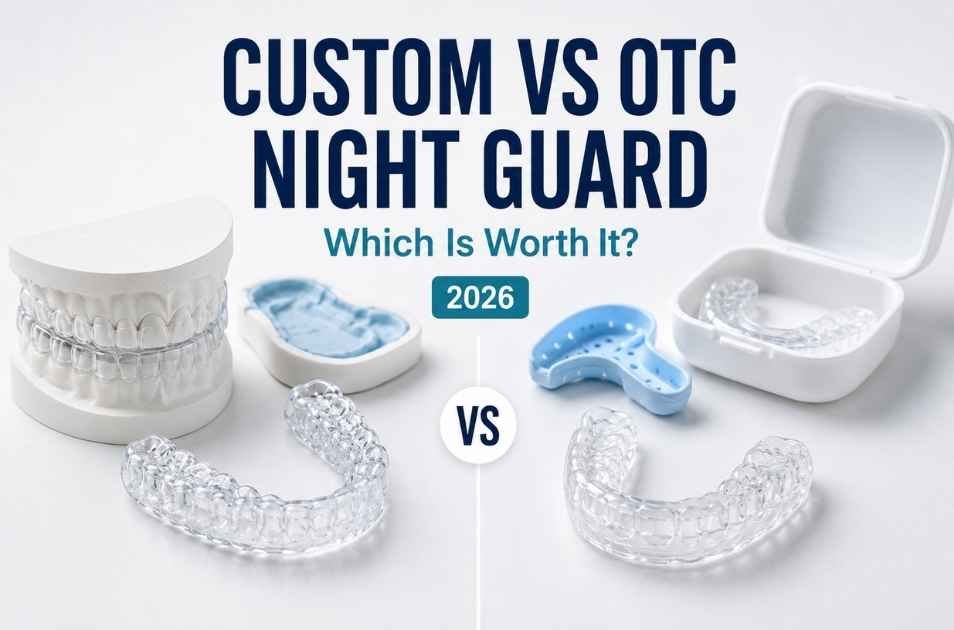
A custom guard is fabricated from an impression of your teeth. Its inner surface is shaped around your individual dental arch rather than beginning as a universal appliance. When the impression and fabrication are done well, the result should seat securely without you consciously holding it in place.
A boil-and-bite guard creates its fit differently. You soften the material and mold it around your teeth at home. The result depends heavily on the product and your fitting technique — how evenly the material is positioned, whether the guard is overheated, and how closely you follow the manufacturer’s instructions.
A good OTC mold can fit surprisingly well. A poor one can feel loose, uneven, or unstable.
Some premium OTC guards reduce the risk of wasting the product by allowing repeated fitting. SOVA Aero, for example, can be reheated and remolded up to 20 times. LunaGuard makes a similar remoldability claim. That makes them much more forgiving than an appliance with a more limited fitting process.
Pre-formed, adjustable and disposable guards skip full tooth-by-tooth molding. That’s convenient, but the fit is naturally less individualised. Whether that’s perfectly adequate or frustrating depends on the person wearing it.
The practical point is simple: custom gives the lab more information about your individual teeth; OTC gives you speed, convenience and a much lower entry cost.
Comfort and Thickness
Comfort is the sleeper variable in this comparison — literally. A guard that’s theoretically excellent but stays in the drawer protects nothing.
Custom fabrication can make an appliance feel more secure because it’s produced from your own impression. Less movement inside the mouth can matter just as much as thickness.
But custom does not automatically mean thinner. Thickness depends on the material and the design chosen. Remi, for example, offers multiple thickness options, while enCore offers Soft, Hybrid, Hard and Ultra Thin constructions.
OTC guards vary just as widely. Cheap generic boil-and-bite models can feel bulky, but premium options have narrowed the gap considerably. SOVA Aero and LunaGuard are both approximately 1.6mm thick — thinner than some custom appliances.
DenTek Ultimate approaches the problem differently with a slim-profile bite-pad design. SleepRight avoids a full molded arch entirely and uses adjustable bite pads.
So don’t assume:
- custom automatically means thin
- OTC automatically means bulky
- thinner automatically means more comfortable
Mouth size, tongue space, gag sensitivity, material feel, retention, and where the appliance contacts your teeth all affect comfort.
The most useful test is boring but important: can you wear it consistently without pain or persistent bite changes?
Durability and Lifespan
This is where comparison articles often become too confident.
There is no reliable lifespan chart that can tell you a custom guard will last exactly two years while an OTC guard will last exactly three months. Two people can buy the same guard and wear through it at completely different rates.
Durability depends on:
- how forcefully and frequently you grind or clench
- the guard material
- thickness
- fit
- where your teeth contact the appliance
- how the guard is cleaned and stored
Hard custom appliances are generally chosen when wear resistance is a priority. Hybrid guards combine a softer inner layer with a harder exterior. Soft custom guards prioritise flexibility and comfort.
OTC durability also varies significantly. A limited-use Plackers guard belongs in a completely different category from SOVA Max or LunaGuard. SOVA backs the Aero and Max with a 120-day durability warranty, while LunaGuard currently advertises a 180-day durability warranty.
Those warranties are more useful than invented lifespan promises because they tell you what the manufacturer is actually willing to stand behind.
If you’re repeatedly biting through or deforming OTC guards quickly, that’s useful information. At that point, buying another identical guard may make less sense than discussing a more durable custom design with a dentist.
Annual Cost (The Real Comparison)
Upfront price doesn’t tell you everything. Replacement frequency matters.
But annual-cost comparisons only work when they’re honest about the assumptions. So rather than pretending every guard lasts a predictable number of months, the examples below show hypothetical scenarios.
| Example Scenario | Example Cost | Example Replacement Rate | Annualised Cost |
|---|---|---|---|
| OTC example A | $25 | Every 3 months | $100/year |
| OTC example B | $40 | Every 6 months | $80/year |
| Custom example A | $150 | Every 18 months | $100/year |
| Custom example B | $180 | Every 24 months | $90/year |
| Dentist-made example | $600 | Every 3 years | $200/year |
Important: These are mathematical examples, not predicted guard lifespans or current product prices. Your actual replacement rate may be much shorter or longer. See: Night Guard Cost Breakdown for the full analysis.
The math shows why the cheapest guard at checkout isn’t necessarily the cheapest long-term.
If you spend $25 on an OTC guard and replace it every three months, that’s $100 per year. If a $150 custom guard lasts 18 months in your particular case, its annualised cost is also about $100.
Change either lifespan and the comparison changes immediately.
If that same OTC guard lasts six months, it costs only $50 per year. If a heavy grinder destroys it every month, the annual cost jumps to $300.
That’s why the useful question isn’t:
“Which guard costs less?”
It’s:
“What will this guard cost me for every year I can comfortably and safely use it?”
You can’t know the answer perfectly before wearing one. But after you’ve replaced one or two guards, your own wear pattern becomes much more useful than a generic lifespan chart.
Fit, Safety and Bite Changes
Any oral appliance worn for hours at a time should fit comfortably and should not create persistent unwanted changes in how your teeth meet.
A custom guard isn’t automatically risk-free simply because it’s custom, and an OTC guard isn’t automatically unsafe because it came from a store. Fit matters in both categories.
Pay attention to warning signs such as:
- persistent tooth pain or pressure
- new jaw pain
- a guard that suddenly feels much tighter or looser
- difficulty seating or removing the appliance
- a bite that still feels noticeably different after the guard has been removed
If any of those happen, don’t simply keep wearing the appliance indefinitely. Stop and have the fit assessed by a dentist.
Custom guards have an advantage in that they’re fabricated from an individual impression. OTC guards have the advantage of being inexpensive enough to replace or abandon if a particular design doesn’t work for you.
Long-term users should mention their guard at routine dental visits regardless of which category they use. Your dentist can inspect both the appliance and your teeth for wear, fit issues, or changes that aren’t obvious at home.
When Custom Makes Sense
- You already know you’ll wear a guard regularly
- You repeatedly wear through or deform OTC guards
- OTC guards feel loose, unstable, or too uncomfortable to wear consistently
- You want a specific construction such as hard, hybrid, soft, or ultra-thin
- You have crowns, bridges, veneers, implants, or other dental work that deserves professional guidance
- Your dentist has specifically recommended a custom appliance
- You’re willing to pay more upfront for an individually fabricated fit
Amazon-available custom options: Remi is the more straightforward choice if you want two guards and multiple thickness options. enCore gives you more choice of construction, including Soft, Hybrid, Hard and Ultra Thin. Check current Amazon pricing before comparing value.
Full reviews: Best Custom Night Guard.
When OTC Makes Sense
- You’re trying a night guard for the first time
- You want a lower-cost starting option
- You need something immediately rather than waiting for lab fabrication
- Budget is the main constraint
- You want a travel or backup guard
- You haven’t had persistent problems with OTC fit
- You don’t have a complicated dental situation that requires professional fitting advice
OTC options worth comparing: SOVA Aero if you want a thin remoldable design, LunaGuard for another slim remoldable option with a durability warranty, The Doctor’s NightGuard for a two-layer moldable design, and HONEYBULL if you want a multi-pack with thin and thick options.
Check current Amazon pricing rather than relying on fixed prices in an article.
Full reviews: Best OTC Night Guard.
Frequently Asked Questions
Is an online custom guard as good as one from a dentist?
The basic fabrication concept can be similar: an impression of your teeth is used to manufacture an individual appliance.
The important difference is clinical oversight. With a dentist-made guard, the dentist can examine your teeth and jaw, take or supervise the impression or scan, choose the appliance design, check the bite, make adjustments, and monitor the result.
An online lab shifts much of that process to you. You make the impression at home and communicate with the lab remotely. Services such as Remi and enCore review impressions before manufacturing, which reduces one potential source of error, but it isn’t the same as an in-person dental examination.
For a straightforward case, the lower cost and convenience of an online custom guard may be attractive. If you have significant dental work, pain, bite problems, active orthodontics, or an uncertain diagnosis, professional assessment matters more.
Can an OTC guard damage my teeth?
A poorly fitting oral appliance can cause discomfort, pressure, or unwanted bite changes regardless of whether it is OTC or custom.
Don’t assume pain or a persistent change in your bite is something you simply need to “get used to.” Stop using the appliance and ask a dentist to assess it.
A well-fitted OTC guard may be perfectly usable for some people. The problem is not the OTC label itself — it’s whether the particular appliance fits your mouth appropriately.
Should I start with OTC and upgrade to custom?
That can be a reasonable strategy, particularly if you’ve never worn a guard and want a lower-cost way to find out whether you can sleep comfortably with one.
But there is no rule saying you need to wait a particular number of months before switching.
Consider moving to custom sooner if:
- you repeatedly fail to get a stable OTC fit
- you stop wearing the guard because it’s uncomfortable
- you wear through OTC guards quickly
- you have significant tooth wear or dental restorations
- your dentist recommends a custom appliance
Likewise, if an OTC guard fits well, remains comfortable, and your dentist has no concerns, simply reaching an arbitrary six-month date doesn’t automatically mean you need to replace it with custom.
What about getting one from my dentist instead?
A dentist-made guard costs more because you’re paying for more than the plastic appliance. You’re also paying for examination, professional impression-taking or scanning, appliance selection, fit adjustments, bite assessment, and follow-up.
That additional oversight can be particularly valuable if you have multiple restorations, jaw pain, bite problems, active orthodontic treatment, or other complicating factors.
An online lab trades some of that in-person oversight for lower cost and convenience.
For the full cost comparison, see: Night Guard Cost: Dentist vs Online vs OTC.
Which is better for heavy grinding?
If you’re repeatedly wearing through guards or seeing significant bite-through, that’s a good reason to involve your dentist rather than relying only on product labels like “heavy duty.”
A more durable custom construction — often a harder material — may be considered depending on your teeth, restorations, grinding pattern, and comfort.
Among OTC options, SOVA Max is the thicker 2.4mm version of the SOVA design, while LunaGuard offers a 180-day manufacturer durability warranty. Neither should be assumed to last a fixed number of months for every heavy grinder.
For the full breakdown, see: Best Night Guard for Heavy Grinders.

Sources & References
The Short Version
A custom guard’s clearest advantage is the individually fabricated fit. That can make it especially appealing if you already know you’ll wear a guard regularly, if OTC designs won’t stay comfortably in place, or if you keep replacing them because of wear.
OTC guards win on price, speed, and convenience. They’re a sensible starting option for someone who wants to try a night guard without committing to lab fabrication, and premium OTC designs have narrowed the gap considerably in thickness and fitting flexibility.
There isn’t a universal point when everyone should “upgrade.” A better trigger is your own experience: poor fit, inconsistent wear, repeated replacement, significant tooth wear, complicated dental work, or a dentist’s recommendation.
If an inexpensive OTC guard fits comfortably and works for your situation, there’s no prize for spending more. If you’re cycling through OTC guards or avoiding them because they’re uncomfortable, custom starts to make much more sense.
For the full reviews: Best Custom Night Guard and Best OTC Night Guard. For the broader comparison across all types: Best Night Guard for Teeth Grinding (2026).