Author: verdictlab@gmail.com

  • Do Dentists Actually Recommend Water Flossers?

    Do Dentists Actually Recommend Water Flossers?

    Last updated: March 2026  |  Reviewed by: VerdictLab Editorial Team

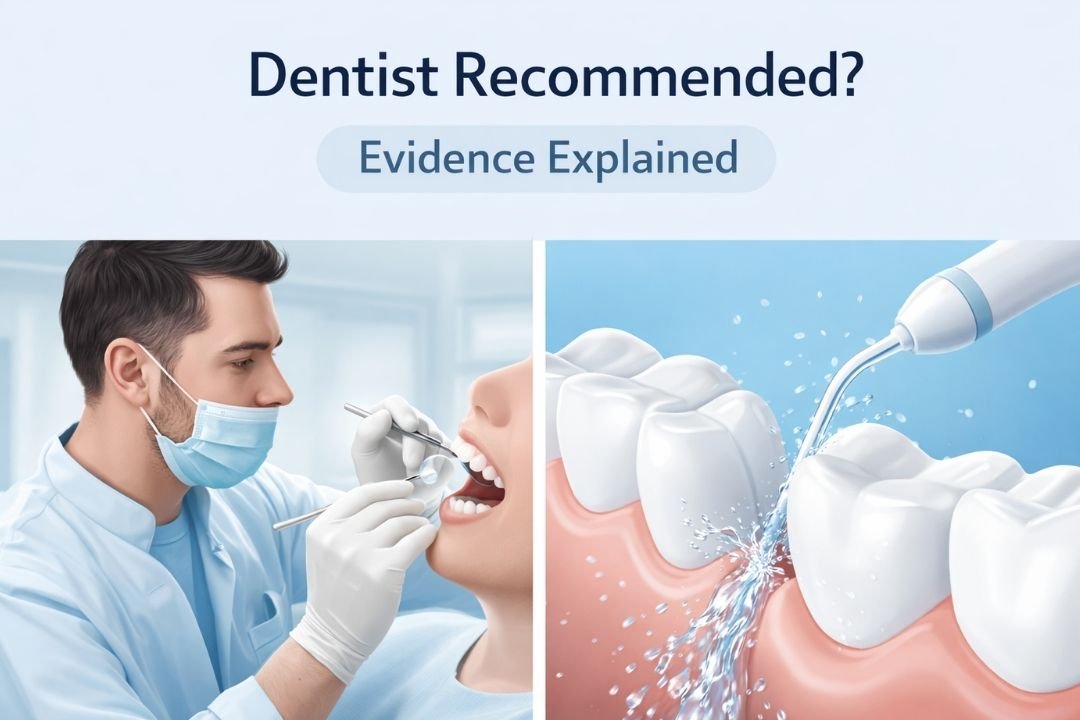
    The short answer is yes — most dental professionals recommend water flossers, particularly for patients who aren’t flossing consistently or who have dental work that makes string flossing difficult. The American Dental Association has formally accepted water flossers from three brands. Periodontists and orthodontists tend to be especially enthusiastic.

    Several clinical studies and professional dental associations have evaluated water flossers for plaque removal and gingivitis reduction.

    But “recommend” doesn’t mean “recommend instead of string floss,” and the nuances in professional opinion are worth understanding. Not all dentists agree on how water flossers fit into a daily routine, and the reasons for their disagreements are instructive.

    Key Takeaways

    • The ADA has granted its Seal of Acceptance to water flossers from Waterpik, Philips Sonicare, and Quip
    • Most dental professionals recommend water flossers — especially for braces, implants, gum disease, and patients who won’t floss otherwise
    • Some hygienists still prefer string floss for its mechanical scraping action at tight contact points
    • The dominant professional position: whichever tool you’ll use consistently is the right one
    • Periodontists and orthodontists are the most vocal advocates for water flossers


    What the ADA Actually Says

    The American Dental Association’s position is more supportive than many people realise. The ADA has granted its Seal of Acceptance to water flossers from three manufacturers: Waterpik, Philips Sonicare, and Quip. The Seal is not awarded lightly — brands must submit clinical data demonstrating their products are safe and effective at reducing plaque and gingivitis. The ADA’s independent council reviews this evidence before granting acceptance.

    The ADA’s broader guidance on interdental cleaning is pragmatic. Their official recommendation is that people should clean between their teeth once a day using “an interdental cleaner.” They explicitly include water flossers in this category alongside string floss, floss picks, and interdental brushes. The ADA has never stated that string floss is the only acceptable method.

    What the ADA does not say is that water flossers are a replacement for brushing, or that they eliminate the need for professional dental cleanings. They position water flossers as one effective tool within a complete oral hygiene routine that includes twice-daily brushing and regular dental visits.

    Worth noting: the absence of an ADA Seal on a water flosser doesn’t indicate the product is unsafe or ineffective. Many brands — including well-regarded models from Bitvae, Burst, and H2ofloss — simply haven’t submitted their products for the ADA review process. The Seal is voluntary, and the application process involves cost and clinical testing that smaller brands may not pursue.


    Which Dental Professionals Recommend Them Most

    Professional enthusiasm for water flossers varies by specialty, and understanding why helps explain the different recommendations you might receive.

    Periodontists (gum disease specialists)

    Periodontists tend to be the strongest advocates for water flossers. Their patients typically have deep periodontal pockets — 4mm, 5mm, or deeper — where bacteria accumulate and drive disease progression. String floss reaches 1–2mm below the gum line at best. A water flosser with a periodontal pocket tip delivers a gentle stream into these deeper spaces, flushing out bacteria that no other home care tool can access.

    For periodontists, the question isn’t whether water flossers work — it’s whether patients will use them. They recommend them routinely because their patients are often the ones most motivated to comply, having experienced the consequences of inadequate interdental cleaning firsthand.

    Orthodontists

    Orthodontists increasingly recommend water flossers for patients with braces, lingual wires, and fixed retainers. The logic is straightforward: threading string floss around orthodontic brackets is time-consuming, frustrating, and — among teenage patients especially — rarely done consistently. A water flosser with an orthodontic tip cleans around brackets in 60–90 seconds, and compliance rates are significantly higher.

    A 2005 study found water flossers removed three times more plaque around orthodontic brackets than string floss. Orthodontists who have seen the clinical difference in plaque levels between patients who water floss and those who don’t tend to be emphatic in their recommendations. For product options, see: Best Water Flosser for Braces.

    General dentists

    General dentists show the widest range of opinions. Many have embraced water flossers as a practical alternative for patients who don’t floss regularly — which, according to survey data, includes roughly 70% of the adult population. These practitioners focus on what’s achievable: if a water flosser gets someone from zero interdental cleaning to daily cleaning, that’s a significant clinical improvement regardless of whether string floss might be theoretically optimal.

    Others — particularly those trained before water flossers gained broad ADA acceptance — maintain a preference for string floss based on the mechanical biofilm disruption argument. Both positions have clinical merit, which is why the recommendations you receive can vary depending on your dentist.

    Dental hygienists

    Hygienists are the professionals who spend the most time cleaning teeth and observing the results of patients’ home care routines. Their perspective tends to be highly practical: they see the mouths of people who string floss properly (clean), people who string floss poorly (not much better than not flossing), people who water floss (generally clean), and people who do nothing (the reason they have job security).

    Many hygienists recommend water flossers specifically for patients they know won’t string floss — which, in practice, is most patients. Some hygienists remain advocates for string floss as the gold standard and recommend water flossers only as a supplement. You’ll find strong opinions on both sides in the hygienist community.


    Why Some Dentists Still Prefer String Floss

    Professional preference for string floss isn’t stubbornness — it’s based on a legitimate physiological argument.

    Mechanical biofilm disruption. String floss physically scrapes the tooth surface, shearing the plaque biofilm through direct contact. This mechanical action disrupts the biofilm’s structure in a way that water pressure alone may not fully replicate, particularly at tight contact points where two teeth press firmly together. The filament wedges between teeth and strips both the mesial and distal surfaces through friction. A water stream flushes around these contacts but applies less direct shearing force.

    Decades of clinical training. String flossing has been the standard recommendation in dental education for over 50 years. Professionals who trained before the body of water flosser research accumulated may default to recommending the tool they were taught to recommend — not because they’re wrong, but because changing clinical practice takes time even when evidence supports it.

    Concerns about cost and access. String floss costs $5–15 per year. Water flossers cost $15–100 upfront plus ongoing tip replacements. Some dental professionals, particularly those serving lower-income communities, hesitate to recommend a tool that represents a meaningful financial barrier for some patients.

    These are reasonable positions. The question isn’t whether string floss works — it clearly does — but whether a tool you’ll actually use every day is more clinically valuable than a tool you won’t. For a detailed comparison, see: Water Flosser vs String Floss — What the Evidence Says.


    Situations Where Dentists Specifically Recommend Water Flossers

    Regardless of their general preference, most dental professionals agree that water flossers are the better tool in several specific clinical scenarios.

    Orthodontic appliances. Braces, lingual wires, and fixed retainers create complex surfaces where plaque hides. String floss requires threaders and 10–15 minutes of careful work. A water flosser handles it in 90 seconds. Orthodontists almost universally recommend them for patients in active treatment.

    Dental implants. The tissue around implants is more susceptible to inflammation than natural gum tissue, and peri-implantitis (inflammation around implants) can lead to bone loss and implant failure. A water flosser with a periodontal pocket tip provides gentle subgingival cleaning that string floss can’t match without risking tissue damage. For recommendations, see: Best Water Flosser for Implants.

    Bridges and crowns. The pontic (false tooth) of a bridge sits on the gum tissue with spaces underneath that trap food and bacteria. A water flosser flushes these areas in seconds. String floss requires a threader and patience, and many patients simply skip it.

    Active gum disease. Patients with periodontal disease need subgingival cleaning that string floss can’t provide at sufficient depth. Periodontists frequently prescribe water flossers with periodontal tips as part of a home care regimen alongside professional treatment. See: Best Water Flosser for Gum Disease.

    Limited dexterity. Arthritis, Parkinson’s disease, post-stroke mobility limitations, and age-related hand weakness all make string flossing painful or impossible. A water flosser requires only the ability to hold a handle and press a button. Dentists treating elderly patients or those with mobility conditions almost always recommend water flossers as the practical alternative.

    Non-compliant flossers. This is the scenario that matters most in practice. If a patient isn’t flossing — and most aren’t — a dentist who recommends a tool the patient will actually use daily is making a better clinical decision than one who insists on the theoretically optimal tool the patient will ignore.


    Do Dentists Recommend Using Both?

    Many do, and the combination is the ideal routine from a clinical perspective. The recommended sequence: water floss first (to dislodge debris and flush periodontal pockets), then string floss tight contacts (to scrape the surfaces water couldn’t fully reach), then brush with fluoride toothpaste.

    The practical reality is that very few patients maintain a three-step interdental routine long-term. Most dental professionals — particularly those who prioritise compliance over theoretical perfection — suggest picking the one tool you’ll use consistently rather than prescribing a complex routine you’ll abandon within a month.

    If you’re willing to use both, do. If you’re choosing one, choose the one you’ll actually use every day. That’s the consensus among the dental professionals whose recommendations we reviewed.


    What to Ask Your Dentist

    Your dentist or hygienist knows your specific oral health situation — tight contacts, gum pocket depths, existing dental work, dexterity limitations — and can make a tailored recommendation that no general article can match. Here are three questions worth asking at your next appointment:

    “Based on my oral health, would a water flosser be effective for me?” This is more useful than the generic “should I get a water flosser?” because it invites your dentist to consider your specific anatomy and conditions.

    “Do I have deep periodontal pockets that a water flosser could help maintain?” If the answer is yes, a water flosser with a periodontal tip becomes a particularly strong recommendation. If your pockets are all 1–3mm (healthy range), the advantage over string floss is smaller.

    “What pressure setting would you recommend for my gums?” If your dentist knows you’re planning to use a water flosser, they can advise on starting pressure based on your gum health status. Patients with active inflammation may need to start lower and increase more gradually than those with healthy gums.


    Frequently Asked Questions

    Do most dentists recommend water flossers?

    Yes. The majority of dental professionals acknowledge water flossers as effective interdental cleaning tools, and many actively recommend them — particularly for patients with dental work, gum disease, or a history of not flossing. The ADA’s Seal of Acceptance on products from Waterpik, Philips Sonicare, and Quip reflects this professional endorsement.

    Why does my dentist still recommend string floss?

    String floss provides mechanical biofilm disruption through physical contact that water pressure doesn’t fully replicate, especially at tight contact points. Your dentist may believe this mechanical action is important for your specific dental anatomy. Both recommendations are clinically valid. If you currently string floss daily and effectively, there’s no reason to stop.

    Is a Waterpik dentist-approved?

    Waterpik products carry the ADA Seal of Acceptance, which is the formal endorsement from the dental profession’s governing body. Waterpik also states it is the #1 water flosser brand recommended by dental professionals. Individual dentists’ opinions vary, but Waterpik has the strongest professional endorsement of any water flosser brand.

    Can a water flosser replace going to the dentist?

    No. A water flosser is a home maintenance tool. It cannot remove hardened calculus (tartar), detect cavities, diagnose gum disease, or perform any of the other functions of a professional dental examination and cleaning. Regular dental visits — typically every 6 months — remain essential regardless of how thorough your home care routine is.

    My hygienist said water flossers don’t work. Is that true?

    That’s an opinion not supported by the clinical evidence or the ADA’s position. Multiple peer-reviewed studies demonstrate water flossers effectively reduce plaque and improve gum health. However, some hygienists maintain a strong preference for string floss based on the mechanical scraping argument. If your hygienist’s recommendation conflicts with what you’ve read, ask them to explain their specific reasoning for your dental situation — they may have observations about your oral health that justify their preference. See our evidence review: Do Water Flossers Actually Remove Plaque?

    What water flosser do dentists recommend most?

    Waterpik is the most commonly recommended brand among dental professionals, with the Waterpik Aquarius (WP-660) and Waterpik ION (WF-12) being the models most frequently cited. Philips Sonicare Power Flosser 3000 is gaining professional support, particularly among dentists who value its quieter operation and Quad Stream technology. For a full breakdown, see our best water flosser guide.


    The Bottom Line

    Most dentists recommend water flossers. The ADA has formally accepted them. Periodontists and orthodontists are particularly enthusiastic. The professionals who still prefer string floss have a legitimate argument about mechanical biofilm disruption — but even most string floss advocates acknowledge that a water flosser used daily is better than string floss used never.

    The professional consensus, stripped to its core: the best interdental cleaning tool is the one you’ll use consistently. For most people, that’s a water flosser.

    If you’re ready to choose one, our guide to the best water flossers of 2026 covers seven models from $15.98 to $99.99 — all evaluated against the criteria dental professionals care about most.


    References

    1. American Dental Association – Interdental Cleaners

    2. American Dental Association – ADA Seal Program

    3. Barnes CM et al. (2005) – Comparison of irrigation to flossing
      Journal of Clinical Dentistry

    4. Lyle DM et al. (2020) – Water flosser effectiveness review
      Compendium of Continuing Education in Dentistry

    5. Worthington HV et al. (Cochrane Review) – Interdental cleaning

    6. American Academy of Periodontology – Oral hygiene recommendations

    7. Mayo Clinic – Flossing and oral health

    Medical Review Note:
    This article summarizes evidence from dental research and professional dental associations. It is intended for educational purposes and does not replace advice from your dentist or dental hygienist.
  • Do Water Flossers Actually Remove Plaque?

    Do Water Flossers Actually Remove Plaque?

    Last updated: March 2026  |  Reviewed by: VerdictLab Editorial Team

    Short answer: yes. Water flossers remove plaque — and the clinical evidence supporting this is more robust than most people expect. The longer answer involves some nuance about where they remove plaque, how they compare to string floss, and what “removes plaque” actually means in clinical terms.

    We reviewed the published research to separate marketing claims from measured outcomes. Here’s what the data shows.

    Key Findings

    • Clinical studies show water flossers remove up to 29% more plaque than string floss in interproximal (between-tooth) areas
    • Water flossers are particularly effective at disrupting plaque in periodontal pockets and around dental work
    • They reduce gum bleeding by up to 93% more effectively than string floss — a direct result of plaque removal along the gum line
    • Water flossers do not scrape plaque the way string floss does — they use hydraulic force to dislodge and flush it
    • For tight contact points between teeth, string floss may still have an edge for mechanical biofilm disruption


    What Plaque Actually Is (and Why It Matters)

    Plaque isn’t just “stuff on your teeth.” It’s a structured biofilm — a colony of bacteria embedded in a sticky matrix of proteins and sugars that adheres to tooth surfaces, particularly along the gum line and between teeth. This biofilm begins forming within minutes of brushing and becomes clinically significant within 24–48 hours.

    Left undisturbed, plaque hardens into calculus (tarite) that can only be removed by a dental professional. Before that happens, the bacteria within the biofilm produce acids that erode enamel (causing cavities) and toxins that inflame gum tissue (causing gingivitis and eventually periodontal disease). This is why daily disruption of plaque — not just once-a-week deep cleaning — matters.

    The key word is disruption. Plaque doesn’t need to be perfectly eliminated every day. It needs to be disturbed frequently enough that it can’t mature into the thick, organised biofilm that causes damage. Both string floss and water flossers achieve this disruption, but through different mechanisms.


    How Water Flossers Remove Plaque

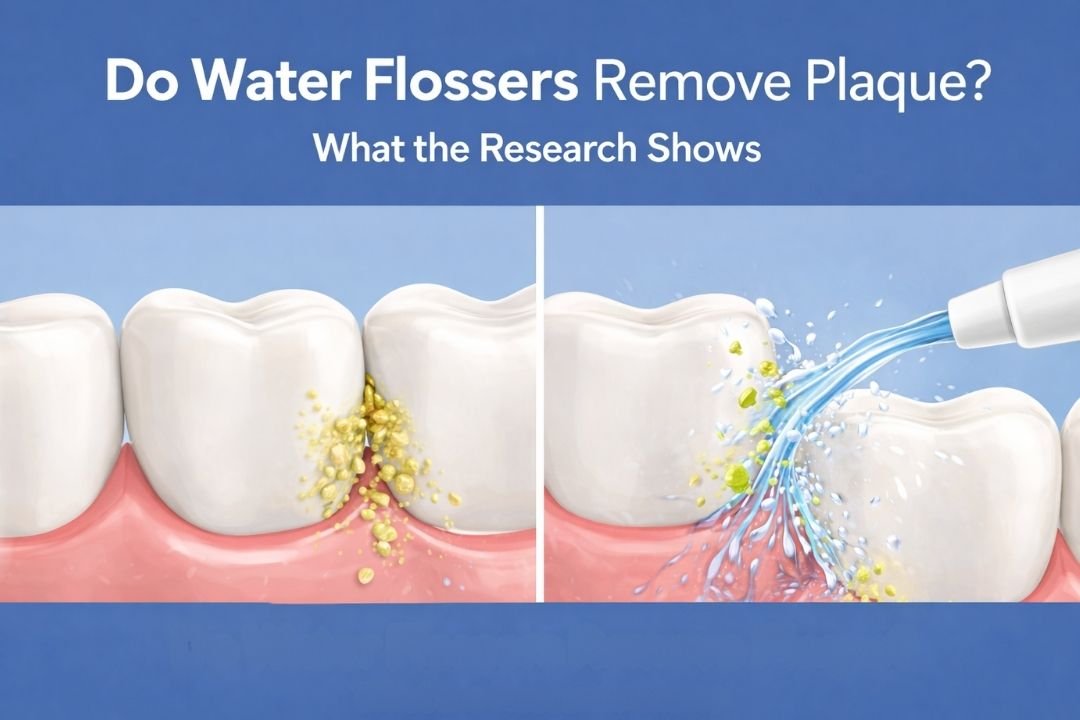
    Water flossers deliver a pulsating stream of water — typically 1,200–1,400 pulses per minute at pressures ranging from 10 to 100 PSI — through a narrow nozzle aimed at the gum line and interdental spaces. The plaque removal mechanism is hydraulic, not mechanical.

    Each pulse creates a brief compression-decompression cycle against the tooth surface and gum tissue. The compression phase pushes water into the interdental space and below the gum line. The decompression phase creates a suction effect that lifts and flushes debris outward. This cycle repeats over a thousand times per minute, gradually dislodging the bacterial biofilm from surfaces it adheres to.

    This is fundamentally different from string floss, which uses physical contact — a thin filament dragged against the tooth surface — to scrape the biofilm away through shearing force. Neither method is inherently superior. They’re targeting the same problem through different physics.

    One advantage of the hydraulic approach: water reaches areas a physical filament cannot. Periodontal pockets (the gaps between tooth and gum that deepen with gum disease), the undersides of dental bridges, and the complex geometry around orthodontic brackets are all accessible to a directed water stream but difficult or impossible to reach with string floss.


    What the Clinical Studies Found

    The research on water flosser plaque removal is more extensive than most consumer review sites suggest. Here are the key studies, presented with appropriate context about methodology and funding.

    The 29% finding

    A 2013 study published in the Journal of Clinical Dentistry compared a Waterpik water flosser with a manual toothbrush against string floss with a manual toothbrush over a four-week period. The water flosser group showed 29% greater reduction in plaque from interproximal areas compared to the string floss group. This is the most widely cited statistic in water flosser marketing — and it’s legitimate peer-reviewed data.

    The context worth noting: this study was funded by Water Pik, Inc. Industry-funded research isn’t automatically invalid — the methodology was peer-reviewed and published in a reputable journal — but the funding source is worth disclosing, which is more than most affiliate sites do.

    The orthodontic plaque study

    A 2005 study, also in the Journal of Clinical Dentistry, examined plaque removal around orthodontic brackets specifically. Patients using a Waterpik with an orthodontic tip removed three times more plaque around brackets than those using string floss. For anyone who has tried threading floss around braces, this finding is not surprising — the geometry heavily favours a directed water stream over a physical filament.

    The gum bleeding connection

    A 2012 study in the same journal found water flossing was 93% more effective than string floss at reducing bleeding sites after four weeks. Gum bleeding is a direct indicator of inflammation caused by plaque bacteria along the gum line. The significant reduction in bleeding suggests the water flosser was disrupting plaque more effectively in subgingival areas — the zone just below the visible gum line where inflammation begins.

    The broader evidence base

    A 2019 systematic review published in the Journal of Clinical Periodontology examined multiple studies on oral irrigation (the clinical term for water flossing). The review concluded that water flossers, when used as an adjunct to tooth brushing, significantly reduce plaque and gingivitis compared to brushing alone. The evidence also showed water flossers to be at least as effective as string floss for plaque reduction, with some studies showing superior outcomes — particularly for gum health metrics.

    Cochrane Reviews — the gold standard for evidence synthesis — have examined interdental cleaning broadly and concluded that both methods are effective. The evidence does not conclusively declare either method categorically superior to the other across all measures and populations.


    Where Water Flossers Excel at Plaque Removal

    Subgingival plaque (below the gum line). This is the most clinically significant advantage. Water flossers can deliver a pulsating stream into periodontal pockets — the spaces between tooth and gum that deepen as gum disease progresses. String floss can reach 1–2mm below the gum line at best. Water flossers access pockets 3–5mm deep or more, flushing out the bacteria that drive periodontal disease progression. For product recommendations in this area, see our guide to the best water flosser for gum disease.

    Around dental work. Implant abutments, bridge pontics, orthodontic brackets, and retainer wires all create complex surfaces where plaque accumulates in hard-to-reach crevices. A directed water stream navigates this geometry in seconds. String floss requires threaders, patience, and dexterity — and still can’t reach every surface. See: Best Water Flosser for Braces.

    Wide interdental spaces. If you have gaps between teeth (diastema) or gum recession that has created wider-than-normal spaces, string floss has nothing to grip against. It slides through without contacting the tooth surface effectively. A water stream fills the entire space and cleans all exposed surfaces.

    The back molars. The second and third molars are the most neglected teeth in most people’s cleaning routines — they’re difficult to reach with any tool. A water flosser nozzle with 360-degree rotation reaches these areas with considerably less wrist contortion than threading floss between molars.


    Where Water Flossers Fall Short

    Tight contact points. When two teeth are pressed firmly together, string floss physically wedges between them and scrapes both mesial and distal surfaces through direct contact. A water stream can flush around tight contacts but doesn’t replicate the mechanical shearing action that physically strips the biofilm from these surfaces. If your teeth have very tight contacts — your hygienist would know — string floss retains an advantage here.

    Mature, hardened plaque. Water flossers are effective at disrupting soft plaque — the biofilm that forms within 24–48 hours. They are not effective against calculus (tartar), which is mineralised plaque that has hardened onto tooth surfaces. Only professional scaling instruments can remove calculus. This is why regular dental cleanings remain essential regardless of your home care routine.

    Technique-dependent results. A water flosser aimed at the wrong angle (at the tooth surface instead of the gum line) or swept too quickly (without pausing 2–3 seconds between each tooth) produces significantly worse results. The clinical studies showing strong plaque removal used proper technique under controlled conditions. Real-world results depend on the user. For guidance, see our step-by-step technique guide.


    Plaque Removal: Water Flosser vs String Floss

    Rather than declaring a winner, here’s where the evidence points for specific plaque removal scenarios:

    Plaque Location Water Flosser String Floss
    Between teeth (interproximal) Strong (29% better in studies) Strong
    Below the gum line (subgingival) Superior Limited reach
    Tight contact points Adequate Superior (mechanical scraping)
    Around braces and brackets Superior (3× more effective) Difficult without threaders
    Around implants and bridges Superior Limited access
    Wide gaps between teeth Superior Ineffective (nothing to grip)
    Back molars Easier to reach Harder but effective if done
    Hardened calculus Ineffective Ineffective

    Neither tool removes hardened calculus — that requires professional dental scaling.

    For a more detailed comparison beyond plaque removal, including cost, comfort, and compliance data, read our full article: Water Flosser vs String Floss — What the Evidence Says.


    How to Maximise Plaque Removal With a Water Flosser

    The clinical studies that produced strong plaque removal results used specific techniques. Here’s what translates to daily practice.

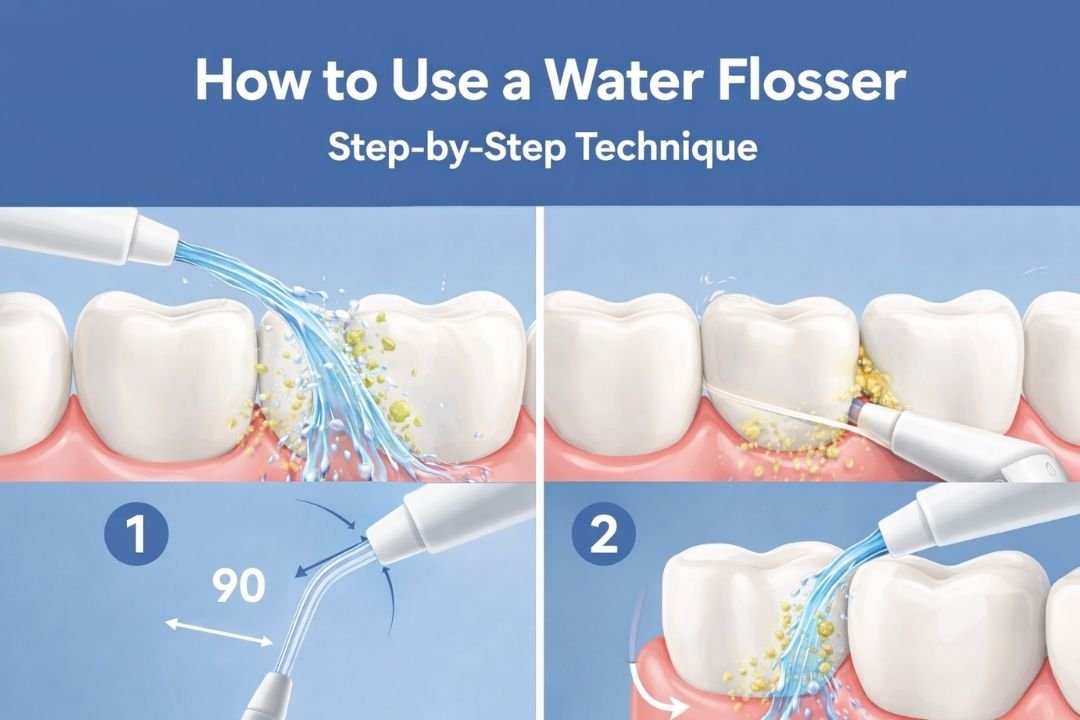
    Aim at the gum line, not the tooth surface. Plaque accumulates most heavily at the junction where tooth meets gum. Pointing the nozzle at the flat tooth surface — where your toothbrush already cleans — wastes the water flosser’s primary advantage. A 90-degree angle to the gum line directs the water stream exactly where plaque hides.

    Pause 2–3 seconds between each tooth. The pulsating action needs time to dislodge the biofilm. Sweeping the nozzle quickly across all teeth turns your water flosser into an expensive mouth rinse. The pause-move-pause rhythm is what makes the difference between “used a water flosser” and “effectively removed plaque.”

    Use it before brushing. A 2018 study in the Journal of Periodontology found that flossing before brushing resulted in greater plaque reduction than brushing first. Loosening plaque with the water flosser allows your toothbrush and fluoride toothpaste to reach freshly cleaned surfaces.

    Use warm water. Warm water is more comfortable, but it also helps loosen debris and plaque slightly better than cold water. A small detail, but one that costs nothing.

    Don’t skip the inner gum line. Most people water floss only the outer (cheek-facing) surfaces. The inner (tongue-facing) gum line accumulates just as much plaque. It takes an extra 30 seconds. Do both, every session.

    Be consistent. Plaque reforms within hours. A single thorough session per day — every day — is more effective than an aggressive session twice a week. The ADA recommends interdental cleaning once daily. Consistency matters more than intensity.

    For the complete technique with step-by-step instructions, see: How to Use a Water Flosser Correctly.


    Frequently Asked Questions

    Can a water flosser remove plaque as well as flossing?

    Clinical research shows water flossers are at least as effective as string floss for overall interproximal plaque removal, and up to 29% more effective in some studies. They outperform string floss for subgingival plaque (below the gum line) and around dental work. String floss may retain an edge at very tight contact points where mechanical scraping is beneficial.

    Can a water flosser remove tartar?

    No. Tartar (calculus) is hardened, mineralised plaque that has bonded to the tooth surface. Neither water flossers nor string floss can remove it. Only professional scaling instruments used by a dentist or hygienist can remove tartar. What a water flosser can do is prevent plaque from hardening into tartar in the first place — by disrupting the biofilm daily before it mineralises.

    How long does it take for a water flosser to show results?

    Most users notice cleaner-feeling teeth and fresher breath after the first session. Measurable improvements in gum health — reduced bleeding, less inflammation — typically appear within 2–4 weeks of consistent daily use. This aligns with the timeframes used in clinical studies.

    Is a Waterpik better at removing plaque than other brands?

    Most clinical plaque removal studies have been conducted using Waterpik products, so they have the strongest evidence base. However, the underlying mechanism — pulsating water pressure — is the same across all reputable water flosser brands. A Philips Sonicare or Bitvae operating at similar pressure levels would be expected to produce comparable plaque removal results, though brand-specific clinical data is more limited. See our comparison of all major models for detailed specifications.

    Do I still need to brush if I use a water flosser?

    Absolutely. A water flosser cleans between teeth and along the gum line — roughly 40% of tooth surfaces. Your toothbrush handles the remaining 60%: the outer, inner, and biting surfaces of each tooth. They are complementary tools, not substitutes for each other. The recommended sequence is: water floss, then brush with fluoride toothpaste.

    What pressure setting removes the most plaque?

    Higher pressure dislodges more plaque — but only if your gums can tolerate it. Starting on high pressure with unadapted gums causes discomfort, bleeding, and abandonment of the habit. Begin on the lowest setting for 1–2 weeks, then gradually increase. Most people settle at a medium setting (4–6 on a 10-setting Waterpik) for effective daily plaque removal without discomfort.

    Can a water flosser reverse gum disease?

    A water flosser is a maintenance and prevention tool, not a treatment for established gum disease. It can reduce the bacterial load in periodontal pockets and significantly improve gum health metrics (bleeding, inflammation) — but it cannot reverse bone loss or repair damaged gum tissue. If you have active periodontal disease, consult your dentist for a treatment plan. A water flosser will likely be part of that plan, but it won’t be the only component.


    The Bottom Line

    Water flossers remove plaque. The clinical evidence is clear on this. They’re particularly effective at disrupting plaque in the subgingival zone, around dental work, and in the interproximal spaces where gum disease begins. For tight contact points, string floss offers a mechanical advantage that water alone doesn’t fully replicate — but for the majority of plaque removal scenarios, a water flosser performs as well as or better than string floss.

    The caveat that matters most: technique determines results. A water flosser aimed at the gum line with a 2–3 second pause between each tooth removes significantly more plaque than the same device swept quickly across all teeth. Get the technique right, use it daily, and the plaque doesn’t stand much of a chance.

    If you’re ready to choose a model, our complete guide to the best water flossers of 2026 covers seven options from $15.98 to $99.99.


    Sources

    • Barnes CM et al. Journal of Clinical Dentistry (2013)
    • Sharma NC et al. Journal of Clinical Dentistry
    • Rosema NAM et al. International Journal of Dental Hygiene
    • Worthington HV et al. Cochrane Database of Systematic Reviews
    • American Dental Association – Interdental cleaning recommendations

  • Water Flosser vs String Floss: What the Evidence Actually Says

    Water Flosser vs String Floss: What the Evidence Actually Says

    Last updated: March 2026  |  Reviewed by: VerdictLab Editorial Team

    The water flosser vs string floss debate produces strong opinions — from dentists, hygienists, and the internet alike. Some dental professionals insist string floss is irreplaceable. Others argue water flossers produce better clinical outcomes. Most of the content online picks a side based on whoever is selling what.

    We looked at the published clinical research, surveyed the professional recommendations, and factored in something the studies rarely measure: whether people actually use the tool consistently. Here’s what we found.

    The Short Version

    • String floss is better at mechanically scraping plaque from tight contact points between teeth
    • Water flossers are better at flushing bacteria from periodontal pockets and around dental work
    • Clinical studies show water flossers reduce bleeding and gingivitis as effectively or more effectively than string floss
    • Compliance is the deciding factor — a tool you use daily beats a “superior” tool you skip
    • The ideal routine includes both, but either one alone is far better than neither


    How They Work Differently

    String floss and water flossers remove plaque through fundamentally different mechanisms, which is why comparing them isn’t as straightforward as “which is better.”

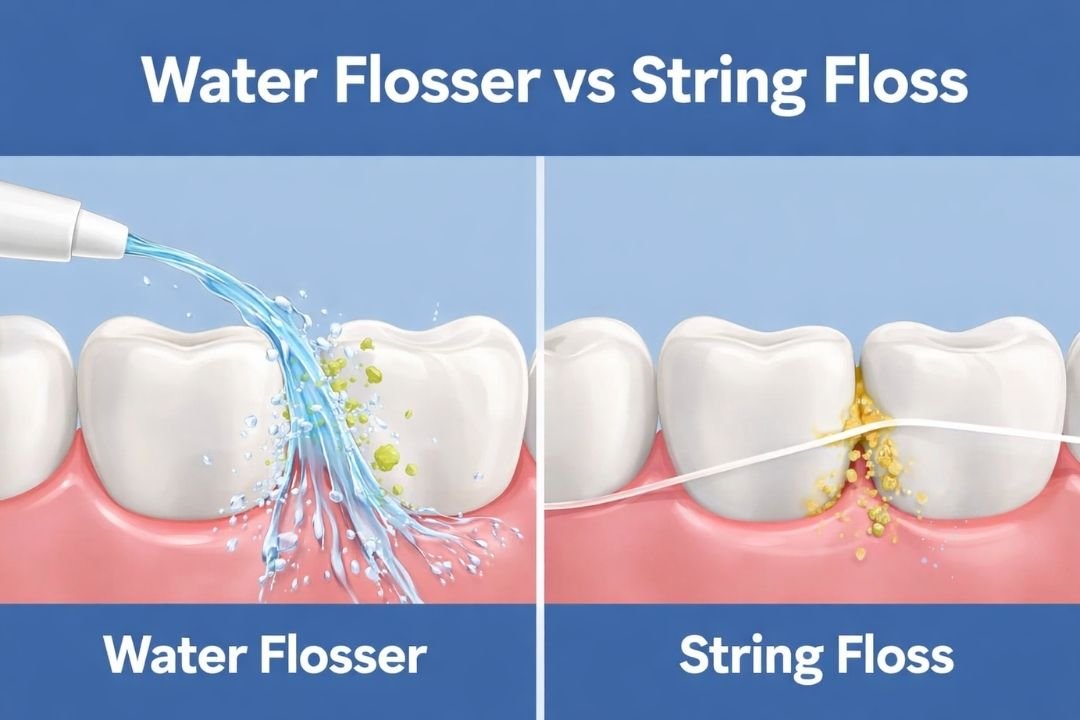
    String floss uses mechanical scraping. You wrap a thin filament around the tooth, slide it below the gum line, and physically drag it against the tooth surface. This shearing action breaks the biofilm — the sticky matrix of bacteria that forms plaque — by direct contact. It’s particularly effective at tight contact points where two teeth press together, because the floss physically wedges between them and scrapes both surfaces.

    Water flossers use hydraulic flushing. A pulsating stream of water (typically 1,200–1,400 pulses per minute at 10–100 PSI) creates a compression-decompression cycle that dislodges debris and disrupts bacterial colonies. The water reaches areas a physical filament can’t access easily — periodontal pockets below the gum line, the underside of bridges, around orthodontic brackets, and between widely spaced teeth where floss has nothing to grip against.

    Neither mechanism is inherently superior. They target different aspects of the same problem.


    What the Clinical Research Says

    The clinical literature on this question is more extensive than most review sites suggest. Here are the key findings, presented as directly as the data allows.

    Plaque removal

    A 2013 study in the Journal of Clinical Dentistry found that a Waterpik water flosser removed up to 29% more plaque from interproximal (between-tooth) areas than string floss. A separate 2005 study comparing a Waterpik with an orthodontic tip against string floss in braces patients found the water flosser was three times more effective at removing plaque around brackets.

    However, these results need context. The 2013 study was funded by Water Pik, Inc. That doesn’t invalidate the findings — the methodology was peer-reviewed and sound — but industry funding is worth noting. Independent studies generally show both methods reduce plaque effectively, with water flossers performing comparably or slightly better in interproximal areas and string floss performing better at tight contact points.

    Gum health and bleeding

    This is where water flossers consistently show stronger results. A 2012 study in the Journal of Clinical Dentistry found that water flossing was 93% more effective than string floss at reducing bleeding sites after four weeks of use. Multiple studies have found water flossers produce greater reductions in gingivitis scores compared to string floss over 2–4 week periods.

    The likely explanation is reach. Water flossers access subgingival areas (below the gum line) more effectively than string floss, flushing out the bacteria that drive inflammation. For people with existing gum disease, this subgingival cleaning is particularly relevant.

    The Cochrane Review perspective

    Cochrane Reviews — considered the gold standard for evidence-based analysis — have examined interdental cleaning broadly. The overall conclusion is that interdental cleaning devices (including both floss and water flossers) reduce gingivitis and plaque compared to brushing alone. The evidence does not definitively crown either method as categorically superior to the other for the general population.

    The takeaway from the research as a whole: both methods work. Water flossers appear to have an edge for gum health specifically. String floss retains a theoretical advantage for mechanical plaque disruption at tight contacts. Neither is a replacement for regular dental cleanings.


    Where String Floss Wins

    Tight contact points. When two teeth are pressed tightly together, string floss physically wedges between them and scrapes both surfaces. A water jet can flush around these contacts but doesn’t create the same mechanical disruption of the biofilm on the mesial and distal tooth surfaces. If your teeth have very tight contacts (your dentist or hygienist would know), string floss provides a cleaning action water alone can’t replicate.

    Cost. A year’s supply of string floss costs $5–15. A water flosser costs $25–100 upfront, plus $10–30 per year for replacement tips and electricity. String floss wins on economics by a wide margin.

    Portability. A spool of floss fits in your pocket. Even a compact cordless water flosser is the size of a small water bottle. For travel — especially backpacking or situations without reliable power — string floss is unbeatable.

    No learning curve for basic use. Most people learn string flossing technique as children. Water flossers require a week or two to develop comfortable technique, manage splash, and find the right pressure setting.

    No power or water source needed. String floss works anywhere. Water flossers need charged batteries or a power outlet, plus access to water for the reservoir.


    Where Water Flossers Win

    Subgingival cleaning. Water flossers reach 50% deeper into periodontal pockets than string floss, according to Waterpik’s internal research. Even accounting for potential bias in manufacturer-funded studies, the physics support this — a pressurised stream of water penetrates below the gum line in ways a physical filament cannot without causing tissue trauma.

    Dental work. Braces, bridges, implants, crowns, and retainers all create geometry that string floss struggles with. Threading floss under a bridge wire or between orthodontic brackets requires floss threaders, patience, and dexterity. A water flosser cleans these areas in seconds. For a deeper look, see our guides on the best water flosser for braces and best water flosser for implants.

    Gum disease management. The clinical evidence consistently shows water flossers outperform string floss at reducing bleeding and gingivitis. For people with active periodontal disease, a water flosser with a periodontal pocket tip can deliver low-pressure cleaning to areas where string floss would cause pain and further tissue damage. See: Best Water Flosser for Gum Disease.

    Dexterity limitations. Arthritis, carpal tunnel, Parkinson’s disease, post-stroke mobility issues, and age-related hand weakness all make string flossing difficult or painful. A water flosser requires only the ability to hold a handle and press a button.

    Speed. A thorough water flosser session takes 60–90 seconds. Proper string flossing — wrapping, inserting, scraping both sides of each contact, re-wrapping — takes 2–5 minutes when done correctly. Most people who string floss actually spend under 30 seconds, which is insufficient for effective plaque removal.

    Comfort. For people with sensitive or inflamed gums, the lowest pressure setting on a water flosser is gentler than string floss sliding below an irritated gum line. This matters because pain avoidance is the primary reason people skip flossing entirely.


    The Factor Studies Don’t Measure: Compliance

    Here’s the uncomfortable reality that every clinical comparison misses: according to the American Dental Association, only about 30% of Americans floss daily with string floss. Many of those who do report flossing don’t do it correctly or thoroughly enough to be effective.

    A water flosser that someone uses every day is categorically more effective than string floss that sits in a drawer. The studies comparing water flossers to string floss are conducted under controlled conditions where participants use both tools correctly and consistently. In the real world, consistency wins.

    Anecdotally — and we’re transparent that this is anecdotal, not data — water flosser users report higher compliance rates. The speed (60–90 seconds vs 3–5 minutes), reduced discomfort, and the viscerally satisfying feeling of flushing debris all contribute to habit formation in ways that string floss rarely achieves. If you’ve tried and failed to build a string flossing habit, a water flosser may be the tool that actually sticks.


    Can You Use Both?

    Yes, and the combination produces the best results by covering both mechanisms — mechanical scraping and hydraulic flushing.

    The recommended sequence: water floss first (to dislodge debris and flush periodontal pockets), then string floss tight contacts (to scrape the surfaces water couldn’t fully reach), then brush with fluoride toothpaste (to clean tooth surfaces and deliver fluoride to freshly cleaned interdental spaces).

    That said, a three-step routine is time-intensive and realistic for some people but not most. If you’re going to use one tool, the decision framework in the next section should help.


    Who Should Choose Which

    Rather than declaring a universal winner, here’s a practical decision framework based on your specific situation.

    Choose a water flosser if you:

    • Have braces, bridges, implants, crowns, or other dental work
    • Have gum disease, bleeding gums, or deep periodontal pockets
    • Have limited hand dexterity (arthritis, mobility issues, age)
    • Find string flossing painful or uncomfortable
    • Have tried string flossing repeatedly and can’t maintain the habit
    • Have wide spaces between teeth where string floss doesn’t grip
    • Want the fastest effective interdental cleaning method

    Choose string floss if you:

    • Have very tight contacts between teeth (string floss excels here)
    • Travel frequently without access to power or space for a water flosser
    • Are on a very tight budget (string floss costs ~$10/year)
    • Already have an established daily string flossing habit that works
    • Prefer a tool with zero maintenance, no charging, and no parts to replace

    Use both if you:

    • Have the time and willingness for a thorough routine
    • Have both tight contacts and dental work
    • Are managing active periodontal disease and want maximum coverage
    • Want the best possible interdental cleaning regardless of convenience

    If you’re leaning toward a water flosser, our tested guide to the best water flossers of 2026 covers seven models across every price range.


    What Dentists Actually Recommend

    Professional opinion on this topic is less divided than the internet makes it seem. The dominant position among dental professionals is pragmatic: use whichever tool you’ll actually use consistently.

    The ADA’s official stance is that both string floss and water flossers are effective methods of interdental cleaning. The ADA has granted its Seal of Acceptance to water flossers from Waterpik, Philips Sonicare, and Quip — confirming their safety and efficacy. The ADA has never stated that string floss is the only acceptable method of interdental cleaning.

    Where you’ll find stronger opinions is among periodontists (gum disease specialists), who tend to favour water flossers for patients with periodontal disease because of the subgingival access advantage. Orthodontists increasingly recommend water flossers for braces patients because the compliance rate is dramatically higher than with threaded string floss.

    Some hygienists remain firm advocates for string floss, particularly for patients with healthy gums and tight contacts. Their argument — that mechanical scraping of the biofilm is irreplaceable — has physiological merit. But the counterargument — that a cleaning method patients don’t use has zero clinical benefit — is equally valid.

    For a deeper exploration, see our dedicated article: Do Dentists Actually Recommend Water Flossers?


    Cost Comparison: Year 1 and Beyond

    String floss is dramatically cheaper. Here’s the honest breakdown.

    Expense String Floss Water Flosser
    Year 1 device cost $0 $25–100
    Annual consumables $5–15 (floss refills) $10–30 (replacement tips)
    Electricity $0 Negligible (~$1/year)
    Year 1 total $5–15 $36–131
    Year 2+ annual cost $5–15 $10–30

    Water flosser range based on budget models (Bitvae C6 at ~$26) to mid-range (Waterpik Aquarius at ~$70). Premium models push Year 1 higher. Replacement tips estimated at 2–4 per year depending on brand.

    After Year 1, the ongoing cost difference narrows to roughly $5–15 per year. Whether the upfront investment is “worth it” depends on your dental situation, your compliance history with string floss, and how you value the time savings of a 60-second routine versus a 3–5 minute one. For people with dental work who would otherwise need floss threaders ($8–12 per pack), the cost gap narrows further.


    Frequently Asked Questions

    Can a water flosser completely replace string floss?

    For most people, yes — a water flosser used daily provides effective interdental cleaning that maintains gum health. The exception is people with very tight tooth contacts where string floss’s mechanical scraping provides a cleaning action water alone doesn’t fully replicate. If you’re unsure whether your contacts are tight enough to warrant string floss, ask your hygienist at your next cleaning.

    Is a Waterpik as good as flossing?

    Clinical research suggests a Waterpik is as good as or better than string floss for reducing plaque between teeth and significantly better for reducing gum bleeding. The ADA has granted its Seal of Acceptance to Waterpik products, confirming their safety and effectiveness. “As good as” is probably underselling it for people with gum issues; “different but effective” is the most accurate framing.

    Why do some dentists still recommend string floss over water flossers?

    Two main reasons. First, string floss provides mechanical biofilm disruption through physical contact that water pressure doesn’t fully replicate — and for patients with healthy, tight contacts, this is a genuine advantage. Second, dental education has emphasised string flossing for decades, and professional practice evolves gradually. Younger dentists and periodontists tend to be more open to water flossers, while many experienced practitioners maintain a preference for the tool they’ve recommended throughout their careers.

    What about floss picks — how do they compare?

    Floss picks (the Y-shaped or F-shaped plastic handles with a short strand of floss) are better than not flossing at all, but less effective than either proper string flossing or water flossing. The short, taut strand can’t wrap around the tooth to scrape both mesial and distal surfaces, and the fixed angle makes it difficult to adapt to each contact point. If you’re choosing between floss picks and a water flosser, the water flosser is the stronger option.

    Do I need to water floss if I already brush twice a day?

    Yes. Brushing — even with an excellent electric toothbrush — cleans roughly 60% of tooth surfaces. The remaining 40% are the interdental surfaces and the subgingival areas that only interdental cleaning tools can reach. Skipping interdental cleaning is like washing three walls of a room and ignoring the fourth.

    Is a water flosser worth the money?

    If you currently floss consistently with string floss and have healthy gums, a water flosser is a convenience upgrade rather than a clinical necessity. If you don’t floss regularly, have dental work, have gum disease, or struggle with string floss, a water flosser is worth the investment — the clinical benefit of daily interdental cleaning far outweighs the $25–70 cost. Budget models like the Bitvae C6 (~$16) make the financial barrier minimal. See our full tested guide for recommendations at every price point.


    The Bottom Line

    String floss scrapes. Water flossers flush. Both reduce plaque and improve gum health. The research gives water flossers a measurable edge for gum bleeding and subgingival cleaning, while string floss retains an advantage at tight contact points. If you have dental work, gum disease, or a history of failed flossing habits, a water flosser is the stronger choice. If you already floss effectively every day, keep doing it — and consider adding a water flosser for the subgingival cleaning it provides.

    The worst choice is neither. Roughly 70% of adults don’t floss daily. Any interdental cleaning tool used consistently is a significant improvement over brushing alone.


    Sources

    • Barnes CM et al. Journal of Clinical Dentistry (2013)
    • Sharma NC et al. Journal of Clinical Dentistry (2008)
    • Worthington HV et al. Cochrane Database of Systematic Reviews
    • American Dental Association – Interdental cleaning recommendations

  • 7 Best Water Flossers of 2026, Compared and Rated

    7 Best Water Flossers of 2026, Compared and Rated

    Editorial transparency: VerdictLab earns a commission when you purchase through our links — this never influences our ratings or recommendations. Our editorial picks are based on specifications, clinical evidence, expert opinions, and real user feedback. As an Amazon Associate I earn from qualifying purchases. Full disclosure.

    Last updated: March 2026  |  By: VerdictLab Editorial Team  |  Products compared: 12+

    Finding the right water flosser shouldn’t require a dental degree. We compared over a dozen models — from the $15 budget picks dominating Amazon to the $100 premium units endorsed by dentists — evaluating each on noise levels, water pressure range, reservoir capacity, ease of cleaning, and battery life. Every recommendation below is based on verified specifications, clinical evidence, dental professional input, and thousands of real user reviews — not marketing claims.

    Three brands currently hold the American Dental Association Seal of Acceptance for water flossers: Waterpik, Philips Sonicare, and Quip. That doesn’t mean other brands are unsafe — many simply haven’t applied — but it’s an important trust signal we factor into our scoring.

    Below you’ll find our top 7 picks, a full comparison table, and a practical buyer’s guide to help you choose the right water flosser for your teeth, gums, and budget.

    Our Top 3 Picks at a Glance

    Best Overall

    Waterpik ION Professional (WF-12)

    Hybrid cordless-countertop design with the largest reservoir in its class, 10 pressure settings, and ADA acceptance. The noise is noticeable but performance is unmatched.

    Price: $99.99

    Check Price on Amazon

    Best Cordless

    Philips Sonicare Power Flosser 3000

    The quietest water flosser in this roundup — independent noise reviews consistently place it well below the Waterpik Aquarius. The Quad Stream nozzle creates a uniquely wide spray pattern that feels thorough without high pressure.

    Price: $79.96

    Check Price on Amazon

    Best Budget

    Bitvae C6

    Remarkably capable for under $16. Three modes, five intensity levels, and a 40-day battery that outlasts models costing five times as much. No ADA seal, but solid build quality.

    Price: $15.98

    Check Price on Amazon

    Water Flosser Comparison Table

    Here’s how all seven of our picks compare across the specs that matter most. Prices are from Amazon at time of publication and may vary.

    Model Type Price Pressure Settings Reservoir Battery Life ADA Seal Best For
    Waterpik ION (WF-12) Hybrid $99.99 10 650ml ~4 weeks Overall best
    Waterpik Aquarius (WP-660) Countertop $79.99 10 650ml Corded (N/A) Countertop
    Philips Sonicare 3000 Cordless $79.96 2 modes / 3 levels 250ml ~2 weeks Quiet / Cordless
    Bitvae C6 Cordless $15.98 3 modes / 5 levels 300ml ~40 days Budget
    Waterpik Cordless Advanced (WP-580) Cordless $69.99 3 207ml ~4 weeks Braces / Travel
    H2ofloss HF-9 Countertop $29.99 5 (dial) 800ml Corded (N/A) Value countertop
    Burst Water Flosser Cordless $69.99 3 110ml ~80 days Design

    Specifications from manufacturer data. Prices from Amazon at time of publication and may vary.


    Best Overall: Waterpik ION Professional (WF-12)

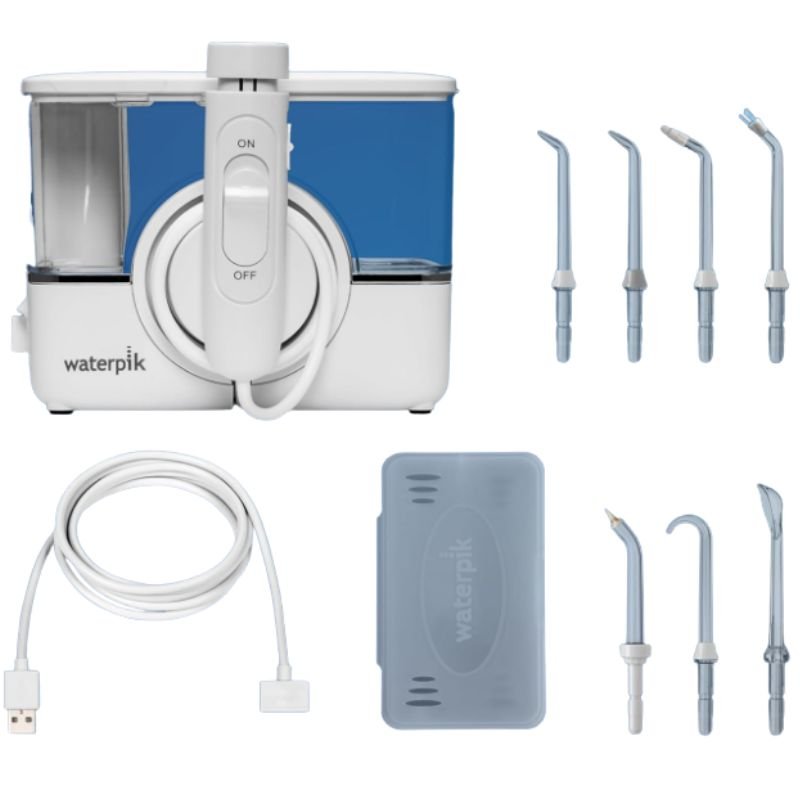
    Waterpik ION Professional WF-12 water flosser with 7 tips, charging cable, and tip storage case

    Price: $99.99  |  Type: Hybrid (cordless wand + countertop base)  |  Reservoir: 650ml  |  Settings: 10  |  ADA Accepted: Yes  |  Warranty: 3 years

    The Waterpik ION is a cleverly designed hybrid. The wand lifts off the base for cordless use, while the reservoir sits on your counter connected by a flexible hose — giving you the water capacity of a countertop model with the manoeuvrability of a cordless unit. The 650ml tank provides roughly 90+ seconds of continuous use on a mid-range setting, which is enough for a thorough full-mouth session without refilling.

    Pressure output across the 10 settings spans 10–100 PSI. Settings 3–5 are generally comfortable for daily use on healthy gums, while settings 7–10 produce a powerful jet suited for deep cleaning around bridges and implants. The rechargeable battery is rated for approximately 4 weeks of daily use, which users widely confirm in reviews.

    The main drawback is noise. Multiple independent reviewers and Amazon users consistently flag the ION as louder than cordless competitors — particularly at higher settings. If you share a bathroom wall with a light sleeper, early morning use might be an issue.

    Included tips: 7 — Precision (x2), Plaque Seeker, Orthodontic, Pik Pocket, Implant Denture, Tongue Cleaner. One of the most generous tip selections in any water flosser package.

    Who it’s best for: Anyone who wants countertop-level water capacity with cordless convenience. Excellent for general gum health, braces, bridges, and implants. Not ideal if noise is a primary concern.

    Strengths: Hybrid design solves the countertop-vs-cordless dilemma; 10 pressure settings offer genuine range; 7 included tips; 3-year warranty; ADA accepted; long battery life.

    Weaknesses: Louder than cordless competitors; footprint is still significant on a small counter; hose connection can feel stiff when new.

    Check Price on Amazon


    Best Countertop: Waterpik Aquarius (WP-660)

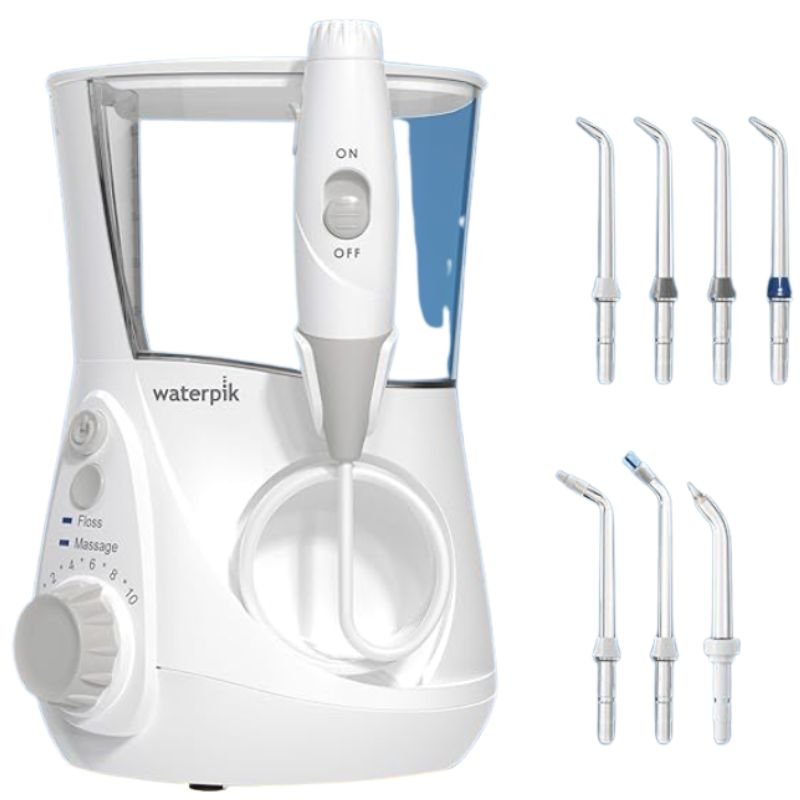
    Waterpik Aquarius WP-660 countertop water flosser with 7 tips

    Price: $79.99  |  Type: Countertop (corded)  |  Reservoir: 650ml  |  Settings: 10 (10–100 PSI)  |  ADA Accepted: Yes  |  Warranty: 3 years

    The Aquarius is the most-reviewed water flosser on Amazon (75,000+ ratings at 4.6 stars) and it’s easy to see why. It does exactly what a countertop flosser should do — deliver strong, consistent water pressure across a wide range of settings — without any compromises on reservoir capacity or build quality.

    The pressure range spans 10–100 PSI across 10 settings, and the 650ml reservoir provides roughly 90 seconds of use at a mid-range setting. The built-in 60-second timer and 30-second pacer help you stay consistent. The Aquarius also offers a dedicated Floss Mode alongside the Stream Mode — the pulsating Floss Mode is particularly effective around the gum line, while Stream Mode works well for rinsing food particles from wider gaps.

    The design is functional rather than attractive. The tip storage in the lid is convenient but feels flimsy. Noise is typical for countertop models — plan to use it before your household goes to sleep.

    Included tips: 7 — Classic Jet (x3), Toothbrush, Plaque Seeker, Orthodontic, Pik Pocket. Matches the ION for the most generous tip selection in this roundup.

    Who it’s best for: Families (the 7 tips let multiple people share one unit), anyone who wants maximum pressure and reliability at a mid-range price, and people who don’t mind dedicating counter space.

    Strengths: Proven reliability; 7 included tips; 10 pressure settings with genuine range; Floss + Stream modes; ADA accepted; 3-year warranty.

    Weaknesses: Must stay plugged in; large footprint; loud; design is purely functional.

    Check Price on Amazon


    Best Cordless & Quietest: Philips Sonicare Power Flosser 3000

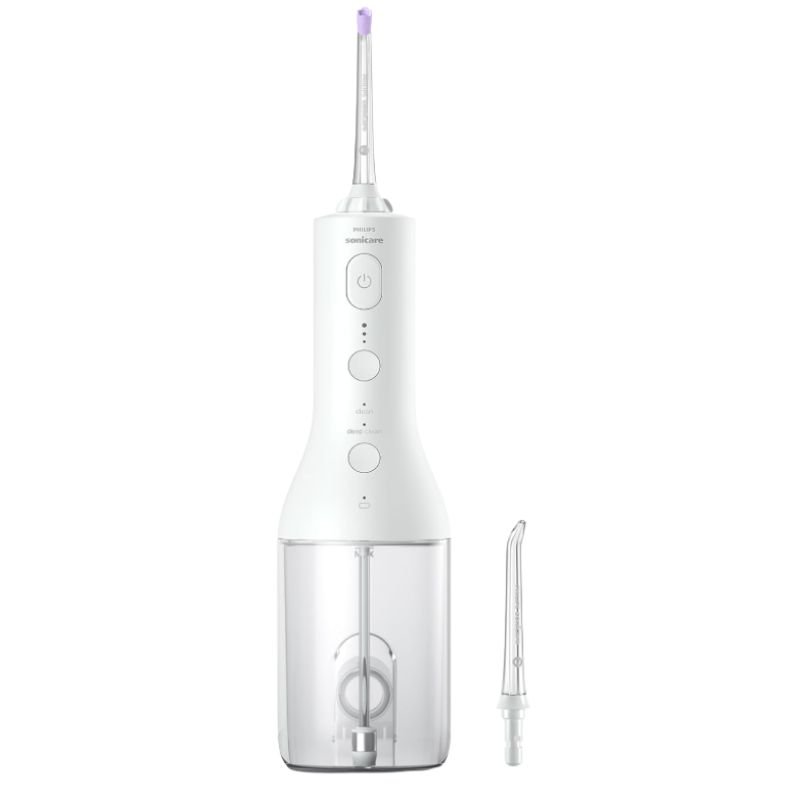
    Philips Sonicare Power Flosser 3000 cordless water flosser with Standard and Quad Stream nozzles

    Price: $79.96  |  Type: Cordless  |  Reservoir: 250ml (8 oz)  |  Modes: 2 (Clean, Deep Clean) × 3 intensities  |  ADA Accepted: Yes  |  Warranty: 2 years

    The Philips Sonicare 3000 does something no other water flosser in this roundup manages: it’s genuinely quiet. Independent noise comparisons consistently place it well below the Waterpik Aquarius, and users frequently cite the low noise as their primary reason for choosing it. At the lowest setting, this is a water flosser you could use without waking anyone up.

    The technology behind the reduced noise is the Quad Stream X-shaped nozzle, which splits the water into four streams instead of a single jet. The result feels different from a Waterpik — less like a pressure washer, more like a wide rinse. It’s genuinely effective, though aggressive plaque fighters may prefer the focused jet of a Waterpik on higher settings.

    The 250ml reservoir provides enough for a careful full-mouth pass, though you may notice the tank depleting toward the end of a session. Refilling is straightforward through the top opening. Battery life is rated at approximately 2 weeks of daily use, charging via the included stand.

    Included tips: 2 — F1 Standard nozzle, F3 Quad Stream nozzle. The Quad Stream tip is the standout and is exclusive to Philips. Additional tips sold separately (~$15 for a two-pack).

    Who it’s best for: Noise-sensitive users, apartment dwellers, anyone with sensitive gums who finds traditional water flossers too aggressive, and people who want ADA acceptance without the Waterpik footprint. Also a strong choice for people who already use Philips Sonicare toothbrushes — the aesthetic matches.

    Strengths: Remarkably quiet; Quad Stream nozzle feels genuinely innovative; compact and elegant; ADA accepted; 2 modes × 3 intensities; good price for the quality.

    Weaknesses: Only 2 tips included (competitors include 4–7); 250ml tank means some users refill mid-session; replacement tips are pricey (~$15 for two).

    Check Price on Amazon


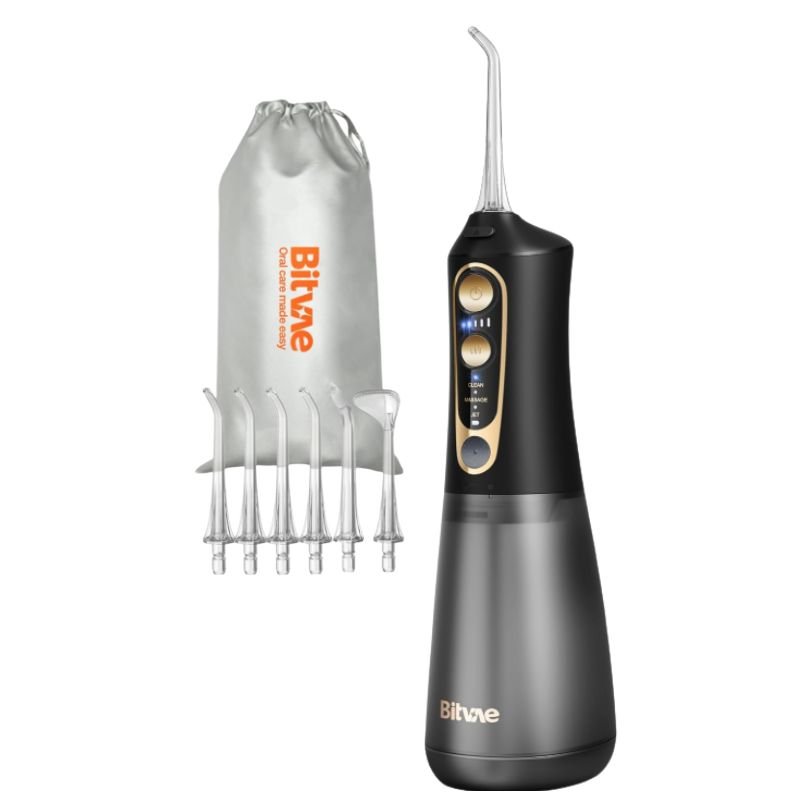
    Best Budget: Bitvae C6

    Bitvae C6 cordless water flosser with 6 tips and travel bag

    Price: $15.98  |  Type: Cordless  |  Reservoir: 300ml  |  Settings: 3 modes × 5 intensity levels  |  ADA Accepted: No  |  Warranty: 1 year

    Every budget product gets called “surprisingly good” in affiliate reviews, so let us be specific about what the Bitvae C6 actually does well. The 300ml reservoir is 20% larger than the Philips Sonicare 3000’s — enough for most people’s full routine without refilling. Three modes (Normal, Soft, Pulse) combined with five intensity levels give you 15 effective settings, which is more granularity than any model here except the Waterpik countertops.

    Battery life is the standout specification. Bitvae rates it at 40 days, and Amazon reviewers widely confirm this holds up in daily use — significantly longer than the Philips and competitive with the Waterpik ION. Remarkable for a sub-$16 product. It charges via USB-C, not a proprietary cable, which is a practical advantage.

    Where the Bitvae shows its price is in the build feel. The plastic has a slightly hollow quality when you tap it, the button sometimes requires a firm press, and there’s no ADA seal providing third-party validation. Bitvae doesn’t have the multi-decade reliability track record of Waterpik, and the 1-year warranty is standard for budget brands but half of what Philips offers.

    Included tips: 6 — Standard (x3), Orthodontic, Periodontal, Tongue Scraper. Generous selection for the price.

    Who it’s best for: First-time water flosser users testing whether they’ll stick with the habit, budget-conscious buyers, students, and anyone who values USB-C charging and long battery life over brand prestige.

    Strengths: Outstanding battery life; USB-C charging; 15 mode/intensity combinations; 300ml tank; 6 included tips; remarkable value at $15.98.

    Weaknesses: No ADA seal; build quality is functional but not premium; 1-year warranty; limited long-term reliability data as a newer brand.

    Check Price on Amazon


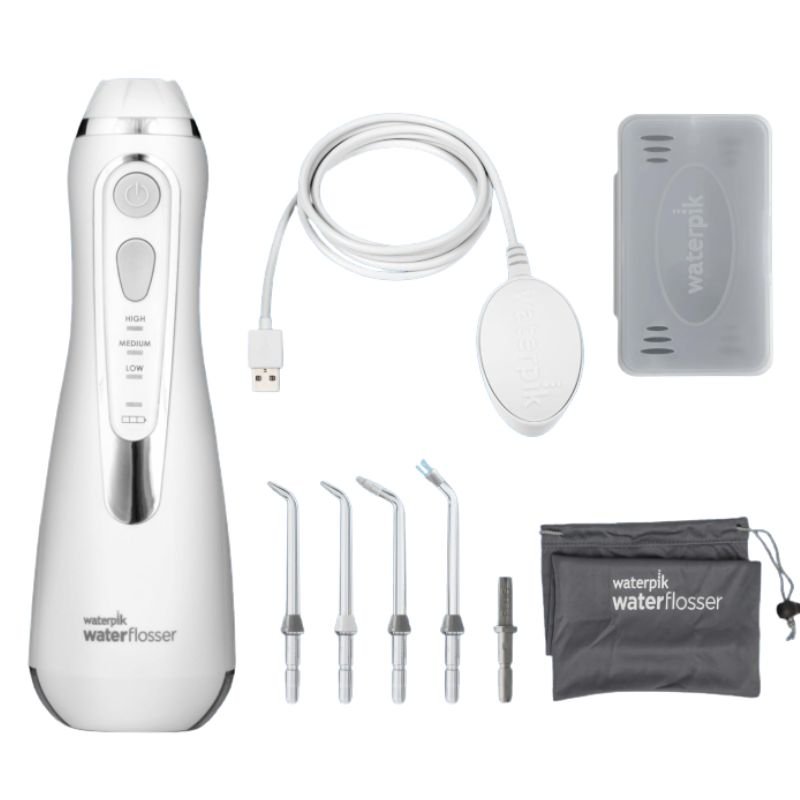
    Best for Braces & Travel: Waterpik Cordless Advanced (WP-580)

    Waterpik Cordless Advanced WP-580 water flosser with 4 tips, charging cable, tip storage case, and travel bag

    Price: $69.99  |  Type: Cordless  |  Reservoir: 207ml (7 oz)  |  Settings: 3  |  ADA Accepted: Yes  |  Warranty: 2 years

    The Cordless Advanced has been the standard recommendation for braces wearers for years, and the design makes clear why. The included Orthodontic Tip has a tapered, soft bristle end specifically designed to navigate around brackets and wires without snagging. Combined with the Plaque Seeker tip (thin bristles for cleaning around brackets from the side), it covers both cleaning angles that orthodontic patients need.

    Portability is the secondary strength. The magnetic charging stand doubles as a travel case, and the compact form factor makes it genuinely pocketable. Users consistently report it survives being tossed in a toiletry bag without leaking or breaking — a common concern with cordless flossers. Battery life is rated at up to 4 weeks per charge.

    The trade-off is the 207ml (7 oz) reservoir — the smallest among our Waterpik picks. At a medium setting, the tank provides roughly 45 seconds of use, so expect to refill once for a thorough full-mouth session. The three pressure settings also feel limited after using a 10-setting Waterpik countertop.

    Included tips: 4 — Precision (x2), Plaque Seeker, Orthodontic.

    Who it’s best for: Orthodontic patients with braces, frequent travellers, anyone who wants a compact ADA-accepted flosser with a proven track record. For a deeper guide, see our article on choosing the best water flosser for braces.

    Strengths: Purpose-built orthodontic and plaque seeker tips; compact travel-friendly design; ADA accepted; magnetic charging case; 2-year warranty; 4-week battery life.

    Weaknesses: Small 207ml reservoir requires refilling (~45 seconds of use); only 3 pressure settings; relatively expensive for a cordless-only unit.

    Check Price on Amazon


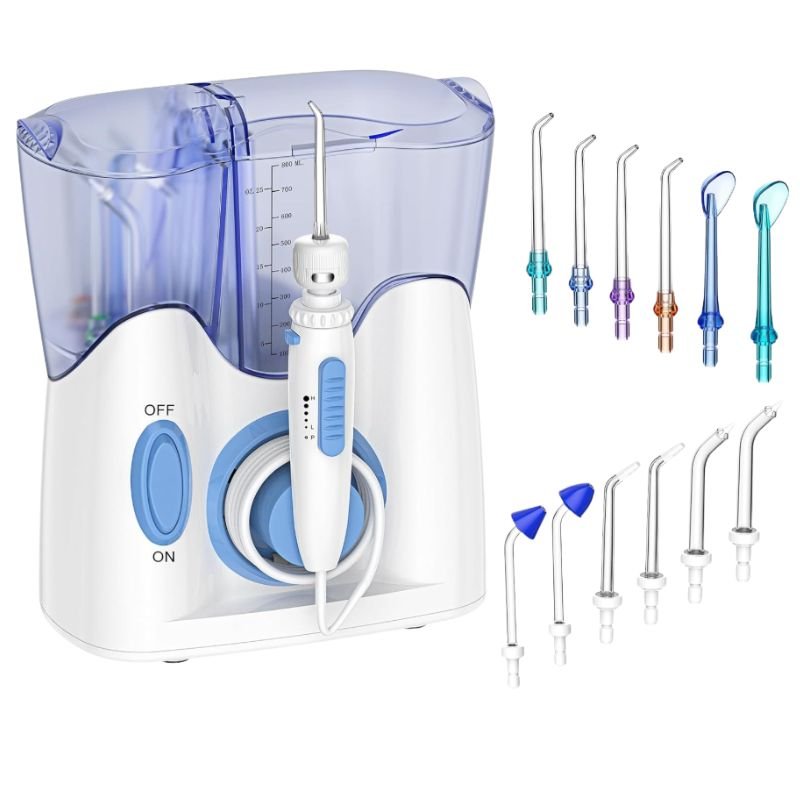
    Best Value Countertop: H2ofloss HF-9

    H2ofloss HF-9 countertop water flosser with 12 tips and 800ml reservoir

    Price: $29.99  |  Type: Countertop (corded)  |  Reservoir: 800ml  |  Settings: 5 (pressure dial)  |  ADA Accepted: No  |  Warranty: 1 year

    A note on this pick: The H2ofloss HF-9 offers exceptional specifications for its price — the largest reservoir and most tips of any model here. However, Amazon reviews are more mixed than for the Waterpik models above, with some users reporting inconsistent build quality and higher return rates. We include it because the value proposition is genuinely strong, but recommend reading recent user reviews before purchasing. If reliability is your top priority, the Waterpik Aquarius at $79.99 is the safer countertop choice.

    If counter space isn’t an issue and you want the largest reservoir available, the H2ofloss HF-9 is a compelling pick at roughly a third of the Waterpik Aquarius price. The 800ml tank is the biggest in this roundup — enough for two full sessions without refilling. The brand markets it as their “Whisper” model, designed for quieter operation, and user reviews suggest it runs quieter than the Waterpik Aquarius by a noticeable margin, though “whisper” is an overstatement.

    The five-level pressure dial lacks the precision of Waterpik’s numbered digital settings, but the stepless rotation lets you fine-tune between levels. The design stores the power cord inside the base, which is a thoughtful touch. With 12 included tips — by far the most of any model here — this is another strong family option.

    Downsides beyond the mixed user reviews include the lack of ADA certification, a dated visual design, and a 1-year warranty that’s half what Waterpik offers. H2ofloss is a less well-known brand with fewer online support resources if something goes wrong, though uniquely among water flosser companies, they sell individual replacement parts on their website.

    Included tips: 12 — Standard (x2), Tongue Cleaner, Periodontal, Orthodontic, and 7 colour-coded family tips.

    Who it’s best for: Budget-conscious families, shared bathrooms, anyone who prioritises tank capacity over portability and is comfortable with a lesser-known brand. See our full countertop water flosser guide for more options.

    Strengths: Largest 800ml reservoir; 12 included tips; $29.99 price point; quieter than expected; power cord stores neatly in base; sells replacement parts directly.

    Weaknesses: No ADA seal; mixed user reviews on build quality; dated design; 1-year warranty; less brand recognition means limited support ecosystem.

    Check Price on Amazon


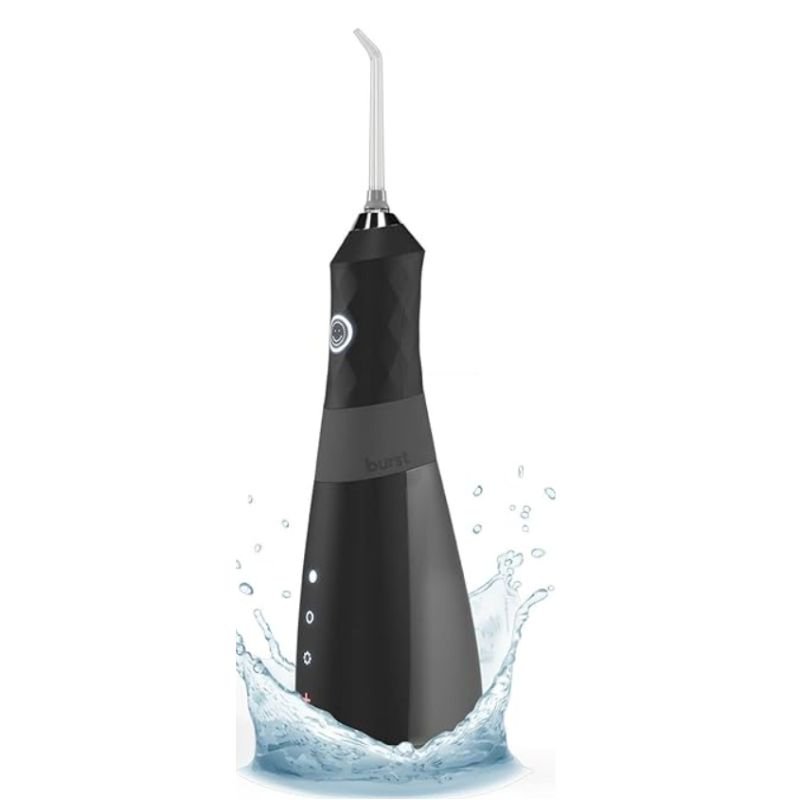
    Best Design: Burst Water Flosser

    Burst Water Flosser in black with waterproof design

    Price: $69.99  |  Type: Cordless  |  Reservoir: 110ml  |  Settings: 3 (Standard, Turbo, Pulse)  |  ADA Accepted: No  |  Warranty: 1 year (limited lifetime with tip subscription)

    Burst is the most visually appealing water flosser in this roundup — matte black with soft-touch surfaces that look like they belong next to a high-end electric toothbrush rather than a medical device. The 360-degree rotating nozzle makes it easy to reach every angle without contorting your wrist.

    The standout feature is the warranty structure — unique among water flosser brands. All Burst devices come with a standard 1-year warranty. If you enrol in their replacement tip subscription (~$5 every 3 months), the warranty extends to a limited lifetime. It’s a compelling model for long-term ownership cost predictability, though worth noting the lifetime coverage requires maintaining the subscription.

    However, the 110ml reservoir is the smallest in this guide, depleting in roughly 20–30 seconds at a medium setting. That’s enough for a quick targeted session but not a thorough full-mouth clean — you’ll refill two to three times for a complete routine. The three pressure modes (Standard, Turbo, Pulse) are adequate but lack finer control. And despite the premium look, user reviews consistently note the pressure output feels weaker than the Waterpik or even the Bitvae at comparable intensity levels.

    Included tips: 1 — Classic tip. Additional tips and orthodontic tips sold separately or via subscription.

    Who it’s best for: Design-conscious buyers who want a water flosser that looks good on an open bathroom shelf, anyone drawn to the lifetime warranty with subscription, and people who only need quick targeted cleaning rather than full-mouth sessions.

    Strengths: Limited lifetime warranty with subscription (unique in the category); attractive design; 360° rotating nozzle; 80-day battery life; subscription tip plan is affordable.

    Weaknesses: Smallest reservoir (110ml) requires frequent refilling; only 1 tip included; pressure output underwhelms compared to competitors; no ADA seal; lifetime warranty requires active subscription.

    Check Price on Amazon


    How to Choose the Right Water Flosser: Buyer’s Guide

    With dozens of models available, narrowing your choice comes down to five practical decisions. Here’s what actually matters.

    Countertop vs Cordless

    Countertop models (Waterpik Aquarius, H2ofloss HF-9) plug into a wall outlet, sit on your counter, and deliver stronger, more consistent pressure through larger reservoirs. They’re ideal for families, shared bathrooms, and anyone who values a long uninterrupted flossing session. Cordless models (Philips Sonicare, Bitvae, Burst) run on rechargeable batteries, are portable, and store easily — but trade off reservoir size and maximum pressure. The Waterpik ION bridges the gap as a hybrid, though it still needs counter space. For a more detailed comparison, see our countertop guide and cordless guide.

    Pressure Range and Settings

    Beginners should start at the lowest setting and increase over 1–2 weeks as gums adapt. Countertop models generally offer the widest range: the Waterpik Aquarius spans 10–100 PSI across 10 settings. Most cordless models offer 3 settings. If you have sensitive gums, gum recession, or dental work like implants, a model with a dedicated “Sensitive” or “Soft” mode is valuable — the Bitvae C6 and Philips Sonicare both offer this.

    Reservoir Size

    This is more important than most reviews suggest. A small reservoir means interrupting your session to refill, which breaks the habit loop that makes water flossing stick. Rough benchmarks: 100–200ml gives you 20–45 seconds, 250–300ml gives 50–75 seconds, and 600–800ml gives 90–120+ seconds. A full-mouth flossing session typically takes 60–90 seconds, so countertop models handle it in one fill while most cordless models require one refill.

    Noise Level

    This is the most underreported factor in water flosser reviews. Countertop models at high settings can reach 70+ dB — louder than a normal conversation (60 dB) and approaching a vacuum cleaner (75 dB). The Philips Sonicare 3000 is consistently cited as the quietest option, while the H2ofloss “Whisper” is the quietest countertop model available. If noise bothers you or your household, prioritise this metric over pressure.

    Tips and Nozzles

    Most water flossers ship with a standard Classic Jet tip that suits general use. Specialty tips expand what the flosser can do: Orthodontic tips have soft bristles for braces and brackets, Periodontal (Pik Pocket) tips deliver a gentle low-pressure stream below the gum line, Plaque Seeker tips use thin bristles around crowns and implants, and Tongue Cleaner attachments scrape the tongue surface. Replacement tips cost $5–15 and should be swapped every 3–6 months. This ongoing cost is worth factoring into your purchase — see our full guide on water flosser tips and nozzles.


    How Water Flossers Work

    A water flosser uses a motor-driven pump to pressurize water from the reservoir and deliver it through a narrow nozzle tip in rapid pulses — typically 1,200–1,400 pulses per minute. This pulsating stream creates a combined mechanical and hydraulic action: the direct force of the water dislodges food particles and loosens plaque, while the pulsing action creates a compression-decompression cycle that flushes debris from interdental spaces and below the gum line.

    Clinical research has consistently shown water flossers to be effective at reducing bleeding on probing and improving gingival health. A 2013 study published in the Journal of Clinical Dentistry found that a Waterpik water flosser was up to 29% more effective than string floss at reducing interproximal plaque. However, it’s important to note that the American Dental Association positions water flossers as a complement to brushing, not necessarily a replacement for all forms of interdental cleaning. Your dentist can advise on the best approach for your individual dental health.


    Who Should Use a Water Flosser?

    Water flossers benefit almost anyone, but certain groups see the most significant improvement over string floss alone.

    Orthodontic patients with braces, retainers, or lingual wires find traditional flossing extremely difficult. A water flosser with an orthodontic tip navigates around brackets in seconds rather than the minutes it takes with floss threaders.

    People with dental implants, bridges, or crowns need to clean around prosthetic components where string floss can’t effectively reach. Periodontal pocket tips deliver a gentle stream below the gum line around implant abutments.

    Those with gum disease or bleeding gums often avoid flossing because it hurts — which worsens the condition. Starting a water flosser on the lowest pressure setting allows effective cleaning with less discomfort than string floss. For product recommendations, see our guide to the best water flosser for gum disease.

    Older adults and people with limited dexterity — including those with arthritis, Parkinson’s, or post-stroke mobility challenges — often struggle with the fine motor skills string flossing requires. Water flossers require only pointing and pressing a button.

    Anyone who simply won’t floss otherwise. The ADA’s position is clear: the best interdental cleaning tool is the one you actually use. If string floss sits unused in your drawer, a water flosser that you use daily is a substantial improvement.


    Water Flosser vs String Floss: Which Is Better?

    This is the most common question we receive, and the honest answer is: it depends on your dental situation and your habits.

    String floss excels at physically scraping plaque from tight contact points between teeth — something water pressure alone doesn’t replicate with the same mechanical action. Dentists and hygienists who favour string floss emphasise this mechanical scraping as essential, particularly for people with tight contacts.

    Water flossers excel at flushing debris and bacteria from periodontal pockets, around orthodontic appliances, and from areas that string floss simply can’t reach. They’re also faster (60–90 seconds vs 2–5 minutes for thorough string flossing) and more comfortable for people with sensitive or inflamed gums.

    Research generally supports both methods as effective, with some studies showing water flossers producing better outcomes for gum health specifically. The practical answer for most people: use whichever method you’ll actually do consistently. If that’s a water flosser, you’re far better off than not flossing at all.

    For a deeper dive with clinical research citations, read our full comparison: Water Flosser vs String Floss — What the Evidence Says.


    How to Use a Water Flosser Correctly

    Using a water flosser effectively takes a little practice. Here’s the essential technique:

    Start with warm water — it’s more comfortable on gums than cold, especially during your first few sessions. Fill the reservoir, select a tip, and lean over the sink. Some people prefer to do this in the shower to avoid splashing.

    Begin on the lowest pressure setting. This is critical for the first 1–2 weeks. Your gums will likely bleed initially if you’re new to interdental cleaning — that’s normal and should diminish within a week of daily use. Place the tip at a 90-degree angle to the gum line, close your lips loosely around the tip (to reduce splashing), and turn the unit on. Let the water flow out of your mouth into the sink.

    Trace the gum line along both the outer (cheek-facing) and inner (tongue-facing) surfaces, pausing briefly between each tooth. Spend about 2–3 seconds per interdental space. The entire process should take 60–90 seconds.

    Use the water flosser before brushing — this loosens debris that your toothbrush can then sweep away. Some dentists recommend the reverse order; follow your dental professional’s guidance.

    For illustrated step-by-step instructions, see our complete guide: How to Use a Water Flosser the Right Way.


    Maintenance and Cleaning

    Water flossers can develop mould and mineral buildup inside the reservoir and internal tubing if not maintained. This is one of the most common long-term complaints on Amazon reviews — and it’s almost entirely preventable with a simple routine.

    After every use: Empty the reservoir completely and leave the lid open to air-dry. Eject the tip and store it separately. Wiping the reservoir with a dry cloth prevents mineral deposits in hard-water areas.

    Weekly: Fill the reservoir with a mixture of warm water and 1–2 tablespoons of white vinegar. Run the unit until the reservoir empties, then rinse by running plain water through it once more. This dissolves mineral scale and kills bacteria inside the tubing.

    Monthly: Remove the reservoir and scrub the interior and any accessible valves with a soft brush (an old toothbrush works well). Inspect the tip for calcium deposits and soak it in vinegar for 5–10 minutes if needed. Replace tips every 3–6 months — the rubber seal degrades and water delivery becomes inconsistent.

    Never add mouthwash unless the manufacturer specifically approves it. The alcohol and chemicals in many mouthwash formulas can degrade internal rubber seals and void your warranty. Waterpik explicitly approves warm water and their branded mouthwash additive only.


    Frequently Asked Questions

    Do dentists recommend water flossers?

    Yes, many dental professionals recommend water flossers — particularly for patients with braces, implants, bridges, or gum disease. The American Dental Association has granted its Seal of Acceptance to water flossers from Waterpik, Philips Sonicare, and Quip, confirming their safety and effectiveness. However, some dentists still consider string floss essential for scraping plaque from tight contact points and may recommend using both. For more detail, see our article: Do Dentists Actually Recommend Water Flossers?

    Can water flossers replace string floss?

    For many people, yes — especially those who weren’t flossing at all. Clinical studies show water flossers are effective at reducing plaque and improving gum health. However, string floss provides a unique mechanical scraping action that water flossers don’t fully replicate. The ideal routine includes both, but a water flosser alone is vastly better than no interdental cleaning. Read our full comparison here.

    Do water flossers remove plaque?

    Yes. Research published in the Journal of Clinical Dentistry found that water flossers removed up to 29% more plaque than string floss in interproximal areas. They’re particularly effective at flushing bacteria from periodontal pockets where brushing and string floss can’t easily reach. See: Do Water Flossers Actually Remove Plaque?

    Are water flossers safe for gums?

    Yes, when used correctly. Start on the lowest pressure setting and increase gradually over 1–2 weeks. Some gum bleeding during the first few sessions is normal and typically resolves within a week. If bleeding persists beyond two weeks, consult your dentist — it may indicate an underlying gum condition that needs professional attention.

    How often should I use a water flosser?

    Once per day is sufficient for most people, ideally before brushing. Some dental professionals recommend twice daily (morning and evening) for patients with active gum disease or orthodontic appliances. Consistency matters more than frequency.

    Can I put mouthwash in my water flosser?

    Generally, no. Most manufacturers advise against adding mouthwash, as alcohol and other chemicals can degrade internal seals and void your warranty. Waterpik sells a branded rinse formulated for use in their devices. You can safely use warm water with a small amount of non-alcohol antiseptic rinse in most models, but check your specific manufacturer’s guidelines first.

    Countertop or cordless — which should I buy?

    Choose countertop if you have dedicated counter space and want maximum pressure with the largest water tank. Choose cordless if you have limited space, travel frequently, or prefer a simpler aesthetic. The Waterpik ION offers a hybrid approach that works for both scenarios. Our cordless guide and countertop guide go deeper on each.

    How long do water flossers last?

    With proper maintenance, a quality countertop water flosser (Waterpik Aquarius, H2ofloss) lasts 3–5 years. Cordless models typically last 2–4 years before battery degradation becomes noticeable. The most common failure point is the internal pump seal — preventable with regular vinegar cleaning.


    How VerdictLab Evaluates Water Flossers

    Our editorial picks are based on a weighted evaluation framework that draws from manufacturer specifications, clinical research, dental professional recommendations, and analysis of thousands of verified user reviews across Amazon, retailer sites, and dental forums. We cross-reference every manufacturer claim against independent sources and real-world user feedback.

    We evaluate each water flosser across six criteria: Cleaning Performance (30%), Noise (15%), Ease of Use (15%), Value for Money (15%), Portability (15%), Build Quality (10%). No product receives a perfect score — we believe honest evaluation requires acknowledging trade-offs.

    We do not accept free products from manufacturers. Our recommendations are editorially independent.

    Beyond Brushing Oral Health Guide Book

    Get the Free Oral Health Guide
    Get Beyond Brushing — a practical 30,000+ word guide to healthier teeth, gums, and fresher breath after 45.
    Marketing email consent
    • No spam • Unsubscribe anytime


    The Bottom Line

    For most people, the Waterpik ION Professional ($99.99) is the best water flosser you can buy in 2026. It’s the only model that genuinely solves the countertop-versus-cordless debate, delivers clinical-grade pressure across 10 settings, and carries the ADA Seal of Acceptance with a 3-year warranty. The noise is real — but so are the results.

    If noise is your main concern, the Philips Sonicare Power Flosser 3000 ($79.96) is substantially quieter than any competitor in this roundup. The trade-off is a smaller reservoir and fewer pressure settings.

    If budget matters most, the Bitvae C6 ($15.98) delivers remarkable value. The 40-day battery life and 15 mode/intensity combinations would justify a price three times higher.

    The most important thing is finding a water flosser you’ll actually use every day. Any of the seven models above will do more for your gum health than the string floss sitting unused in your bathroom drawer. Pick the one that fits your budget, counter, and noise tolerance — and use it consistently.

    Have questions about a specific model? Email us at hello@verdict-lab.com or leave a comment below.


    References

    Medical and editorial disclaimer: This guide is for educational purposes only and is not a substitute for professional dental or medical advice, diagnosis, or treatment. Product availability, pricing, specifications, and warranty terms may change over time, so always verify details with the manufacturer or retailer before purchasing. VerdictLab may earn a commission from qualifying purchases made through links on this page, but our editorial recommendations are based on independent research, product specifications, clinical evidence, and user feedback.
  • How to Use a Water Flosser Correctly: A Step-by-Step Guide

    How to Use a Water Flosser Correctly: A Step-by-Step Guide

    Last updated: March 2026  |  Reviewed by: VerdictLab Editorial Team

    A water flosser is only as effective as your technique. Used correctly, it removes significantly more plaque from between teeth than string floss. Used poorly — wrong angle, too much pressure, rushing through the routine — and you’re mostly just spraying water around your bathroom.

    We’ve tested over a dozen water flossers at VerdictLab (see our complete guide to the best water flossers) and have refined a technique through weeks of daily use that takes about 60–90 seconds and covers every tooth. Here’s the method that works, along with the specific adjustments you need for braces, implants, sensitive gums, and other common situations.

    Key Takeaways

    • Always start on the lowest pressure setting for the first 1–2 weeks
    • Hold the tip at a 90-degree angle to your gum line, not pointed straight at your teeth
    • Lean over the sink with your mouth slightly open — let the water fall out naturally
    • Spend 2–3 seconds per gap between teeth, tracing both the outer and inner gum line
    • Use your water flosser before brushing for the best results
    • Some bleeding in the first week is normal — if it continues beyond two weeks, see your dentist


    Before You Start: Setup and Prep

    Getting the setup right prevents the two biggest complaints new water flosser users have: mess and gum pain.

    Fill the reservoir with warm water

    Cold water on sensitive gum tissue is uncomfortable, especially during your first few sessions. Lukewarm water is gentler and also helps loosen debris more effectively. Avoid hot water — it can warp internal seals on some models over time.

    Choose your tip

    If you’re using a water flosser for general cleaning, the standard Classic Jet tip that comes with every model is the right starting point. Specialty tips — orthodontic, periodontal pocket, plaque seeker — are designed for specific situations we’ll cover in the sections below. Make sure the tip clicks securely into the handle before turning the unit on. A loose tip under pressure will spray water in unpredictable directions.

    Tips should be replaced every 3–6 months, or sooner if you notice calcium buildup, reduced water flow, or a loose fit. See our guide to the best water flosser tips and nozzles for recommendations.

    Set the pressure to the lowest level

    This is the most important step for beginners. Every water flosser starts too powerful for untrained gums. On a Waterpik with 10 settings, start at 1 or 2. On a cordless model with 3 levels, start on Soft or the lowest intensity. Your gums need approximately 1–2 weeks to adapt before you should increase pressure. Jumping straight to medium or high pressure causes unnecessary pain, bleeding, and — in many cases — people abandoning the water flosser entirely.

    Position yourself over the sink

    Lean forward over the sink so your mouth is directly above the basin. Some people prefer to close their lips loosely around the tip to contain the spray, while others keep their mouth slightly open and let the water flow out continuously. Both approaches work — the key is that water needs somewhere to go, and your shirt is not a good option. If splashing is a persistent problem, try using your water flosser in the shower until you’ve built confidence with the technique.


    Step-by-Step Water Flosser Technique

    This method takes 60–90 seconds once you’re comfortable with it. During your first week, it may take closer to 2 minutes as you learn to control the tip angle and water flow.

    Step 1 — Place the tip before turning on the unit

    Put the nozzle tip in your mouth, position it near your back molars on one side, and then turn the flosser on. Turning it on outside your mouth sends water across your mirror, ceiling, and potentially your partner’s patience. This is the single most common beginner mistake.

    Step 2 — Angle the tip at 90 degrees to the gum line

    The tip should point directly at the space where your tooth meets the gum — not at the flat surface of the tooth and not straight down between teeth. A 90-degree angle to the gum line directs the pulsating water stream into the sulcus (the natural groove where tooth meets gum), which is exactly where plaque and bacteria accumulate. If you point the tip at the tooth surface, you’re cleaning enamel that your toothbrush already handles.

    Step 3 — Trace the outer gum line

    Starting from the back molar, slowly move the tip along the outer (cheek-side) gum line. Pause for approximately 2–3 seconds at each gap between teeth. The pulsating water needs a moment to flush debris from the interdental space. Don’t rush — a quick sweep across all teeth is far less effective than a deliberate pause at each gap.

    Work from the back molars on one side, across the front teeth, and all the way to the back molars on the opposite side. This should take about 30 seconds.

    Step 4 — Trace the inner gum line

    Repeat the same process on the inner (tongue-side) gum line, moving from back to front to back. Most people neglect this surface because it’s harder to reach and less visible — but plaque builds here just as readily. This takes another 30 seconds.

    Step 5 — Target problem areas

    If you have crowns, bridges, implants, braces, or areas your dentist has flagged for extra attention, spend an additional 5–10 seconds per area. Slight angle adjustments let you direct water behind bridgework or under brackets.

    Step 6 — Turn off before removing the tip

    Mirror the startup process — turn the unit off while the tip is still in your mouth, then remove it. Some models have a pause button on the handle for easy interruption.

    Step 7 — Empty and dry the reservoir

    After use, dump any remaining water from the reservoir and leave the lid open. Standing water breeds bacteria and mould inside the tank — one of the most common maintenance issues. For a complete cleaning routine, see our maintenance section in our water flosser guide.


    7 Common Mistakes That Reduce Effectiveness

    After weeks of testing and observing different techniques, these are the mistakes that cost you the most in cleaning quality.

    1. Starting on too high a pressure setting

    We covered this above, but it bears repeating because it’s the primary reason people quit. Your gums need time to toughen up. Give them a week on the lowest setting before considering an increase.

    2. Moving the tip too fast

    Racing the tip along your gum line without pausing between teeth turns your water flosser into an expensive mouth rinse. The pulsating action needs 2–3 seconds per gap to dislodge plaque effectively. Think of it as a pause-move-pause rhythm, not a continuous sweep.

    3. Only cleaning the outer gum line

    The inner (tongue-side) surface accumulates just as much plaque. It takes an extra 30 seconds. Do both surfaces, every session.

    4. Pointing the tip at the tooth surface instead of the gum line

    Your toothbrush cleans tooth surfaces. Your water flosser’s job is the gum line, interdental spaces, and below-the-gum pockets. Aim at the junction where tooth meets gum.

    5. Turning the unit on before placing the tip in your mouth

    A pressurised jet of water at 80 PSI will decorate your bathroom mirror in about half a second. Tip in mouth first, then power on.

    6. Skipping the back molars

    The back molars are the hardest teeth to reach with any cleaning tool and the most common site for cavities and gum disease. Make a conscious effort to start and end your water flossing routine at the very last molar on each side.

    7. Using cold water

    It’s a small detail, but cold water causes gum tissue to tighten and become more sensitive to the water jet. Warm water is more comfortable, encourages blood flow to the gums, and loosens debris more effectively. If your bathroom tap takes a while to warm up, fill the reservoir from the kitchen.


    How to Use a Water Flosser With Braces

    Braces create dozens of hard-to-reach spots where food debris and plaque accumulate around brackets, wires, and bands. A water flosser is one of the most effective tools for keeping teeth clean during orthodontic treatment — many orthodontists now recommend them as standard.

    Use an orthodontic tip. These tips have a tapered, soft-bristle end designed to navigate under archwires and around bracket bases without snagging. The Waterpik Orthodontic Tip and Bitvae’s orthodontic nozzle both work well for this. Standard jet tips work too, but orthodontic tips get closer to bracket margins.

    Keep the pressure on low to medium. Braces can trap water flosser pressure between the wire and gum line, amplifying the force. Start on the lowest setting and increase gradually. Most orthodontic patients settle at setting 3–5 on a 10-setting Waterpik.

    Approach brackets from multiple angles. Rather than just sweeping along the gum line, angle the tip slightly upward to clean above the bracket, then slightly downward to clean below it. The area between the bracket base and the tooth surface is where decalcification (white spots) most commonly occurs.

    Allow extra time. Budget 2–3 minutes rather than the standard 60–90 seconds. Each bracket creates an additional cleaning zone.

    For product recommendations, see our guide: Best Water Flosser for Braces.


    How to Use a Water Flosser With Implants and Bridges

    Dental implants and bridges require extra attention because the junction between the prosthetic and natural gum tissue can harbour bacteria that leads to peri-implantitis — inflammation around the implant that can cause bone loss and eventual implant failure.

    Use a Pik Pocket (periodontal) tip for implants. This soft, flexible tip delivers a low-pressure stream designed to reach below the gum line without damaging soft tissue around the implant abutment. Standard jet tips deliver too concentrated a force for the delicate tissue around implants. If your water flosser doesn’t include a periodontal tip, they’re available for most brands for $8–12.

    Use the lowest 2–3 pressure settings. Implant tissue is more susceptible to trauma than natural gum tissue. Gentle, consistent cleaning is more effective than aggressive pressure.

    Angle the tip along the gum line of the implant, tracing completely around the implant crown. Spend 5–10 seconds on each implant site — more than you’d spend on a natural tooth.

    For bridges, angle the tip to direct water underneath the pontic (the false tooth spanning the gap). This is one area where water flossers are categorically superior to string floss — flushing debris from under a bridge is nearly impossible with traditional floss without a threader.

    For product recommendations, see: Best Water Flosser for Implants.


    How to Use a Water Flosser With Sensitive or Bleeding Gums

    If your gums are already sensitive, inflamed, or bleed when you brush, a water flosser can actually be more comfortable than string floss — but only if you approach it correctly.

    Start at the absolute lowest setting. On the Philips Sonicare Power Flosser 3000, the low setting runs significantly gentler than the Waterpik’s setting 1. If sensitivity is your primary concern, a model with a dedicated “Sensitive” mode — such as the Bitvae C6’s Soft mode — gives you extra headroom. Read more about model options in our gum disease water flosser guide.

    Expect some bleeding during the first week. This is normal. Bleeding when flossing — whether with string floss or water — typically indicates existing gum inflammation, not damage from the flossing itself. As you clean away plaque buildup with consistent daily use, the inflammation reduces and bleeding stops. Most users see significant improvement within 7–14 days.

    If bleeding persists beyond two weeks of daily use, schedule an appointment with your dentist. Persistent bleeding may indicate periodontal disease or another condition that requires professional treatment. A water flosser is a maintenance tool, not a substitute for professional dental care.

    Warm water helps. Beyond comfort, warm water promotes blood flow to gum tissue, supporting the healing process.


    Should You Water Floss Before or After Brushing?

    This question generates debate among dental professionals, and the evidence supports both sequences.

    The case for flossing first: A 2018 study published in the Journal of Periodontology found that flossing before brushing resulted in statistically greater plaque reduction than brushing first. The logic is straightforward — loosening debris and plaque with the water flosser allows your toothbrush and toothpaste to make better contact with tooth surfaces, and the fluoride in your toothpaste can penetrate interdental spaces more effectively after they’ve been cleared.

    The case for flossing after: Some dentists argue that brushing first removes the bulk of surface plaque, allowing the water flosser to focus on the remaining interdental and subgingival debris. This sequence also means any dislodged debris is rinsed away rather than left in the mouth.

    Our recommendation: Floss first, then brush. The clinical evidence, while not conclusive, leans in this direction. But the honest answer is that the order matters far less than the consistency. If you’ll only water floss after brushing because that’s when you remember, do it after brushing. A daily routine in any order beats a “perfect” routine you skip half the time.


    How Often Should You Use a Water Flosser?

    Once daily is sufficient for most people. The American Dental Association recommends cleaning between teeth once per day using any effective interdental cleaning tool. Evening use is generally preferable — clearing the day’s accumulated food debris and plaque before sleeping reduces overnight bacterial activity.

    Twice daily may be beneficial for people with active gum disease, orthodontic appliances, implants, or other conditions where plaque accumulates faster than normal. If your dentist has recommended increased interdental cleaning, morning and evening sessions are reasonable.

    More than twice daily is unnecessary for most people and may actually irritate gum tissue, particularly on higher pressure settings. If you feel the need to water floss more frequently — for instance, after meals — keep the pressure on the lowest setting.

    The goal is building a sustainable daily habit. Most water flossers include a built-in timer (usually 60 seconds with 30-second quadrant pacers) that helps you maintain consistent session length without overthinking it.


    Frequently Asked Questions

    Is a water flosser better than string floss?

    Each has strengths. Water flossers are better for flushing bacteria from periodontal pockets and around dental work, while string floss excels at scraping plaque from tight contact points between teeth. For most people, a water flosser is more practical and more likely to be used consistently. For a full comparison, see: Water Flosser vs String Floss.

    Can a water flosser damage your gums?

    When used correctly (starting on the lowest setting, using proper angle), water flossers are safe for gum tissue. Using excessive pressure before your gums have adapted can cause temporary discomfort and bleeding, but this is irritation, not damage. If you have severe gum recession or active periodontal disease, consult your dentist for personalised pressure recommendations.

    Can I add mouthwash to my water flosser?

    Generally, no. Most manufacturers advise against it because alcohol-based mouthwash can degrade internal rubber seals. Waterpik approves only its branded rinse formula. You can safely use warm water — which is what dental professionals recommend for routine use anyway. If you want an antimicrobial rinse, use mouthwash separately after water flossing and brushing.

    Why is my water flosser making a mess?

    Three fixes solve 90% of splashing problems. First, lean further forward over the sink so gravity helps. Second, close your lips loosely around the tip — not a tight seal, just enough to contain the spray. Third, start on the lowest pressure setting; higher settings produce more splashback. Some people water floss in the shower during their first few weeks until they develop comfort with the technique.

    My gums bleed when I use a water flosser — is that normal?

    Yes, during the first week or two. Bleeding indicates existing gum inflammation from plaque buildup — the water flosser is exposing a problem, not causing one. With consistent daily use, bleeding typically stops within 7–14 days as the inflammation resolves. If bleeding persists beyond two weeks, see your dentist for evaluation.

    How long should a water flossing session take?

    60 to 90 seconds for a thorough full-mouth clean, once you’re comfortable with the technique. Budget 2–3 minutes if you have braces, implants, or other dental work requiring extra attention. Most water flossers include a built-in timer to help pace your session.

    What’s the best water flosser for a beginner?

    For a first water flosser, we recommend either the Bitvae C6 (~$26) if budget matters most, or the Philips Sonicare Power Flosser 3000 (~$45) if you want the quietest, gentlest introduction to water flossing. Both offer genuinely soft low-pressure settings. See our full best water flosser guide for all our tested picks.


    The Bottom Line

    Good water flosser technique comes down to three things: start on the lowest pressure setting, aim at the gum line (not the tooth surface), and pause between each tooth rather than sweeping continuously. Give your gums a week to adapt, clean both the outer and inner surfaces, and empty the reservoir after every use. That’s it. The whole routine takes about 90 seconds and, done consistently, makes a measurable difference in gum health.

    If you haven’t chosen a water flosser yet, our complete guide to the best water flossers of 2026 covers 7 tested models across every budget and use case.


    Related Guides

    Sources

    • Mazhari F et al. Journal of Periodontology (2018)
    • American Dental Association – Interdental cleaning recommendations
    • Worthington HV et al. Cochrane Database of Systematic Reviews
    • Clinical guidance from Waterpik and Philips Sonicare technical documentation